Diffuse Hereditary Palmoplantar Keratodermas
Comprehensive guide to hereditary skin disorders causing diffuse thickening of palms and soles, including causes, types, diagnosis, and management.
Diffuse hereditary
palmoplantar keratodermas (PPK)
are a clinically heterogeneous group of genetic disorders characterised by abnormal thickening of the skin (hyperkeratosis) on the palms and soles. These conditions arise from mutations in genes encoding proteins essential for epidermal differentiation and keratinization, leading to compensatory epidermal hyperproliferation primarily in palmoplantar skin.What is palmoplantar keratoderma?
**Palmoplantar keratodermas (PPK)** refer to a diverse group of disorders marked by marked thickening of the palmar and/or plantar skin due to excessive keratinization. While acquired forms exist, hereditary PPKs are genetically determined and often present from infancy. Diffuse variants feature uniform, symmetric hyperkeratosis covering most of the palmoplantar surface, distinguishing them from focal, striate, or punctate subtypes.
The palmoplantar epidermis is uniquely adapted for mechanical stress, expressing specialized keratins like K9 (palms/soles-specific) and high levels of K1. Mutations disrupting these lead to cytolysis, inflammation, and secondary hyperkeratosis as the skin compensates.
Who gets palmoplantar keratoderma and why?
Hereditary diffuse PPK affects individuals with specific gene mutations, often inherited in autosomal dominant or recessive patterns. Onset typically occurs in infancy or early childhood, though severity varies.
Key genetic causes include:
- KRT9 mutations: Cause epidermolytic PPK (Vörner type), autosomal dominant, palm/sole-specific due to K9 expression.
- KRT1 mutations: Non-epidermolytic PPK (Unna-Thost type) or epidermolytic forms with possible transgrediens.
- ARSLP1 (SLURP1) mutations: Mal de Meleda, autosomal recessive with transgrediens and periorificial involvement.
- CTSC mutations: Papillon-Lefèvre syndrome (PLS), with periodontitis and psoriasiform plaques.
Risk factors are purely genetic; prevalence is rare, estimated at 1-4 per 10,000 in some populations.
Clinical features of palmoplantar keratoderma
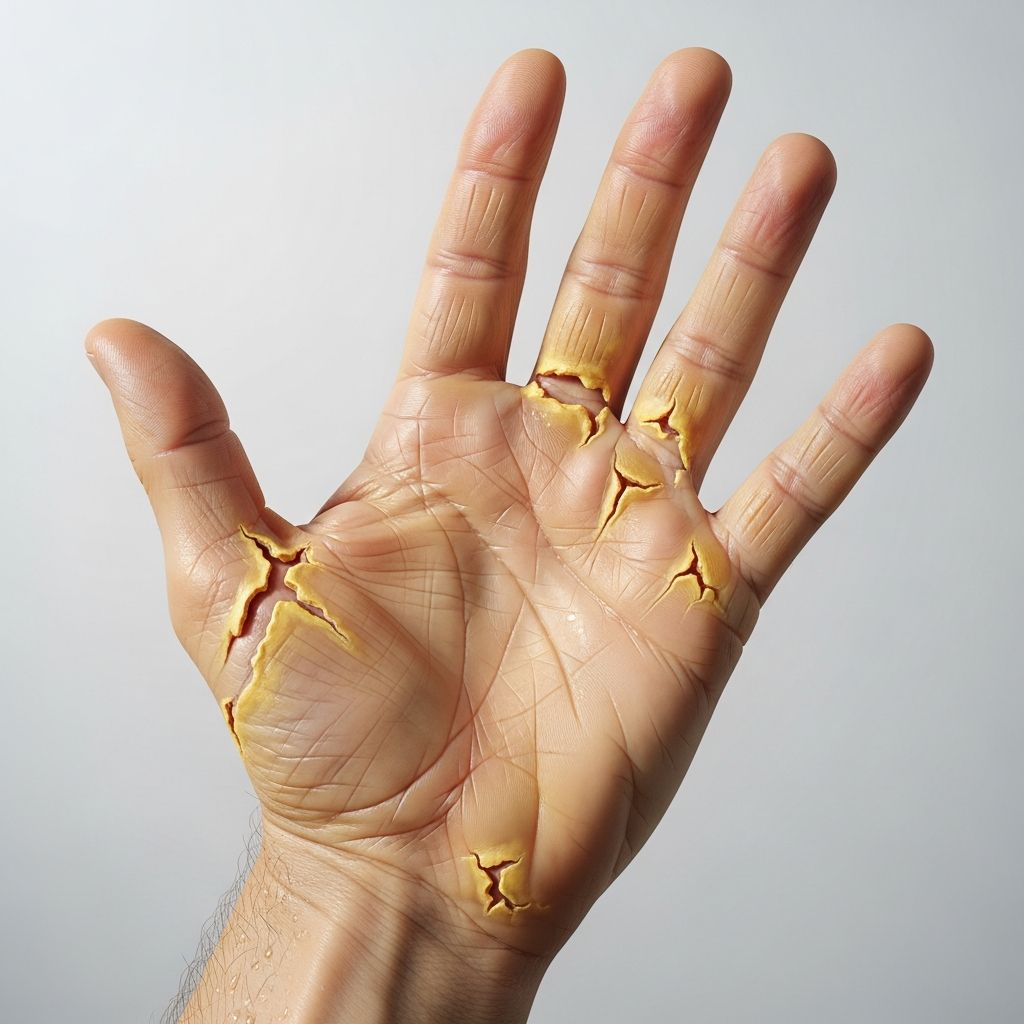
Diffuse PPK manifests as yellow-brown, waxy plaques with sharp erythematous borders, often painful and prone to fissuring. Progression (progrediens) worsens with age; transgrediens extends to dorsal hands/feet.
| Subtype | Inheritance | Onset | Key Features | Gene |
|---|---|---|---|---|
| Non-epidermolytic (Unna-Thost) | AD | Infancy | Symmetric, mild hyperkeratosis, no transgrediens | KRT1 |
| Epidermolytic (Vörner) | AD | Early infancy | Thick, corrugated, blistering | KRT9 |
| Mal de Meleda | AR | Birth | Transgrediens, glove/stocking, hyperhidrosis | ARSLP1 |
| Papillon-Lefèvre | AR | Infancy | PPK + periodontitis, pyogenic infections | CTSC |
PPK without transgrediens
Unna-Thost and Vörner types present by age 3-4 with diffuse palmoplantar hyperkeratosis. Vörner shows epidermolysis and blistering on trauma.
PPK with transgrediens
Extends to wrists, Achilles, dorsal aspects. Mal de Meleda features rapid progression, nail dystrophy, and keratoderma of elbows/knees.
Syndromic palmoplantar keratodermas
Diffuse PPK occurs in syndromes:
- Papillon-Lefèvre syndrome: PPK + aggressive periodontitis (tooth loss by adolescence), palmoplantar pustules, CTSC mutations impairing immune response.
- Vohwinkel syndrome: PPK + starfish-shaped keratoses, hearing loss (GJB2 mutations).
- Olmsted syndrome: Severe mutilating PPK + periorificial keratoses (TRPV3).
- Loricrin keratoderma: Diffuse PPK + ichthyosis, lagophthalmos (LOR).
Diagnosis of palmoplantar keratoderma
Diagnosis relies on clinical pattern, family history, and histopathology. Epidermolytic PPK shows vacuolar degeneration; non-epidermolytic has compact hyperkeratosis.
Genetic testing confirms specific mutations, essential for syndromic cases (e.g., cardiac screening in desmoplakin-related).
Related Stories



Differential includes pachydermoperiostosis, acrokeratoelastoidosis, Reiter syndrome.
Treatment of palmoplantar keratoderma
No cure; management is symptomatic:
- Emollients: Urea (10-40%), lactic acid, propylene glycol daily.
- Keratolytics: Salicylic acid 6-20% plasters for hyperkeratosis.
- Topicals: Topical retinoids (tazarotene), corticosteroids for inflammation.
- Systemic: Acitretin (0.5-1 mg/kg) for severe cases; monitor lipids/liver.
- PLS-specific: Retinoids + dental care; antibiotics for infections.
Surgical debridement or paring for fissures; occlusion enhances penetration.
What is the outcome for palmoplantar keratoderma?
Chronic, non-life-threatening but impacts quality of life via pain, mobility issues, secondary infections. Early treatment prevents complications; some improve with age.
Frequently asked questions (FAQs)
What causes diffuse hereditary palmoplantar keratoderma?
Mutations in keratin genes (KRT1, KRT9) or others like ARSLP1, CTSC, disrupting skin barrier and triggering hyperkeratosis.
Is palmoplantar keratoderma contagious?
No, it’s purely genetic, not infectious.
Can palmoplantar keratoderma be cured?
No cure, but treatments control symptoms effectively.
Does palmoplantar keratoderma affect nails?
Yes, in types like Mal de Meleda (dystrophy, anonychia).
Is genetic testing necessary for PPK?
Recommended for confirmation, prognosis, and screening family/syndromic features.
References
- Hereditary Palmoplantar Keratoderma: A Practical Approach to the Diagnosis — Indian Dermatology Online Journal. 2019-07-01. https://pmc.ncbi.nlm.nih.gov/articles/PMC6615398/
- Palmoplantar Keratodermas — Foundation for Ichthyosis & Related Skin Types. 2023-01-15. https://www.firstskinfoundation.org/types-of-ichthyosis/palmoplantar-keratodermas
- Clinical and Genetic Findings in Patients With Palmoplantar Keratoderma — JAMA Dermatology. 2024-03-20. https://jamanetwork.com/journals/jamadermatology/fullarticle/2826499
- Palmoplantar Keratoderma I, Striate, Focal, or Diffuse — Montefiore Einstein. 2022-06-10. https://montefioreeinstein.org/new-york-center-for-rare-diseases/conditions/blood-immunity-disorders/palmoplantar-keratoderma-i
Similar Articles








Read full bio of Sneha Tete