Diffuse Melanosis Cutis: What You Need To Know
Rare metastatic melanoma complication causing progressive blue-grey skin pigmentation and poor prognosis.
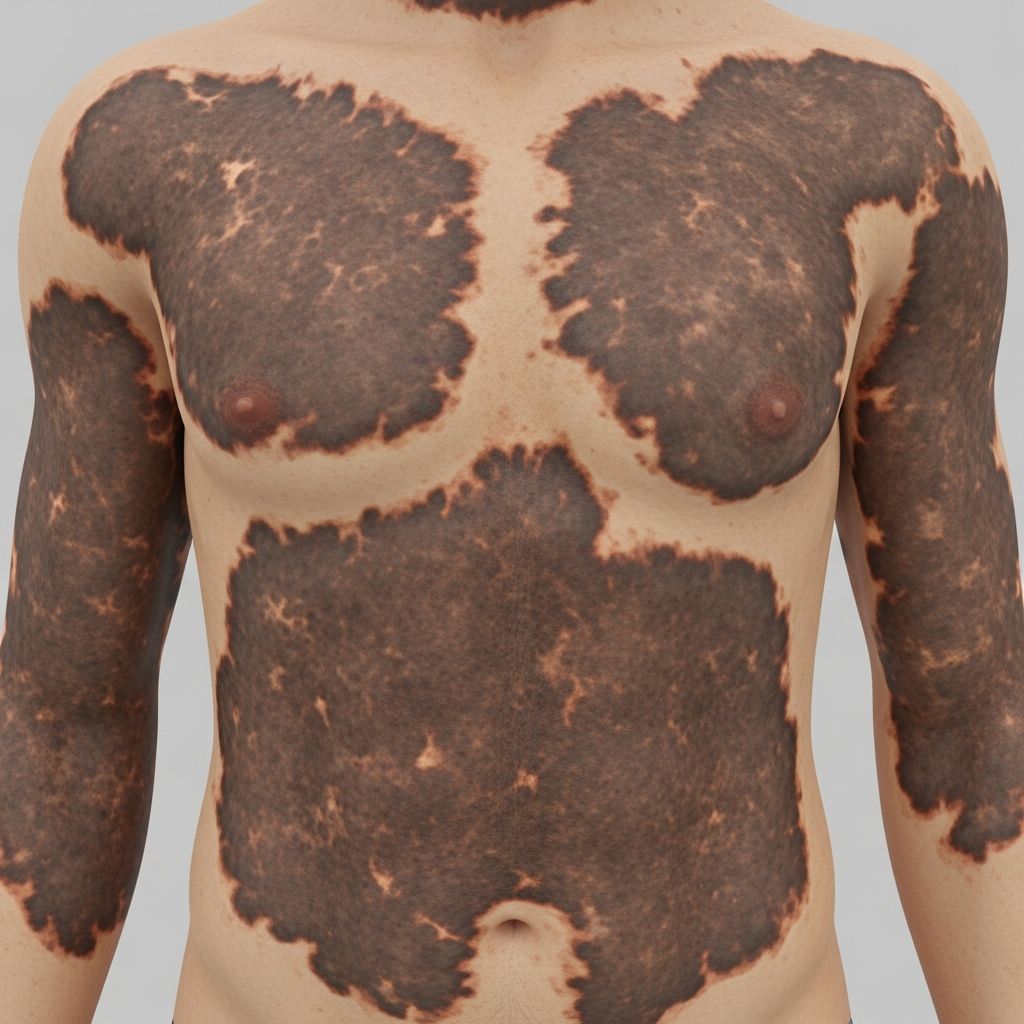
Diffuse melanosis cutis (DMC) represents a rare and ominous manifestation of metastatic melanoma, characterized by diffuse blue-grey hyperpigmentation across the skin and mucous membranes.
What is diffuse melanosis cutis?
**Diffuse melanosis cutis** is an exceptional dermatological presentation occurring in approximately 1–2% of patients with metastatic melanoma. It manifests as a progressive, generalized discoloration of the skin, often described as blue-grey, slate-grey, or metallic-grey, affecting the entire body surface over weeks to months. This pigmentation spares no area, though it may appear more intense in sun-exposed regions like the face, neck, and hands.
Historically, the first well-documented case with photographic evidence dates back to 1937 by Odel et al., though earlier references to ‘melanosis’ or ‘melanoderma’ exist in literature without clear correlation to modern DMC definitions. DMC signals advanced disease, typically emerging late in the course of metastatic melanoma, and carries a grave prognosis with mean survival from onset around 4.36 months based on systematic reviews of 62 cases.
Who gets diffuse melanosis cutis?
DMC exclusively affects individuals with a history of
malignant melanoma (MM)
that has progressed to metastatic stage. Primary melanomas associated with DMC often exhibit substantial Breslow thickness, averaging 3.3 mm across reported cases. It arises in the context of widespread metastases, frequently after initial diagnosis by about one year.Demographic data from 62 patients in a systematic review indicate no strong gender or age predilection, though it predominantly occurs in adults with prior cutaneous melanoma. Even low-risk melanomas have exceptionally presented with DMC as the first sign of recurrence, underscoring its unpredictable nature.
What causes diffuse melanosis cutis?
The precise
pathophysiology
of DMC remains incompletely understood, with several hypotheses proposed but lacking consensus.- Circulating melanin precursors: Melanoma cells release melanin precursors (e.g., 5-S-cysteinyldopa) into the bloodstream, which deposit in the dermis, undergo auto-oxidation to melanin, and are phagocytosed by dermal histiocytes (melanophages). This explains associated melanuria, where urine darkens upon standing due to these precursors.
- Neoplastic growth factors: Factors like alpha-melanocyte stimulating hormone (α-MSH), hepatocyte growth factor (HGF), and endothelin-1 from tumor cells may stimulate dermal melanocyte proliferation or melanin synthesis.
- Dermal micrometastases: Diffuse microscopic melanoma deposits in the dermis produce melanin locally, though biopsies rarely show atypical melanocytes, distinguishing DMC from overt cutaneous metastases.
- Tumor lysis products: Cytolysis of metastatic foci liberates melanosomes and melanin, taken up by histiocytes.
These mechanisms likely interplay, with melanin deposition occurring predominantly perivascularly in the dermis without epidermal involvement or neoplastic cells.
What are the clinical features of diffuse melanosis cutis?
DMC evolves gradually, starting subtly and progressing to striking whole-body pigmentation.
- **Skin changes:** Uniform blue-grey to slate-grey hyperpigmentation, often more pronounced caudocranially (from feet upward) and in sun-exposed areas. Dermoscopy reveals homogeneous pigmented patterns.
- **Mucous membranes:** Variable involvement of oral, conjunctival, or genital mucosa; not always present.
- **Nails:** Diffuse melanonychia with regular pigmented bands across all nails.
- **Melanuria:** Characteristic dark urine (brown-amber) that intensifies on air exposure due to precursor oxidation.
- **Associated signs:** Advanced melanoma symptoms like fatigue, weight loss, lymphadenopathy, or organ failure; no primary lesion typically visible.
Related Stories



Progression spans weeks to months, heralding terminal disease.
How is diffuse melanosis cutis diagnosed?
Diagnosis relies on clinical context in known melanoma patients, supported by histopathology; no specific criteria exist.
Clinical evaluation
Recognize diffuse grey-blue pigmentation with melanuria in metastatic melanoma setting. Exclude mimics:
- Jaundice (yellow hue, scleral icterus)
- Addison disease (hyperpigmentation with adrenal insufficiency)
- Acanthosis nigricans (velvety plaques)
- Drug-induced pigmentation (e.g., minocycline, amiodarone)
- Other metastases or paraneoplastic syndromes
Investigations
| Test | Findings in DMC |
|---|---|
| Skin biopsy | Increased dermal melanin in melanophages (perivascular), free extracellular pigment; epidermis normal; no atypical melanocytes. IHC: CD68+, S100/Sox10/HMB45 negative for neoplasia. |
| Urine analysis | Melanin precursors; darkens on standing. |
| Imaging/staging | Detect metastases (CT/PET-CT). |
| Blood tests | LDH elevation (prognostic); rule out differentials. |
Histology is pathognomonic: dermal melanin without melanoma cells differentiates from metastases.
What is the treatment for diffuse melanosis cutis?
No targeted therapy reverses DMC pigmentation; management focuses on underlying metastatic melanoma. Prognosis is dismal, with median survival 4–6 months post-onset.
- Systemic therapies:**
Modern targeted and immunotherapies show anecdotal responses:
- BRAF/MEK inhibitors (vemurafenib, dabrafenib, trametinib) for BRAF-mutant melanoma.
- Immune checkpoint inhibitors (pembrolizumab, nivolumab).
Case reports note partial regression of pigmentation and prolonged survival, though full reversal unreported. Palliative care addresses symptoms like pain or organ dysfunction.
What is the outcome for diffuse melanosis cutis?
DMC portends poor prognosis, with mean survival 4.36 months from onset across 62 cases; some survive longer with immunotherapy. Pigmentation persists despite tumor response; it signifies heavy metastatic burden.
Frequently Asked Questions
Is diffuse melanosis cutis reversible?
No, pigmentation does not reverse, even with effective melanoma treatment.
Does DMC always involve mucous membranes?
No, skin is primarily affected; mucous membranes variably involved.
Can DMC occur without known melanoma?
Rarely, as first recurrence sign even in low-risk cases, but history usually present.
What causes urine darkening in DMC?
Oxidation of circulating melanin precursors.
Is biopsy always needed for diagnosis?
Essential to confirm dermal melanin and exclude metastases.
References
- Diffuse melanosis cutis — DermNet NZ. 2023. https://dermnetnz.org/topics/diffuse-melanosis-cutis
- Diffuse Melanosis Cutis as the First Sign of Recurrence — Dermatology Practical & Conceptual. 2024-01-01. https://dpcj.org/index.php/dpc/article/view/3196
- Diffuse melanosis cutis: a rare manifestation of metastatic — PubMed. 2019-09-04. https://pubmed.ncbi.nlm.nih.gov/31473636/
- Diffuse Melanosis Cutis as the First Sign of Recurrence of Low-Risk — PMC. 2024. https://pmc.ncbi.nlm.nih.gov/articles/PMC10868795/
- Diffuse melanosis cutis: a systematic review of the literature — PubMed. 2012-12-01. https://pubmed.ncbi.nlm.nih.gov/23219556/
- Diffuse melanosis cutis secondary to metastatic malignant melanoma — Our Dermatology Online. 2019. https://www.odermatol.com/odermatology/20191/22.Diffuse-HassaniCS.pdf
Similar Articles








Read full bio of medha deb