Dihydroxyacetone: A Comprehensive Guide to Safe Sunless Tanning
The science behind DHA, the key self-tanning agent that reacts with skin proteins to produce a safe, temporary tan without UV exposure.
Revised: January 2026
What is dihydroxyacetone?
Dihydroxyacetone (DHA) is a colourless, simple carbohydrate and the primary active ingredient in sunless tanning products. Derived from natural sources like sugar cane or beets, or produced synthetically, DHA reacts with amino acids in the dead cells of the skin’s outermost layer, the stratum corneum, to produce a temporary tan.
This reaction, known as the Maillard reaction—a non-enzymatic browning process—forms brown pigments called melanoidins, mimicking the appearance of a natural UV-induced tan without melanin production. Unlike traditional tanning, DHA does not penetrate deeply into living skin layers under normal use, limiting its effects to the surface.
History
The tanning effect of DHA was first observed in the 1950s by Eva Wittgenstein, who noted skin darkening in children treated with oral DHA solutions for glycogen storage disease. Spills on the skin led to brown discoloration, sparking research into its topical use.
By the mid-20th century, commercial sunless tanners emerged, but early formulations suffered from uneven colour, streaking, and unnatural orange hues. Advances in the 1980s and 1990s improved stability and colour development, making DHA-based products mainstream. Today, DHA remains the gold standard, often combined with erythrulose for longer-lasting, more even results.
Chemical structure and mechanism of action
DHA’s chemical formula is C3H6O3, a ketose sugar with two hydroxyl groups that facilitate its reactivity. When applied topically (typically 2-5% concentration in lotions, gels, mousses, sprays, or wipes), DHA interacts with free amino acids like lysine, arginine, and histidine in the stratum corneum.
The Maillard reaction proceeds in stages: DHA first condenses with amines to form Schiff bases, then undergoes Amadori rearrangement and oxidative dehydration to yield melanoidins—polymeric brown pigments. This process is pH-dependent, optimal at skin’s natural acidity (pH 5-6), and requires water activity for optimal pigment formation.
- Key factors influencing reaction: Relative humidity (peak pigmentation at 84% RH), hydration levels (biphasic response: low or high water inhibits), and amino acid availability from filaggrin proteolysis.
- Colour develops 6-12 hours post-application, peaking at 24-48 hours, and fades in 5-7 days due to stratum corneum desquamation.
Unlike melanogenesis, DHA tanning does not activate tyrosinase or produce eumelanin/pheomelanin, offering no inherent UV protection.
Products containing dihydroxyacetone
DHA is formulated in diverse sunless tanning products:
- Lotions and creams: Hydrating bases for even application on dry skin.
- Gels and mousses: Quick-drying, streak-free for body contours.
- Sprays and mists: Aerosol delivery for large areas; caution advised for inhalation.
- Wipes and towelettes: Portable for face and small areas.
- Combined with erythrulose: Extends tan duration up to 10 days with subtler colour progression.
Concentrations range from 1-15%, with 3-5% common for home use. FDA approves DHA up to 15% for external application but prohibits use on mucous membranes or eyes.
Application method
For optimal results:
- Prepare skin: Exfoliate 24 hours prior; shave/wax 48 hours prior to avoid irritation.
- Apply evenly: Use gloves or wash hands immediately; focus on elbows, knees, ankles.
- Dry and develop: Air-dry 10 minutes; avoid water/sweat for 8 hours. Colour appears in 6-12 hours.
- Maintain: Moisturize daily; reapply every 5-7 days.
Related Stories



Humidity affects development: high hydration may inhibit pigmentation via mass action on dehydration steps.
Safety and side effects
DHA is generally safe for external skin use, but considerations include:
- Skin penetration: ~11% may reach viable epidermis/dermis, potentially causing oxidative stress or free radical formation, especially with UV exposure.
- Irritation: Contact dermatitis in sensitive individuals; patch test recommended.
- Inhalation/mucosal risks: Spray tans pose unclear safety for lungs, eyes, mucous membranes—linked to cellular changes like necrosis, inflammation in lab studies.
- Photosensitivity: Post-tan sun exposure may amplify free radicals; use broad-spectrum SPF 30+.
- Pigmented lesions: May alter appearance of moles/lentigines, mimicking melanoma—monitor changes.
Animal studies show epidermal thickening, hyperkeratosis after prolonged high-dose exposure. No long-term human carcinogenicity data; more research needed.
| Pros | Cons |
|---|---|
| UV-free tan reduces skin cancer risk | Temporary; requires reapplication |
| Customizable shade | Potential irritation or allergies |
| Improves skin appearance instantly | No UV protection; sunscreen essential |
| Safe for most skin types | May streak on dry/uneven skin |
Differential diagnosis
DHA-induced pigmentation must be distinguished from:
- Exogenous ochronosis: Blue-black discoloration from hydroquinone overuse.
- Post-inflammatory hyperpigmentation: Brown macules after inflammation.
- Melanoma/lentigo maligna: DHA can mimic or obscure lesions; dermoscopy/biopsy if suspicious.
- Drug-induced pigmentation: Minocycline, amiodarone.
Investigations
Typically clinical; if pathology suspected:
- Dermoscopy: Identifies artificial vs. melanocytic pigments.
- Wood lamp: DHA fluoresces differently from melanin.
- Biopsy: Rarely needed; shows melanoidins in stratum corneum without atypia.
Management
Treatment is supportive:
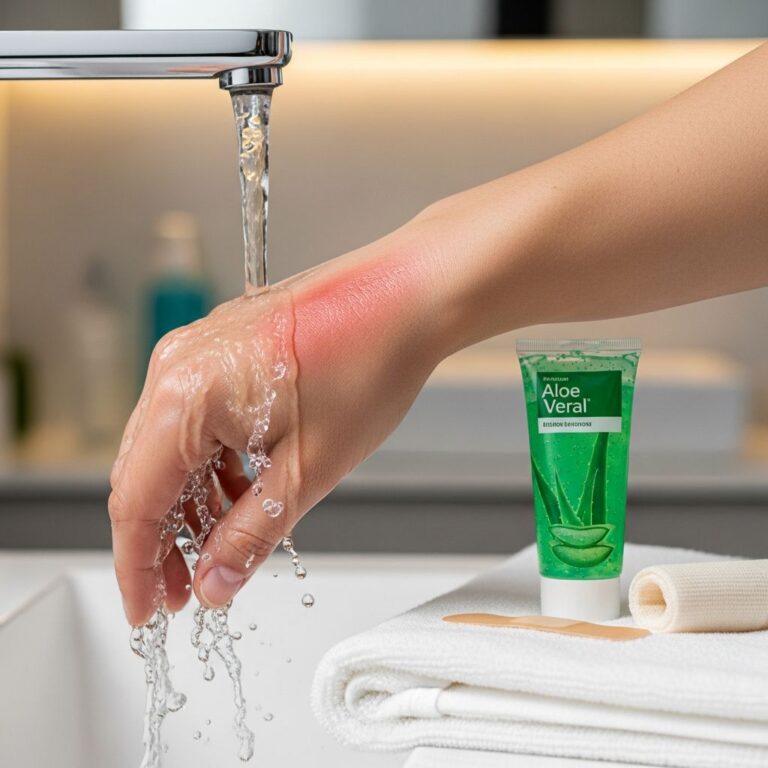
- Discontinue product if irritation occurs.
- Emollients for dryness; mild steroids for dermatitis.
- Fade tan via exfoliation (AHAs, urea creams).
- Monitor skin lesions; refer to dermatology if changes persist.
Prevention: Patch testing, avoid sprays on face/mucosa, daily SPF.
Prevention
- Use only on intact skin; avoid broken areas.
- Combine with erythrulose for even fade.
- Post-tan UV avoidance or sunscreen to mitigate oxidative risks.
- Educate on no photoprotection—DHA tan offers SPF ~3 at best.
FAQ
Is DHA safe for daily use?
Yes, for external skin application per FDA guidelines, but limit frequency to avoid cumulative irritation. No evidence of systemic absorption.
Does DHA provide sun protection?
No, it does not stimulate melanin and offers negligible SPF. Always use sunscreen.
Can DHA cause cancer?
No direct link in humans; lab studies show cellular stress at high doses, but topical use is low-risk with precautions.
How long does a DHA tan last?
5-10 days, depending on skin turnover, product, and maintenance.
Is DHA suitable for all skin types?
Yes, but darker tones may need lower concentrations to avoid unnatural hues; test for allergies.
References
- Sun-Kissed or Stressed? The Science Behind Self-Tanner — Dermascope. 2023. https://www.dermascope.com/sun-kissed-or-stressed-the-science-behind-self-tanner/
- Influence of hydration on dihydroxyacetone-induced pigmentation — PubMed. 2003-03-26. https://pubmed.ncbi.nlm.nih.gov/12648231/
- All about Dihydroxyacetone – Typology — Typology. Accessed 2026. https://us.typology.com/library/all-about-dihydroxyacetone-dha
- Exposure to Dihydroxyacetone in Sunless Tanning Products — Nursing CE Connection. 2018. https://nursing.ceconnection.com/ovidfiles/01412499-201801000-00002.pdf
- In search of the perfect tan: Chemical activity, biological effects — PMC. 2023. https://pmc.ncbi.nlm.nih.gov/articles/PMC10083914/
- The Science of How Fake Tan Works — Lab Muffin Beauty Science. Accessed 2026. https://labmuffin.com/the-science-of-how-fake-tan-works/
- What is the mechanism of Dihydroxyacetone — Patsnap Synapse. Accessed 2026. https://synapse.patsnap.com/article/what-is-the-mechanism-of-dihydroxyacetone
Similar Articles








Read full bio of Sneha Tete