Discoid Eczema: Expert Guide To Symptoms, Causes, Treatment
Understanding discoid eczema: causes, symptoms, diagnosis, and effective management strategies for this chronic skin condition.
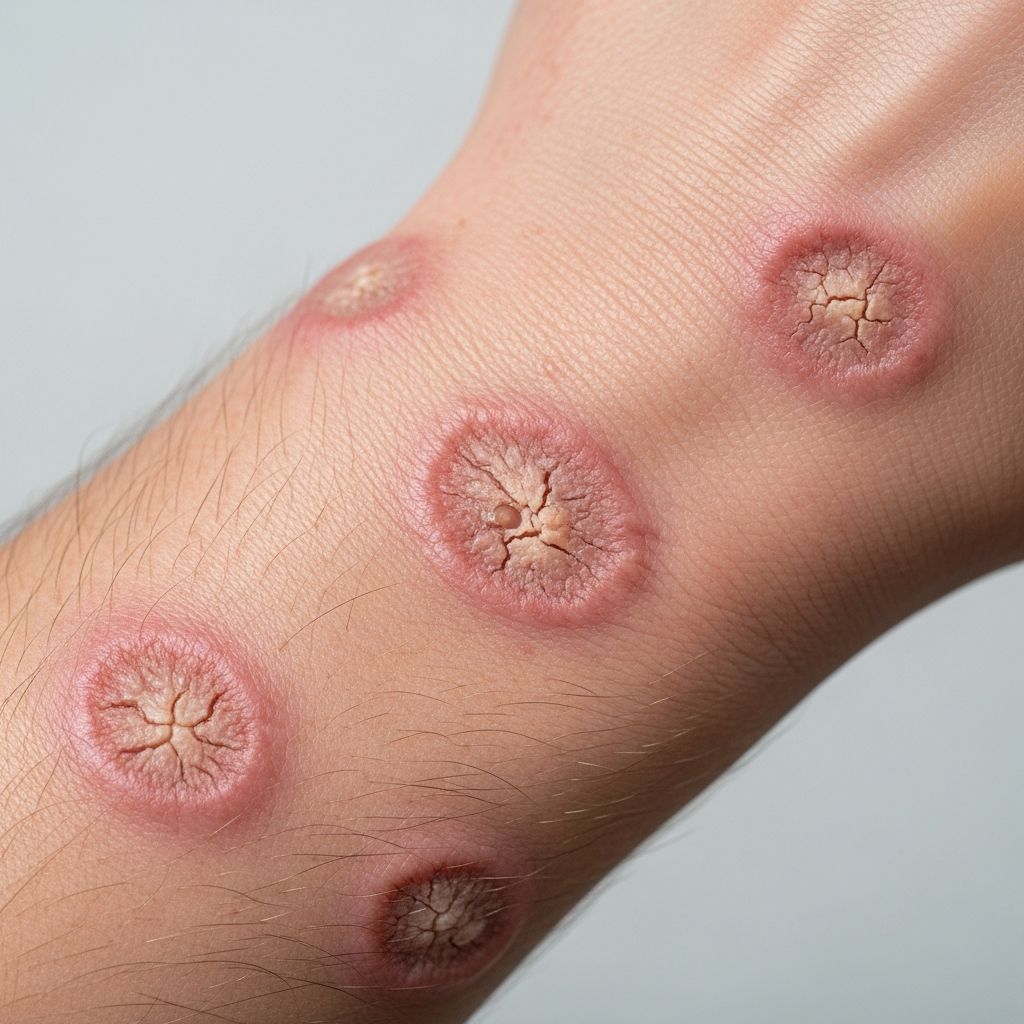
Discoid eczema, also known as nummular eczema, is a chronic skin condition characterised by round or oval patches of eczema that are intensely itchy. These coin- or disc-shaped patches (nummular = coin-shaped) vary in size from 1 cm to 10 cm in diameter and may occur singly or multiply. Discoid eczema is more common in adults than children and affects males more frequently than females.
What is discoid eczema?
Discoid eczema is a particular type of eczema (dermatitis) that appears as persistent round or oval red patches. The patches are usually very itchy and may leak fluid or crust over if they become infected. The condition is also called nummular dermatitis or nummular eczema, derived from the Latin word nummus meaning coin.
It tends to affect the limbs, particularly the outer aspects of the lower legs, arms, and back of the hands. In some cases, it can appear on the trunk or scalp. The rash often starts as small itchy spots that coalesce into larger plaques. Over time, the skin may thicken (lichenification) due to repeated scratching.
Who gets discoid eczema?
Discoid eczema affects approximately 1-2% of the population, with a higher prevalence in adults aged 50-65 years. Men are affected twice as often as women. It is less common in children but can occur at any age.
Risk factors include:
- Dry or sensitive skin
- History of atopic dermatitis or other eczemas
- Previous skin trauma or injury (Koebner phenomenon)
- Winter months due to low humidity
- Medications such as interferon, ribavirin, TNF-alpha blockers, or statins
Individuals with allergies, asthma, or hay fever (atopic background) may be predisposed, though discoid eczema is not always associated with atopy.
What causes discoid eczema?
The exact cause of discoid eczema is unknown, but it is multifactorial. Dry skin is a major predisposing factor, impairing the skin barrier and allowing irritants to penetrate. Minor skin injuries, such as insect bites, cuts, or abrasions, can trigger lesions at the site (idiopathic or post-traumatic).
Common triggers include:
- Environmental irritants: Harsh soaps, detergents, solvents, woollen fabrics, and household cleaners
- Climate: Cold, dry air in winter; low indoor humidity
- Stress and temperature changes
- Infections: Bacterial (Staphylococcus aureus) or fungal overgrowth can complicate or mimic the condition
- Allergens: Contact with nickel, fragrances, or preservatives in some cases
Unlike atopic eczema, discoid eczema is not strongly linked to family history of atopy, though genetic skin barrier defects (e.g., filaggrin mutations) may play a role.
What are the clinical features of discoid eczema?
The hallmark is one or more round or oval erythematous (red) plaques, 1-10 cm in diameter, with sharp margins. Early lesions consist of grouped vesicles or small papules on an erythematous base, resembling ‘bubbles’. These may weep clear fluid or become crusted.
Related Stories



Key features:
- Itch: Intense, worse at night, leading to scratching and lichenification
- Active phase: Red, inflamed, oozing, or crusted
- Chronic phase: Brown, scaly, thickened skin with exaggerated skin markings
- Post-inflammatory changes: Hyperpigmentation (darkening) or hypopigmentation (lightening), especially in darker skin types
Lesions are typically symmetrical but can be unilateral. Common sites: extremities (legs > arms), trunk, buttocks. Rarely involves face, flexures, or mucous membranes.
| Stage | Appearance | Symptoms |
|---|---|---|
| Acute | Red, vesicular, weeping | Severe itch, burning |
| Subacute | Crusted, scaling | Moderate itch |
| Chronic | Thickened, lichenified, hyperpigmented | Persistent itch |
Diagnosis
Diagnosis is clinical, based on characteristic morphology and history. No specific test is required, but skin swabs may be taken if infection is suspected. Dermoscopy can aid in differentiating from other coin-shaped lesions.
Differential diagnoses include:
- Tinea corporis (ringworm) – annular with central clearing, KOH positive
- Psoriasis – thicker plaques, silvery scale
- Contact dermatitis – irregular shape, history of exposure
- Bacterial infection (impetigo) or cellulitis
- Lichen simplex chronicus – single lesion from rubbing
- Cutaneous T-cell lymphoma (rare)
Biopsy is rarely needed but shows spongiosis, acanthosis, and parakeratosis in eczema.
Management
There is no cure for discoid eczema, but symptoms can be effectively controlled. Treatment is stepwise, starting with avoidance of triggers and emollients.
General measures
- Emollients: Apply liberally 2-3 times daily, especially after bathing. Use soap substitutes. Key to restoring skin barrier.
- Bathing: Short lukewarm showers daily; pat dry, apply emollient immediately.
- Avoid triggers: Irritants, extremes of temperature, excessive scratching.
- Humidifier: Maintain indoor humidity 40-60%.
- Wet wraps: For severe itch – apply steroid then damp emollient-soaked bandage overnight.
Topical treatments
Topical corticosteroids: First-line for inflammation. Use potent (e.g., betamethasone) or very potent (e.g., clobetasol) ointments twice daily until clear (1-2 weeks), then taper. Ointments preferred over creams for better penetration. Monitor for side effects like atrophy.
- Mild cases: Moderate potency
- Thick plaques: Very potent
- Face/scalp: Mild potency
Non-steroidal topicals: Calcineurin inhibitors (tacrolimus) for steroid-sparing; coal tar for chronic plaques.
Antibiotics: Topical (mupirocin) or oral (flucloxacillin) if infected (golden crusts, pustules).
Phototherapy
Narrowband UVB or PUVA for widespread, resistant cases. Administered 2-3 times weekly in dermatology clinics.
Systemic treatments
For severe/refractory disease:
- Oral corticosteroids: Short burst (prednisolone 0.5-1 mg/kg for 1-2 weeks)
- Immunosuppressants: Methotrexate, ciclosporin, azathioprine
- Biologics: Dupilumab, tralokinumab, JAK inhibitors (specialist use)
Antihistamines (sedating, e.g., hydroxyzine) for nocturnal itch.
What is the outlook for discoid eczema?
Most cases settle with treatment, but relapses are common, especially in winter. Early intervention prevents chronicity and infection. Pigmentation changes may persist months to years but usually resolve. Rarely, it becomes persistent despite treatment.
Prevention
- Daily emollient use as ‘liquid plaster’
- Protect skin from injury and irritants
- Wear cotton clothing; avoid wool/synthetics
- Manage stress
- Prophylactic mild topical steroid at first sign of itch
Frequently asked questions
Is discoid eczema contagious?
No, it is not infectious or contagious. Secondary bacterial infection can occur from scratching.
Can discoid eczema be cured?
No cure, but manageable with consistent care. Many experience long remissions.
How long do patches last?
Weeks to months untreated; resolve faster with treatment.
Does it affect children?
Rarely; more common in adults.
Can diet help?
No strong evidence, but avoid personal triggers if identified.
References
- Discoid eczema: Treatment, causes, and symptoms — Medical News Today. 2023-10-15. https://www.medicalnewstoday.com/articles/182794
- How to Care for Discoid Eczema: Symptoms, Triggers, Treatment — Healthgrades. 2024-05-20. https://resources.healthgrades.com/right-care/eczema/discoid-eczema
- Doctor explains Discoid Eczema | Causes, Symptoms, Photos and … — NHS UK (via YouTube transcript reference). 2023-08-10. https://www.nhs.uk/conditions/discoid-eczema/
- Discoid eczema — NHS. 2025-01-15. https://www.nhs.uk/conditions/discoid-eczema/
- Discoid eczema — Skin Health Info (BAD Patient Hub). 2024-11-05. https://www.skinhealthinfo.org.uk/condition/discoid-eczema/
- Nummular Dermatitis — NCBI Bookshelf (StatPearls). 2024-07-22. https://www.ncbi.nlm.nih.gov/books/NBK565878/
Similar Articles








Read full bio of medha deb