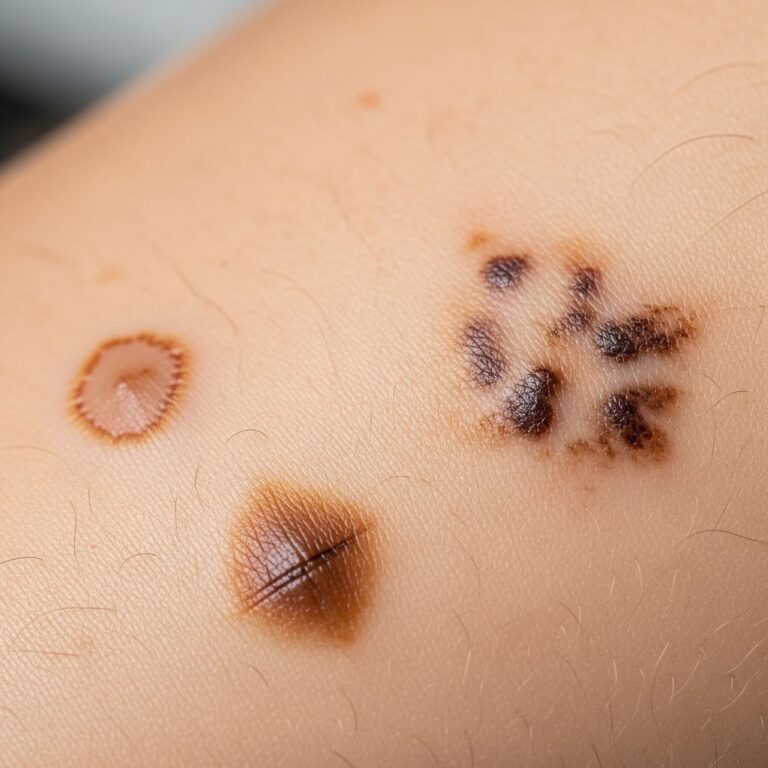
Disseminated Superficial Actinic Porokeratosis
Understanding DSAP: causes, symptoms, diagnosis, and management of this common sun-related skin disorder.
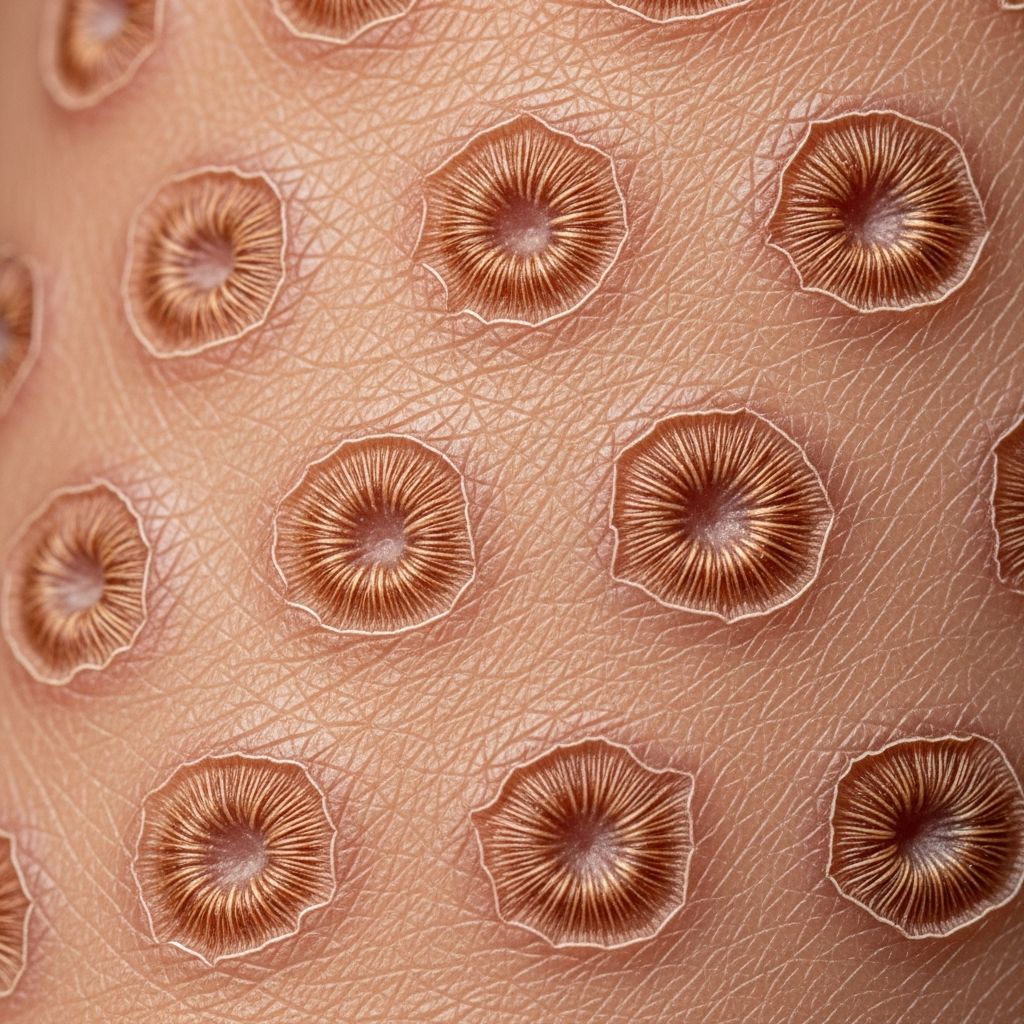
Disseminated superficial actinic porokeratosis (DSAP) is a common inherited disorder of keratinization characterized by multiple discrete dry patches primarily on the extensor surfaces of the forearms and lower legs. This condition, often described as a ‘sunspot’ variant, arises due to genetic predisposition exacerbated by ultraviolet (UV) radiation exposure.
What is disseminated superficial actinic porokeratosis?
DSAP represents a non-contagious skin condition manifesting as numerous small, annular plaques with a distinctive raised, scaly border known as the cornoid lamella. The term ‘porokeratosis’ derives from Greek roots meaning ‘scaly pore,’ though it does not involve hair follicles or sweat pores. Lesions typically measure 2-10 mm in diameter but can enlarge up to 2 cm, appearing as annular or polycyclic plaques with an elevated horny rim.
The central area within the rim is often atrophic, pale, smooth, or slightly hyperpigmented, sometimes featuring follicular plugs or mild scaling. An inner pale ring may separate the rim from the center. Lesions predominate on sun-exposed sites, worsening in summer and fading in winter. DSAP is twice as prevalent in women and individuals with lighter skin phototypes, with onset usually between ages 30-50.
Who gets disseminated superficial actinic porokeratosis?
DSAP exhibits autosomal dominant inheritance, implying a 50% chance of transmission to offspring from an affected parent. While genetically driven, environmental triggers like cumulative UV exposure are essential for lesion development. Immunosuppression, such as post-organ transplantation, renal failure, or HIV, can precipitate or exacerbate DSAP. Additional precipitants include phototherapy, trauma, infections, and systemic illnesses.
Prevalence estimates vary, but DSAP affects up to 9% of certain populations, particularly those of Celtic descent with fair skin. It is rare before puberty and peaks in mid-adulthood. Familial clustering underscores its hereditary nature, though sporadic cases occur.
What causes disseminated superficial actinic porokeratosis?
The pathogenesis involves somatic mutations in the mevalonate kinase or related genes, disrupting cholesterol synthesis and keratinocyte proliferation. UV radiation induces clonal expansion of mutated keratinocytes, forming the characteristic cornoid lamella—a column of parakeratotic cells marking disordered keratinization.
Sun exposure accelerates lesion proliferation, explaining the ‘actinic’ descriptor. Genetic studies identify mutations in MVD, PMVK, and MVKK genes within the mevalonate pathway, confirming DSAP’s molecular basis. These defects lead to abnormal lipid metabolism in keratinocytes, culminating in the hyperkeratotic rim.
What are the symptoms of disseminated superficial actinic porokeratosis?
Most individuals with DSAP are asymptomatic, noting only cosmetic concerns from rough, dry patches. However, sun exposure or heat can provoke pruritus, stinging, or burning within lesions. Affected skin feels anhidrotic (non-sweating) and rough to the touch. Lesions may itch more prominently in summer, prompting patients to seek relief.
- Dry, scaly annular patches
- Mild itch or sting with UV/heat exposure
- Cosmetic distress from visible lesions
- Seasonal exacerbation
What does disseminated superficial actinic porokeratosis look like?
Lesions present as multiple irregular, roundish, annular, or polycyclic plaques, each featuring a thin, raised, thread-like hyperkeratotic rim. The rim accentuates dramatically after application of dihydroxyacetone (fake tan), aiding clinical recognition. Central skin is thinned, erythematous, or hyperpigmented, often with a pale halo just inside the ridge.
Related Stories



Colors range from pinkish-red to brown or purple, varying by skin type and sun exposure. Individual lesions span 1-10 mm, though confluence can form larger patches. Forearms and shins bear the brunt bilaterally; facial involvement occurs in <10% of cases, sparing palms, soles, and scalp.

How is disseminated superficial actinic porokeratosis diagnosed?
Diagnosis relies primarily on clinical examination and dermoscopy, revealing the pathognomonic white thread-like rim. Biopsy confirms via histopathology, demonstrating the cornoid lamella: a parakeratotic column overlying dyskeratotic keratinocytes with epidermal atrophy beneath.
Skin biopsy pitfalls include sampling errors if the rim is excluded, poor orientation, or pathologist oversight. Dermoscopy enhances specificity, displaying the ‘white track’ rim with radial branching. Differential diagnoses encompass actinic keratosis, squamous cell carcinoma in situ, or lichenoid dermatoses.
Unusual types of disseminated superficial actinic porokeratosis
- Linear DSAP: Blaschko-linear distribution, often unilateral.
- Facial DSAP: Rare, affecting forehead/cheeks.
- Immunosuppression-associated DSAP: Rapid, widespread post-transplant.
- Giant DSAP: Lesions >2 cm, atypical sites.
Potential complications of disseminated superficial actinic porokeratosis
The paramount concern is malignant transformation to squamous cell carcinoma (SCC), reported in <10% of cases, though cumulative sun damage elevates overall skin cancer risk. SCC manifests as enlarging, tender, ulcerated nodules within lesions. Vigilant monitoring is advised, particularly for enlarging or symptomatic plaques.
| Complication | Risk Level | Features |
|---|---|---|
| Squamous cell carcinoma | Low (<10%) | Tender nodule, ulceration |
| Actinic keratosis | Moderate | Rough, scaly spots |
| Basal cell carcinoma | Low | Pearly nodule |
Treatment of disseminated superficial actinic porokeratosis
No curative therapy exists for DSAP; management focuses on symptom palliation, lesion reduction, and cancer prevention. Broad-spectrum sunscreen (SPF 50+), protective clothing, and shade avoidance are foundational.
Promising emerging therapy: Topical 2% lovastatin ± cholesterol targets mevalonate pathway defects, yielding partial clearance in trials.
Established treatment options
- Cryotherapy: Liquid nitrogen for isolated lesions; risk of hypopigmentation/scarring.
- Topical 5-fluorouracil (5-FU): Induces inflammation, destroys abnormal cells.
- Imiquimod: Immune modulator; causes redness/soreness.
- Photodynamic therapy (PDT): Light-activated protoporphyrin kills keratinocytes.
- Curettage/electrosurgery: Mechanical removal under local anesthesia.
- Retinoids (topical/systemic): Normalize keratinization.
- Laser resurfacing: Fractional CO2 or erbium for superficial lesions.
Moisturizers with urea or alpha-hydroxy acids alleviate dryness. No regimen guarantees long-term clearance; recurrence is common.
What is the outcome for disseminated superficial actinic porokeratosis?
DSAP persists lifelong but remains benign for most. Lesions stabilize or regress with rigorous photoprotection. Regular dermatologic surveillance detects complications early. Patient education empowers self-management.
Frequently Asked Questions (FAQs)
Is DSAP contagious?
No, DSAP is a genetic skin disorder and cannot be transmitted person-to-person.
Does DSAP turn into skin cancer?
Rarely (<10%); monitor changing lesions and practice sun protection.
Can DSAP be prevented?
Genetic predisposition cannot be altered, but UV avoidance delays/prevents lesions.
Is there a cure for DSAP?
No cure exists; treatments offer symptomatic relief.
How do I manage DSAP daily?
Use daily SPF 50+ sunscreen, moisturize, and avoid peak sun hours.
References
- Disseminated Superficial Actinic Porokeratosis (DSAP) — DermNet NZ. 2023. https://dermnetnz.org/topics/disseminated-superficial-actinic-porokeratosis
- Disseminated Superficial Actinic Porokeratosis (DSAP) — Skin Health Info (British Association of Dermatologists). 2016-07-01. https://www.skinhealthinfo.org.uk/wp-content/uploads/2018/11/Disseminated-Superficial-Actinic-Porokeratosis-DSAP-Updated-July-2016-lay-reviewed-March-20164.pdf
- Disseminated Superficial Actinic Porokeratosis – StatPearls — NCBI Bookshelf (National Center for Biotechnology Information). 2023-10-01. https://www.ncbi.nlm.nih.gov/books/NBK459202/
- Precancerous skin lesion often misdiagnosed — RACGP (Royal Australian College of General Practitioners). 2019-11-01. https://www1.racgp.org.au/ajgp/2019/november/precancerous-skin-lesion-often-misdiagnosed
- Disseminated superficial actinic porokeratosis — Genetic and Rare Diseases Information Center (GARD), NIH. 2023. https://rarediseases.info.nih.gov/diseases/10983/disseminated-superficial-actinic-porokeratosis
Similar Articles








Read full bio of Sneha Tete