Dracunculiasis: Complete Guide To Treatment & Eradication
Dracunculiasis, or Guinea worm disease, is a crippling parasitic infection nearing global eradication through targeted public health interventions.
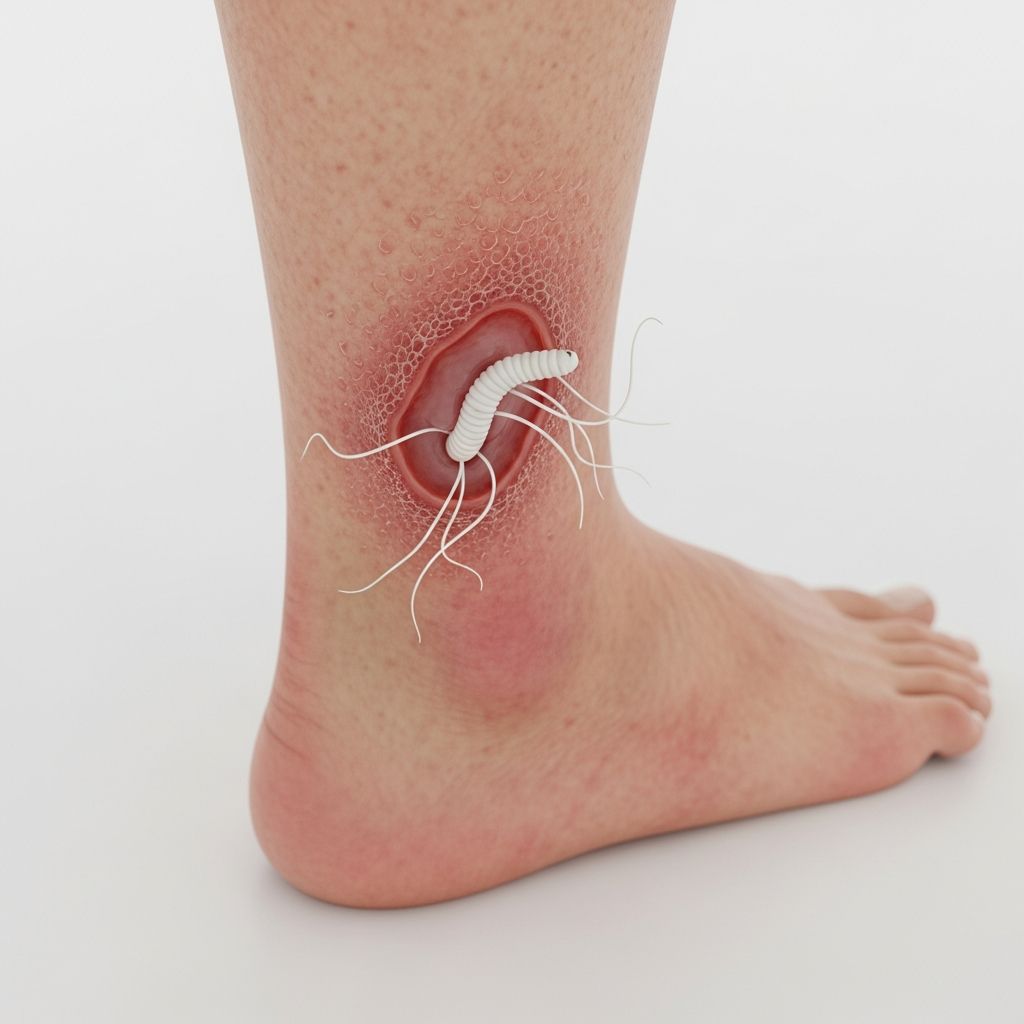
Dracunculiasis, also known as Guinea worm disease (GWD), is a parasitic infection caused by the nematode Dracunculus medinensis. It is transmitted through drinking unfiltered stagnant water containing copepods (water fleas) infected with the parasite’s larvae. After approximately one year of incubation, the mature female worm emerges painfully from the skin, typically the lower limbs, causing debilitating ulcers and mobility impairment.
What is dracunculiasis?
Dracunculiasis is one of the oldest recorded diseases, afflicting humans for millennia. Caused by the large nematode Dracunculus medinensis, it primarily affects impoverished rural communities in sub-Saharan Africa reliant on unsafe drinking water sources. The disease is characterized by the slow, painful emergence of gravid female worms (up to 1 meter long) from subcutaneous tissues, often coinciding with peak agricultural seasons, leading to significant economic losses.
Historically endemic in 20 countries, aggressive eradication campaigns have reduced global cases from millions in the 1980s to just 15 human cases in 2024, per World Health Organization (WHO) data. Transmission occurs exclusively in humans, with no known animal reservoirs completing the cycle, making eradication feasible.
Who gets dracunculiasis?
Dracunculiasis predominantly affects rural villagers in remote areas without access to safe water. Economically active adults and children drinking from contaminated ponds, step-wells, or puddles are most vulnerable. The disease peaks seasonally during dry periods when water sources shrink, concentrating copepods.
- Primarily sub-Saharan Africa (e.g., Chad, South Sudan, Mali as residual foci).
- Individuals fetching water from stagnant sources.
- No immunity develops; reinfections are common.
Causes
The causative agent is Dracunculus medinensis, a filarial nematode. Humans ingest infective third-stage larvae (L3) within copepods of the genus Cyclops from unfiltered water. In the stomach, copepods are digested, releasing larvae that penetrate the intestinal wall, migrate to body cavities, and mature over 10–14 months.
Life cycle
The life cycle completes in about one year:
- Infection: Ingestion of L3 larvae in copepods.
- Migration and maturation: Larvae enter connective tissues; males die post-mating; females grow to 70–120 cm.
- Emergence: Gravid females migrate to skin, form blisters, and discharge larvae into water upon contact.
- Transmission: Larvae ingested by copepods, develop into L3 in 14 days.

Clinical features
Infection is asymptomatic for 10–14 months. Pre-emergence symptoms include fever, urticaria, nausea, and dizziness as the worm nears the skin.
Emergent phase
- Painful papule/blister (often lower leg/foot) with erythema and induration.
- Worm emerges slowly (1–3 cm/day) over 2–6 weeks, causing searing pain.
- Secondary bacterial infections common, leading to cellulitis, abscesses, or sepsis.
Aberrant migrations (e.g., spine, eye, testis) cause compressive symptoms. Joint involvement may result in permanent stiffness or contractures.
Images

Figure 1: Characteristic worm emergence from ankle.
Multiple worms (up to 20 per person) can emerge simultaneously, severely impairing mobility during harvest seasons.
Diagnosis
Diagnosis is clinical, based on characteristic blister/ulcer with emerging white worm.
Related Stories



- Key features: Painful lower extremity lesion; visible coiled worm; history of stagnant water exposure.
- Laboratory: Microscopic identification of larvae from blister fluid (L1 stage, ~200–600 µm).
- Differential: Spider bites, anthrax, other nematodal infections (e.g., loiasis).
Treatment
Supportive care focuses on worm extraction and symptom relief. No antiparasitic drug reliably kills adult worms.
| Method | Description |
|---|---|
| Worm extraction | Traditional: Wind worm onto stick daily after blister rupture (avoid water contact). |
| Modern | Sterile probe to open tract; gentle traction; topical antibiotics. |
| Pain relief | NSAIDs, analgesics; cool compresses (avoid immersion). |
| Antibiotics | For secondary infections (e.g., tetracycline, cephalexin). |
Complete extraction prevents complications; incomplete removal risks abscess.
Prevention and eradication
Eradication strategies target transmission interruption:
- Water filtration: Cloth/monofilament nylon filters remove copepods.
- Chemical treatment: Temephos (Abate®) kills copepods in water sources.
- Case containment: Isolate patients; filter all water; no worm-water contact.
- Health education: Community surveillance, reporting.
- Animal cases: Emerging dog/cat infections managed similarly.
The Carter Center, WHO, and CDC lead efforts; no vaccine needed due to human-only cycle.
Eradication progress
Historic decline: From 3.5 million cases (1986) to 15 (2024).
| Year | Human Cases |
|---|---|
| 2022 | 13 |
| 2023 | 14 |
| 2024 | 15 |
Challenges: Conflict zones, animal reservoirs. Dracunculiasis is poised to be the second eradicated disease after smallpox.
Frequently asked questions
What is dracunculiasis?
Dracunculiasis, or Guinea worm disease, is a parasitic infection by Dracunculus medinensis acquired from drinking copepod-contaminated water, leading to worm emergence after one year.
How is Guinea worm disease transmitted?
Through ingestion of water fleas (Cyclops) harboring infective larvae from stagnant sources.
What are the symptoms of dracunculiasis?
Painful skin blister/ulcer with emerging worm (usually leg), fever, swelling; secondary infections common.
How is Guinea worm disease treated?
Supportive: Gradual worm extraction onto stick/cloth, pain relief, antibiotics for infections. No effective drug kills adults.
Is dracunculiasis curable?
Yes, with proper extraction; full recovery in weeks to months, though scarring or joint damage may persist.
Can Guinea worm disease be prevented?
Yes, via water filtration, temephos treatment, case isolation, and education. Eradication near.
Is there a vaccine for dracunculiasis?
No vaccine; prevention relies on breaking transmission. No immunity develops.
How close is Guinea worm eradication?
Very close: 15 cases in 2024, down from millions. Only polio remains as another eradicable disease.
References
- Dracunculiasis (guinea worm disease) — PubMed Central / NIH. 2004-04-07. https://pmc.ncbi.nlm.nih.gov/articles/PMC332717/
- Dracunculiasis (Guinea worm disease) — Eisai. Accessed 2026. https://www.eisai.com/sustainability/atm/ntds/diseases/guinea.html
- Dracunculiasis (guinea worm disease) — PubMed. 2004. https://pubmed.ncbi.nlm.nih.gov/14970098/
- Dracunculiasis (Guinea-worm disease) — World Health Organization (WHO). Updated 2025. https://www.who.int/data/gho/data/themes/topics/dracunculiasis-guinea-worm-disease
- About Guinea Worm — Centers for Disease Control and Prevention (CDC). Accessed 2026. https://www.cdc.gov/guinea-worm/about/index.html
- Guinea Worm Disease (Dracunculiasis): Cause & Treatment — Cleveland Clinic. Accessed 2026. https://my.clevelandclinic.org/health/diseases/guinea-worm-disease
- Guinea Worm Disease Eradication Program — The Carter Center. Accessed 2026. https://www.cartercenter.org/programs/guinea-worm/
Similar Articles








Read full bio of Sneha Tete