Drug-Induced Vitiligo: Guide To Diagnosis & Treatment
Understanding drug-induced vitiligo: causes, symptoms, diagnosis, management, and prevention strategies for this rare skin condition.
Drug-Induced Vitiligo
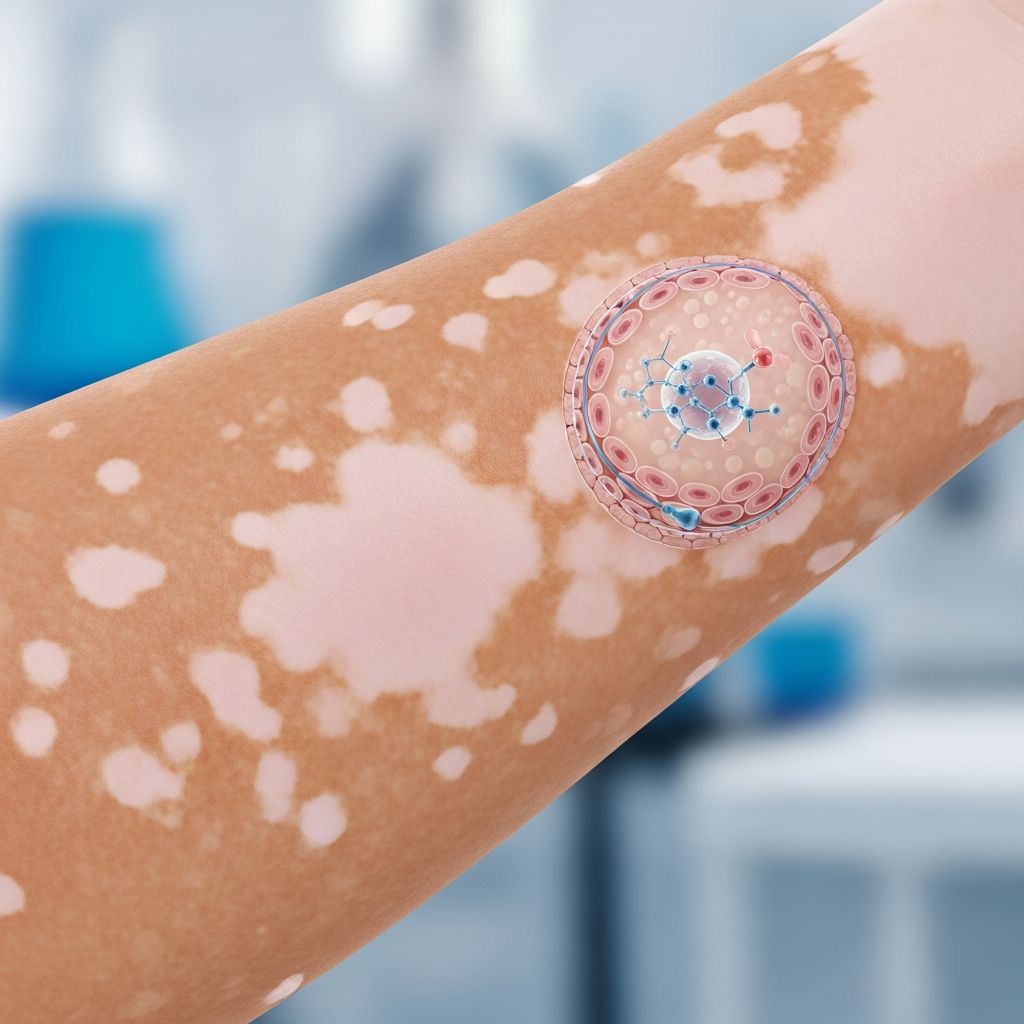
Drug-induced vitiligo is a rare cutaneous adverse reaction characterized by the development of depigmented patches on the skin due to certain medications. Unlike idiopathic vitiligo, which is an autoimmune condition involving progressive loss of melanocytes, drug-induced vitiligo often presents as new-onset or exacerbation of existing vitiligo following exposure to specific pharmacological agents. This condition typically manifests as well-defined, milky-white macules that may be symmetrical and distributed over sun-exposed or friction-prone areas. The pathogenesis involves potential mechanisms such as direct cytotoxicity to melanocytes, immune-mediated destruction, or disruption of neural pathways supplying melanocytes. Recognition is crucial as prompt discontinuation of the offending drug can lead to partial or complete repigmentation in many cases.
What is Drug-Induced Vitiligo?
Drug-induced vitiligo refers to the selective loss of melanocytes resulting in hypopigmented or depigmented skin lesions triggered by therapeutic agents. It differs from other forms of hypopigmentation, such as chemical leukoderma from occupational exposures, by its association with systemic or topical medications used for medical treatment. The hallmark is achromic macules that fluoresce bright white under Wood’s lamp examination, confirming the absence of melanin. Patients may report a history of recent medication initiation coinciding with the onset of lesions, often within weeks to months. Pre-existing vitiligo increases susceptibility to extension upon drug exposure. Histologically, biopsies reveal complete absence of melanocytes in lesional skin, with preserved structures in perilesional areas.
Who Gets Drug-Induced Vitiligo?
Drug-induced vitiligo affects individuals of any age, gender, or ethnicity prescribed implicated medications, particularly those with immune-modulating properties. It is more commonly reported in patients treated for malignancies, autoimmune diseases, or neurological conditions requiring targeted therapies or biologics. Those with a personal or family history of vitiligo, thyroid disorders, or other autoimmune diseases may be at higher risk due to underlying immune dysregulation. Incidence is low, with cases often emerging from post-marketing surveillance rather than clinical trials, highlighting its rarity. Case reports document occurrences in diverse populations, including elderly patients on anticonvulsants and adolescents on biologics for atopic dermatitis.
Causes of Drug-Induced Vitiligo
The primary cause is exposure to medications that interfere with melanocyte survival or function. Hypotheses for pathogenesis include autoimmune activation of CD8+ T cells targeting melanocytes, direct drug-induced apoptosis, and sympathetic nerve-mediated damage. Implicated drugs span several classes:
- Immune checkpoint inhibitors: Nivolumab, pembrolizumab, and ipilimumab, used in immunotherapy for cancers, frequently induce vitiligo-like depigmentation, sometimes correlating with better tumor response.
- Tyrosine kinase inhibitors: Imatinib, dasatinib, gefitinib, sunitinib, pazopanib, vemurafenib—commonly cause hypopigmentation via inhibition of c-KIT signaling essential for melanocyte development.
- Biologic agents: Dupilumab for atopic dermatitis disrupts Th2 immunity, potentially shifting to Th1/Th17 dominance that promotes vitiligo.
- Anticonvulsants: Carbamazepine has been linked to reversible facial and acral depigmentation.
- Antimalarials: Chloroquine induces vitiligo-like changes.
- Other agents: Monoclonal antibodies, interferons, tranexamic acid, and rarely topical phenols like monobenzyl ether of hydroquinone, which can generalize.
Rare reports include chemotherapy drugs and immunomodulators. Genetic predisposition, such as variants in melanocyte-related genes, may modulate susceptibility.
Clinical Features of Drug-Induced Vitiligo
Lesions typically appear as asymptomatic, sharply demarcated white patches, often symmetrical and involving the face, neck, hands, and acral sites. Onset is variable: rapid (days to weeks) with anticonvulsants or gradual with kinase inhibitors. Initial erythema or inflammation may precede depigmentation. Hair within lesions may turn white (poliosis), and mucosal involvement is uncommon unless pre-existing vitiligo. Under Wood’s lamp, lesions exhibit enhanced chalky-white fluorescence. Dermoscopy shows absent pigment network and perifollicular sparing in early stages. Progression halts upon drug withdrawal, distinguishing it from progressive idiopathic vitiligo.
| Feature | Drug-Induced | Idiopathic |
|---|---|---|
| Onset | Post-medication (weeks-months) | Insidious, spontaneous |
| Distribution | Often facial/acral, symmetrical | Periorificial, acral |
| Reversibility | Frequent upon discontinuation | Usually progressive |
| Associations | Recent drug history | Autoimmune diseases |
Diagnosis of Drug-Induced Vitiligo
Diagnosis relies on clinical history of recent drug exposure, characteristic morphology, and exclusion of mimics like pityriasis alba or post-inflammatory hypopigmentation. Wood’s lamp accentuates lesions, while dermoscopy aids differentiation. Skin biopsy, though not always needed, confirms melanocyte absence via Fontana-Masson stain or immunohistochemistry (e.g., gp100, Melan-A). Patch testing is irrelevant as it’s systemic. Naranjo probability scale assesses causality, often scoring ‘probable’. Thyroid function and autoimmune screens rule out syndromic vitiligo.
Management of Drug-Induced Vitiligo
First-line management is discontinuation of the causative drug if feasible, balancing benefits against skin risks. Supportive measures include broad-spectrum sunscreens and cosmetic camouflage to protect vulnerable depigmented skin. For persistent lesions:
- Topical therapies: Corticosteroids (e.g., clobetasol) or calcineurin inhibitors (tacrolimus) promote repigmentation.
- Phototherapy: Narrowband UVB (NB-UVB) is effective and safe, often yielding repigmentation within months; 5 sessions showed near-complete recovery in one case.
- Systemic options: If drug cannot be stopped, oral mini-pulses of steroids or JAK inhibitors for refractory cases.
- Advanced: Excimer laser or surgical grafting for stable, localized lesions.
Monitoring for progression is essential, with multidisciplinary input from dermatology and prescribing specialists.
Prevention of Drug-Induced Vitiligo
Prevention involves risk stratification: screen for vitiligo history before starting high-risk drugs like checkpoint inhibitors. Patient education on early reporting of pigment changes enables prompt intervention. Alternative therapies should be considered in at-risk patients. For unavoidable drugs, prophylactic topical agents or phototherapy may mitigate onset, though evidence is limited. Ongoing pharmacovigilance contributes to updated guidelines.
Outlook for Drug-Induced Vitiligo
Prognosis is favorable compared to idiopathic vitiligo; repigmentation occurs in 50-70% upon drug cessation, often within 2-6 months. Factors favoring recovery include short drug duration, early discontinuation, and phototherapy adjunct. Permanent changes may persist if melanocyte destruction is extensive or treatment delayed. Psychological impact can be significant, warranting support[10]. Long-term follow-up monitors for relapse or new autoimmunity.
Frequently Asked Questions
Q: Is drug-induced vitiligo reversible?
A: Yes, in many cases, especially with prompt drug discontinuation and phototherapy; repigmentation can be complete.
Q: Which drugs most commonly cause vitiligo?
A: Immune checkpoint inhibitors, tyrosine kinase inhibitors, and biologics like dupilumab are frequent culprits.
Q: Can drug-induced vitiligo spread?
A: Progression halts upon stopping the drug; continued exposure risks extension.
Q: Is phototherapy safe for drug-induced vitiligo?
A: Narrowband UVB is first-line, with mild side effects like transient redness.
Q: Should I stop my medication if I notice white patches?
A: Consult your doctor immediately; do not stop unilaterally if essential for your condition.
References
- Carbamazepine-induced reversible vitiligo — PMC – NIH. 2022-07-01. https://pmc.ncbi.nlm.nih.gov/articles/PMC9256838/
- Drug-induced hypopigmentation — VisualDx. 2024. https://www.visualdx.com/visualdx/diagnosis/drug-induced+hypopigmentation
- Biologic drugs induced vitiligo: case reports and review of literature — Frontiers in Immunology. 2024-10-01. https://www.frontiersin.org/journals/immunology/articles/10.3389/fimmu.2024.1455050/full
- Drug-induced vitiligo — DermNet NZ. 2024. https://dermnetnz.org/topics/drug-induced-vitiligo
- Vitiligo – Diagnosis & treatment — Mayo Clinic. 2024-01-01. https://www.mayoclinic.org/diseases-conditions/vitiligo/diagnosis-treatment/drc-20355916
- Vitiligo – drug induced — MedlinePlus. 2024. https://medlineplus.gov/ency/imagepages/2486.htm
Similar Articles






Read full bio of Sneha Tete