Drusen vs Exudates: Key Retinal Differences
Discover the vital distinctions between drusen and exudates, their links to major eye diseases, and strategies for early detection and management.
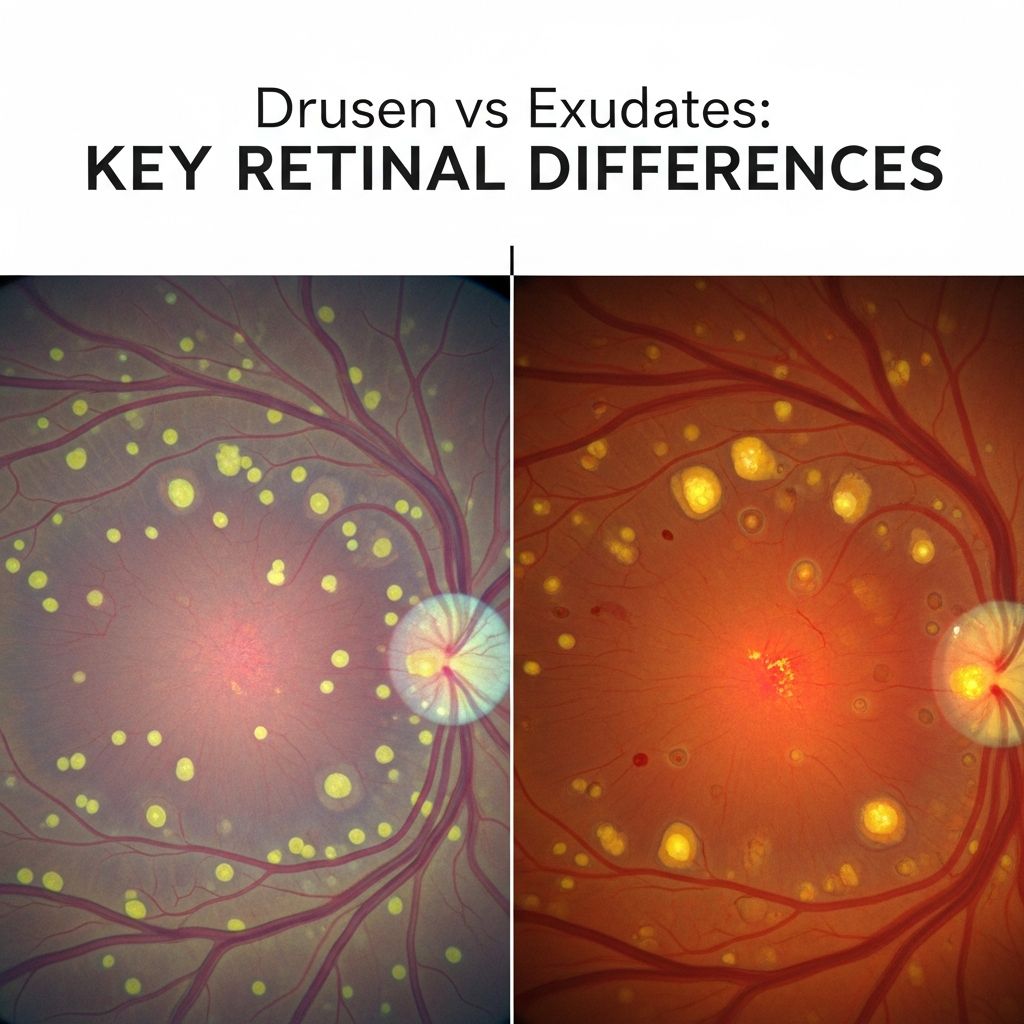
Drusen and exudates are distinct retinal features that appear as bright spots on eye scans but point to different underlying conditions requiring unique approaches to care. Understanding their differences is essential for timely intervention in diseases like age-related macular degeneration (AMD) and diabetic retinopathy (DR).
Understanding Drusen in Retinal Anatomy
Drusen consist of lipid and protein buildup located between the retinal pigment epithelium (RPE) and Bruch’s membrane, the supportive layer beneath the retina. These deposits form due to impaired waste clearance from photoreceptor cells, exacerbated by aging, oxidative stress, and inflammation.
Small, hard drusen are defined by their compact size (under 63 microns) and well-defined borders, posing minimal immediate threat. In contrast, larger soft drusen (over 125 microns) cluster together with fuzzy edges, signaling heightened progression risk to AMD.
- Hard Drusen: Smaller, isolated; low risk of rapid vision decline.
- Soft Drusen: Larger, grouped; up to 50% chance of central vision loss within five years.
The macula, central retina area for detailed vision, is most affected. Accumulation here disrupts RPE function, potentially leading to atrophy or neovascularization.
Exudates: Markers of Vascular Leakage
Exudates arise from damaged retinal blood vessels leaking lipids and proteins into surrounding tissues, primarily in diabetic retinopathy. High blood sugar over years weakens vessel walls, causing hard exudates (waxy, discrete) or soft exudates (fluffy, associated with edema).
Unlike drusen, exudates cluster near leak sources, often in the macula, forming patterns like circinate rings. Their presence escalates DR severity, demanding prompt referral to specialists.
| Feature | Drusen | Exudates |
|---|---|---|
| Origin | Waste buildup in RPE | Vascular leakage |
| Distribution | Diffuse across retina | Clustered near vessels |
| Disease Link | AMD | DR |
| Risk Level | Variable by size/number | High; immediate action |
Clinical Significance and Disease Associations
Drusen and Age-Related Macular Degeneration
Drusen serve as early AMD indicators. Dry AMD features slow RPE thinning and drusen growth, causing blurred central vision. Wet AMD involves choroidal neovascularization, where fragile vessels leak, often triggered by prior drusen.
Not all drusen progress; few small ones may remain benign. However, numerous large soft drusen correlate with 25-50% progression risk over years.
Exudates in Diabetic Retinopathy Progression
Exudates mark non-proliferative DR stages, alongside microaneurysms and hemorrhages. Macular edema from exudate-related fluid buildup threatens sharp vision. Advanced cases risk proliferative DR with neovascularization and potential blindness.
International grading mandates urgent ophthalmologist referral for even few exudates, unlike drusen which may warrant monitoring.
Symptoms and Early Warning Signs
Drusen often asymptomatically precede AMD, but advancing cases yield central vision distortion, scotomas (blind spots), or metamorphopsia (wavy lines). Night vision impairment signals early changes.
Exudates contribute to DR symptoms like fluctuating vision, color desaturation, or field loss from edema. Sudden changes indicate leakage progression.
- Monitor with Amsler grid: Detect distortions early, one eye at a time.
- Home testing crucial for drusen patients at AMD risk.
Related Stories



Diagnostic Approaches and Imaging Techniques
Fundus photography reveals both as yellow-white spots, but differentiation relies on context. Drusen scatter broadly; exudates group focally.
Optical coherence tomography (OCT) excels: Drusen appear as RPE elevations with hyperreflective cores; exudates as intraretinal hyperreflectivities amid fluid.
Fluorescein angiography highlights exudate leakage dynamics, absent in drusen. Automated AI tools, using SVM and spatial analysis, achieve 92% accuracy in classification.
Spatial patterns aid: Drusen distribute evenly; exudates form compact clusters.
Risk Factors Influencing Development
- For Drusen/AMD: Age over 60, family history, smoking, poor diet low in antioxidants.
- For Exudates/DR: Duration of diabetes, poor glycemic control, hypertension, hyperlipidemia.
Shared factors like oxidative stress underscore lifestyle’s role in both.
Management and Treatment Strategies
Handling Drusen and Preventing AMD Progression
No direct drusen removal exists; focus shifts to risk reduction. AREDS2 formula—lutein (10mg), zeaxanthin (2mg), vitamin C (500mg), vitamin E (400IU), zinc (80mg), copper (2mg)—cuts advanced AMD risk by 25% in high-risk individuals.
| Nutrient | AREDS2 Dose | Benefits |
|---|---|---|
| Lutein/Zeaxanthin | 10/2 mg | Antioxidant protection; safer than beta-carotene. |
| Zinc/Copper | 80/2 mg | RPE support; prevents deficiency. |
| Vitamins C/E | 500/400 mg/IU | Combat oxidative damage. |
Wet AMD treatments include anti-VEGF injections (e.g., aflibercept, ranibizumab) to stabilize vision.
Treating Exudates and Diabetic Retinopathy
Glycemic control is paramount; anti-VEGF or steroids address macular edema. Laser photocoagulation seals leaks in advanced cases.
Annual screening for diabetics detects exudates early.
Prevention Tips for Retinal Health
- Quit smoking; maintain healthy weight and blood pressure.
- Eat leafy greens, fish; consider AREDS2 supplements if advised.
- Control diabetes rigorously; schedule regular dilated exams.
- Use UV-protective sunglasses; monitor vision at home.
Future Directions in Detection and Therapy
AI advancements promise precise drusen-exudate differentiation, enhancing screening in underserved areas. Statin trials show drusen regression potential, pending larger studies.
Gene therapies and RPE cell implants target AMD root causes.
Frequently Asked Questions (FAQs)
What causes drusen formation?
Impaired RPE waste processing leads to lipid-protein deposits.
Are exudates always dangerous?
Yes, they indicate vessel damage needing urgent care in DR.
Can drusen disappear?
Rarely; management focuses on slowing growth.
How often should I get eye exams if at risk?
Annually for diabetics; every 1-2 years post-50 or with drusen.
Do supplements cure AMD?
No, but AREDS2 slows progression in intermediate cases.
References
- Understanding the Distinction: Drusen vs. Exudates in Retinal Health — OreaTe AI Blog. 2023. https://www.oreateai.com/blog/understanding-the-distinction-drusen-vs-exudates-in-retinal-health/90f52850bfcf421d934ebd5a4851072f
- Automatic differentiation of color fundus images – Drusen or exudates — PMC (NCBI). 2016-05-24. https://pmc.ncbi.nlm.nih.gov/articles/PMC4866450/
- The Expert Guide To Drusen And Macular Degeneration — Conlon Eye Institute. 2023. https://conloneyeinstitute.com/the-expert-guide-to-drusen-and-macular-degeneration/
- What is the Difference Between Hard and Soft Drusen? — BrightFocus Foundation. 2023. https://www.brightfocus.org/resource/what-is-the-difference-between-hard-and-soft-drusen/
- Detection and Differentiation of Drusen, Exudates, and Cottonwool Spots — Utrecht University Library. 2004. https://dspace.library.uu.nl/bitstream/handle/1874/18680/c7.pdf;sequence=10
Similar Articles








Read full bio of medha deb