Dupuytren Contracture: Causes, Symptoms & Treatment
Complete guide to understanding Dupuytren contracture: symptoms, causes, diagnosis, and treatment options.
Dupuytren Contracture: Overview
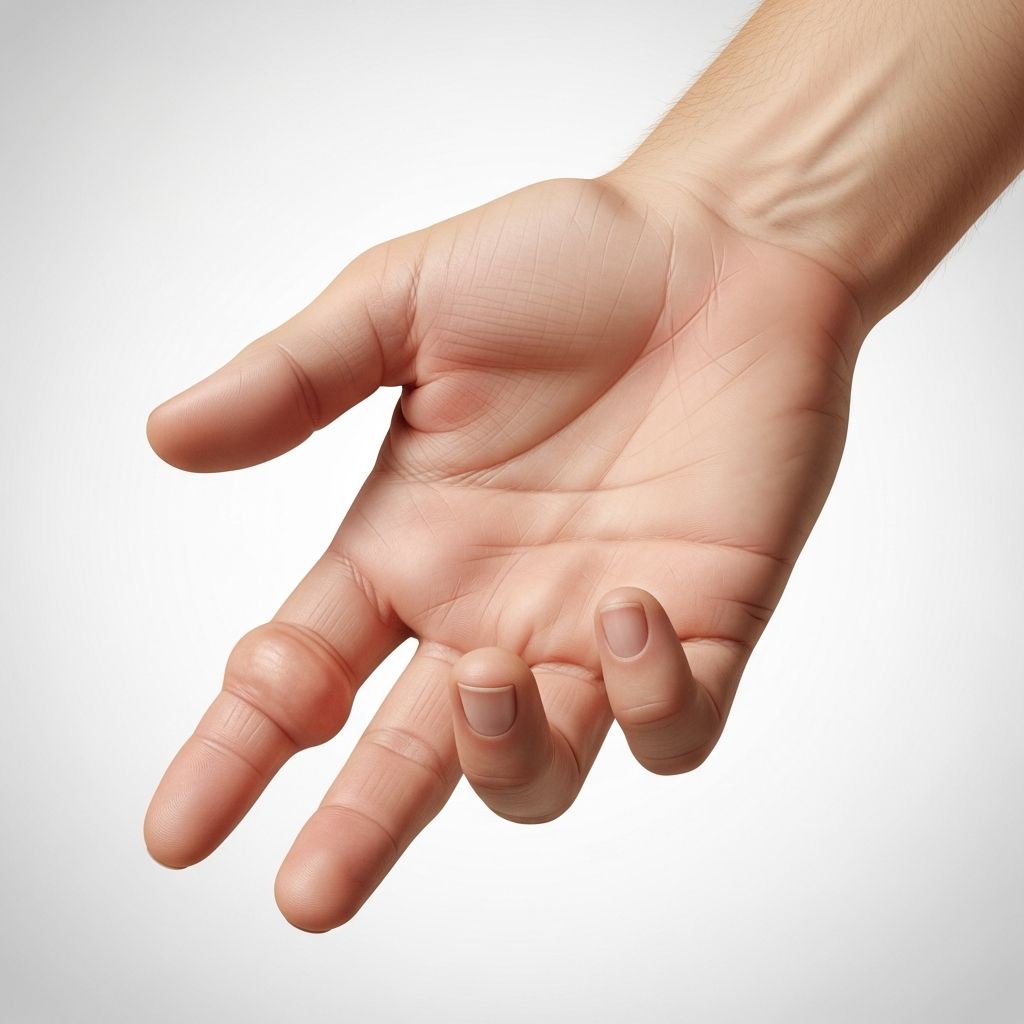
Dupuytren contracture is a progressive hand condition characterized by the thickening and tightening of fibrous tissue beneath the skin of the palm and fingers. The condition causes one or more fingers to gradually bend toward the palm, making it difficult to fully extend or straighten the affected fingers. This progressive disorder primarily affects the ring finger and little finger, though the middle finger may occasionally be involved. The thumb and index finger are rarely affected.
While there is no cure for Dupuytren contracture, various treatment options can help ease symptoms and slow disease progression. The condition develops slowly over months or years, and early intervention may help prevent severe contractures.
What Causes Dupuytren Contracture?
Dupuytren contracture is caused by excessive production of collagen that becomes deposited under the skin. The underlying mechanism involves the thickening and tightening of the palmar fascia—the fibrous tissue layer beneath the skin of the palm.
The exact etiology of Dupuytren contracture remains unknown. However, research has identified that genetic factors play a significant role in disease development. This is classified as a genetic hand disorder, meaning it tends to run in families.
Risk Factors for Dupuytren Contracture
Several risk factors may increase your likelihood of developing Dupuytren contracture, including:
- Family history or genetic predisposition to the condition
- Age (typically develops in middle-aged and older adults)
- Male gender (more common in men)
- Northern European descent
- Certain lifestyle and environmental factors
Symptoms of Dupuytren Contracture
Dupuytren contracture typically progresses slowly over many years and is usually not painful. However, some cases may progress rapidly and present with pain.
The most commonly observed symptoms include:
- Lumps or nodules in the palm of the hand, often beginning as small, sensitive bumps
- Tough fibrous bands or cords that develop under the skin
- Difficulty straightening the fingers, particularly the ring and little fingers
- Progressive finger contracture causing the digits to bend toward the palm
- Reduced hand function affecting everyday activities such as shaking hands or putting on gloves
Early recognition of these symptoms is important for timely intervention and optimal treatment outcomes.
Diagnosis of Dupuytren Contracture
Diagnosis of Dupuytren contracture is primarily clinical, based on physical examination and medical history. Your healthcare provider will assess the presence of nodules, cords, and finger contractures by palpating the palm and observing hand function.
In some cases, your provider may suggest blood tests or imaging studies such as X-rays if they suspect another condition causing similar symptoms. These diagnostic methods help rule out other hand pathologies and confirm the diagnosis of Dupuytren contracture.
Conservative Treatment Options
For mild to moderate cases of Dupuytren contracture, conservative management approaches can help slow disease progression and ease symptoms. These non-surgical options are typically recommended as initial treatment before considering more invasive interventions.
Related Stories



Physical Therapy and Exercise
Hand therapy with specialized physical therapists can help slow the progression of the condition and ease symptoms. Therapeutic interventions include:
- Specific stretching exercises to improve range of motion
- Finger extension exercises to maintain flexibility
- Range of motion activities to increase hand function
- Stretching exercises such as bending the fingers away from the palm
Physical therapy is most effective when started early in the disease course.
Heat and Massage
Applying heat to the palms prior to massage or exercise can help loosen the tissues. Gentle massage of the thickened palm tissues may provide additional benefit and improve tissue flexibility.
Steroid Injections
In the early stages of Dupuytren contracture, your doctor may administer steroid injections directly into the nodules. These injections can:
- Soften or flatten painful nodules
- Ease localized pain and inflammation
- In some cases, stop the condition from progressing further
Repeated injections may be necessary, and multiple treatments over time are often required.
Advanced Non-Surgical Interventions
Several minimally invasive procedures offer alternatives to traditional surgery for patients with more advanced disease.
Collagenase Injection (Xiaflex)
Collagenase injection is an enzymatic drug that breaks down collagen in the contracted tissue. The treatment process involves:
- Injection of the enzymatic drug into the corded tissue
- Manual manipulation of the area after local anesthetic administration to break up the tissue
- Follow-up appointment a few days after injection for assessment
- Potential coverage by insurance with prior approval
This approach can loosen and weaken the contracture, improving hand function and range of motion.
Needle Aponeurotomy
Needle aponeurotomy is a percutaneous procedure involving the insertion of a small needle into the thickened palm tissue. The procedure includes:
- Manipulation of the needle to loosen and break up contracting tissue
- Use of ultrasound guidance to avoid damaging nerves or tendons
- Performance as an in-office procedure under local anesthesia
- Greater utilization in Europe compared to the United States
Radiation Therapy
Low-energy X-ray radiation can be directed at nodules in the early stage of disease. This treatment works best for early-stage Dupuytren contracture and can:
- Soften nodules
- Help prevent contractures from developing
- Be less commonly used in the United States compared to other treatments
Surgical Treatment Options
If conservative treatment fails to resolve symptoms, contractures persist for six months or longer, and quality of life is adversely affected, surgical intervention may be recommended.
Surgical Procedure Overview
Surgery is typically the most common treatment for advanced cases of Dupuytren contracture. The procedure involves:
- Performance in an operating room under local, regional, or general anesthesia
- Outpatient basis with day surgery protocols
- Small incision made to the affected palm area
- Removal of the thickened fibrous tissue causing contracture
- Closure of the incision with sutures and sterile dressing
- In some cases, portions of the wound may be left open to heal by secondary intention
- Occasionally, a local skin graft may be used for larger skin deficits in severe cases
Surgical Outcomes
Surgery is usually successful in improving hand function and reducing or eliminating finger contractures. However, it is important to note that recurrence is common, and some patients may require additional surgery. The likelihood of recurrence and irreversible joint contracture increases if deformity has been present for an extended period.
Disease Progression and Prognosis
Dupuytren contracture is characterized by slow progression over months and years. The disease gradually worsens with time as knots of tissue form under the skin and eventually create thick cords that pull fingers into a bent position.
Interestingly, research indicates that the disease will regress without treatment in approximately 10 percent of cases. This highlights the variable nature of disease progression among different individuals.
As the condition worsens, patients may find it increasingly difficult to perform everyday activities such as:
- Placing hands in pockets
- Putting on gloves
- Shaking hands with others
- Gripping or holding objects
Treatment Timeline and Expectations
The progression of Dupuytren contracture is highly variable among individuals. It may take months or even years to progress from mild symptoms requiring only observation to more severe contractures necessitating advanced intervention.
When multiple injections are needed—such as with collagenase therapy—an average of 3.2 injections per nodule may be required for noticeable improvement in symptoms and hand function. The timing between treatments and the overall treatment course should be discussed with your healthcare provider.
Complications and Considerations
Several complications may arise from Dupuytren contracture or its treatment:
- Injection-related complications: Tenderness, transient depigmentation, atrophy at injection sites, and rupture of the flexor tendon (more likely after repeated injections)
- Proximal interphalangeal (PIP) joint contractures: These are more likely to cause stiffness and respond less favorably to surgical intervention when severe
- Irreversible deformity: The longer a contracture remains untreated, the greater the risk of permanent joint changes
When to Seek Treatment
Early recognition and intervention are crucial for optimal outcomes. You should seek evaluation from a hand specialist if you experience:
- Persistent lumps or nodules in your palm
- Difficulty straightening one or more fingers
- Progressive finger contracture affecting hand function
- Pain in the affected hand or palm
- Difficulty performing daily activities due to hand limitation
Frequently Asked Questions
Q: Is Dupuytren contracture hereditary?
A: Yes, Dupuytren contracture is a genetic condition that tends to run in families. Having a family history of the condition increases your risk of developing it.
Q: Can Dupuytren contracture be prevented?
A: There is no known way to prevent Dupuytren contracture since the exact cause remains unknown. However, early detection and treatment may help slow progression and prevent severe contractures.
Q: Is Dupuytren contracture painful?
A: Dupuytren contracture is usually not painful and progresses slowly. However, some cases may present with pain, particularly in the early stages with nodule formation.
Q: How long does recovery take after surgical treatment?
A: Surgery is typically performed as an outpatient procedure, but recovery time varies depending on the extent of the procedure and individual healing capacity. Your surgeon will provide specific postoperative instructions and recovery timeline.
Q: Will my Dupuytren contracture come back after surgery?
A: Recurrence is common after surgical treatment. Some patients may require additional surgery if the condition returns or progresses in the same or other fingers.
Q: What is the best initial treatment for Dupuytren contracture?
A: For mild cases, observation combined with conservative measures such as physical therapy, heat, and gentle massage is recommended. For more advanced or rapidly progressing cases, injections or surgical intervention may be necessary.
References
- Dupuytren’s Contracture Treatment — David R. Miller, MD. 2024. https://www.davidrmillermd.com/dupuytren-s-contracture-hand-wrist-upper-extremity-surgeon-reston-centreville-va.html
- Dupuytren’s Contracture Treatment Irvine CA — Southern California Orthopedic Specialists. 2024. https://www.scosortho.com/dupuytren-s-contracture-orthopedic-specialists-orange-county-irvine-huntington-beach-ca/
- Dupuytren’s Contracture Explained: Symptoms, Causes and Treatment — The Center, YouTube. 2024. https://www.youtube.com/watch?v=_80TUZ1n3rA
- Dupuytren’s Contracture — Ohio State Wexner Medical Center. 2024. https://wexnermedical.osu.edu/orthopedics/hand-and-upper-extremity/dupuytren
- Dupuytren Contracture — Northwestern Medicine. 2024. https://www.nm.org/conditions-and-care-areas/cancer-care/dupuytren-contracture
- Dupuytren Contracture: Risk Factors, Symptoms & Treatment — Cleveland Clinic. 2024. https://my.clevelandclinic.org/health/diseases/16941-dupuytrens-contracture
- Dupuytren Contracture — Symptoms and Causes — Mayo Clinic. 2024. https://www.mayoclinic.org/diseases-conditions/dupuytrens-contracture/symptoms-causes/syc-20371943
- Dupuytren’s Disease: Diagnosis and Treatment — American Academy of Family Physicians. 2007-07-01. https://www.aafp.org/pubs/afp/issues/2007/0701/p86.html
Similar Articles








Read full bio of Sneha Tete