HIIT For Older Adults: 3 Easy Home Exercises For 2025
Master high-intensity interval training safely at home with age-appropriate exercises designed for seniors.
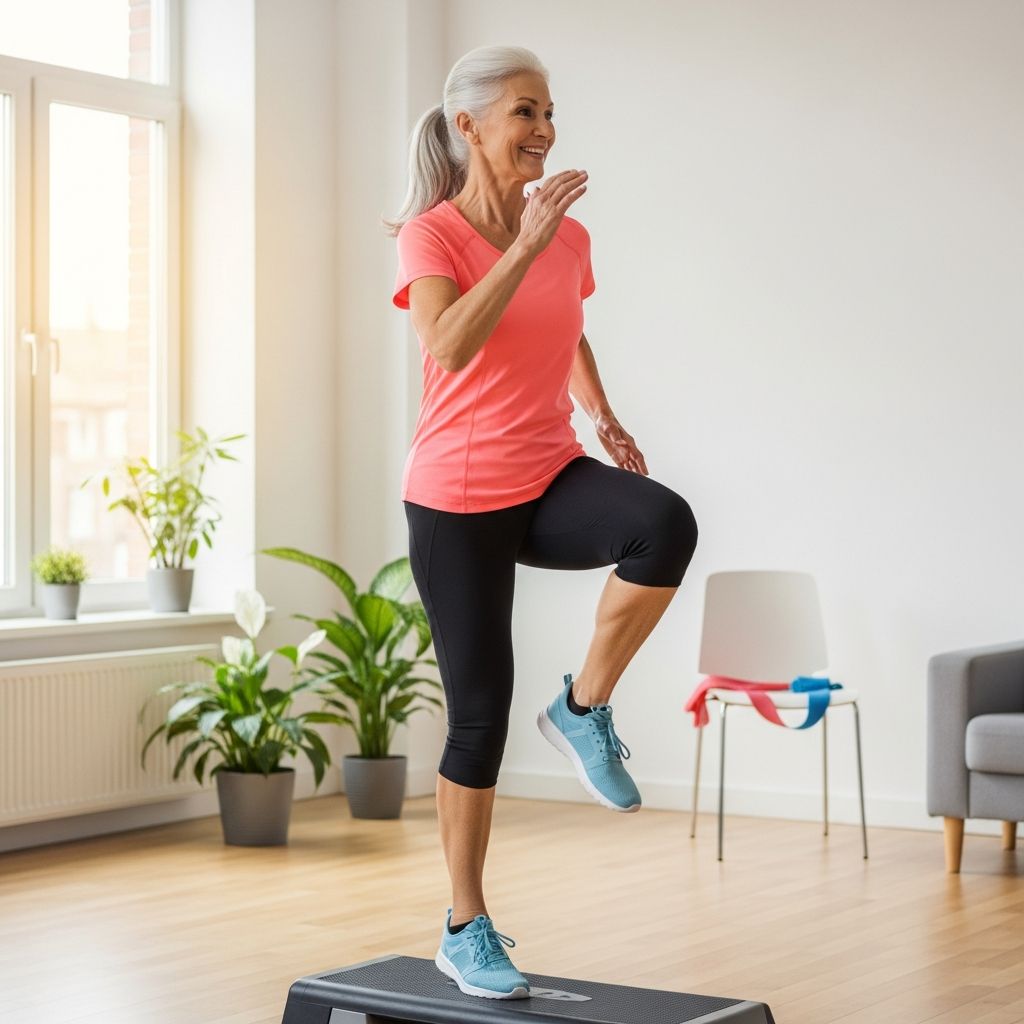
An Easy HIIT Home Workout for Older Adults
High-intensity interval training, commonly known as HIIT, has gained significant popularity in recent years as an efficient and effective form of exercise. However, many older adults believe that HIIT is exclusively designed for younger, more athletic individuals. This misconception often prevents seniors from experiencing the remarkable benefits that this customizable workout approach can offer. The truth is that HIIT can be adapted and modified to suit the fitness levels and physical abilities of older adults, making it an accessible and powerful tool for improving overall health and maintaining functional fitness.
Harvard Medical School has released comprehensive guidance on implementing HIIT workouts specifically for seniors. This evidence-based approach demonstrates that older adults can enjoy the benefits of high-intensity interval training, regardless of their current fitness level or previous exercise history. The key to success lies in understanding how to properly structure these workouts, maintain excellent form throughout each exercise, and gradually progress the intensity as your body adapts and becomes stronger.
Understanding HIIT: The Basics
High-intensity interval training is a workout method that alternates between periods of intense physical activity and periods of recovery. During the intense phases, you push your body to work at a significantly higher level of exertion, while during recovery phases, you reduce your intensity to allow your heart rate to decrease and your body to recuperate. This alternating pattern creates multiple physiological benefits that extend far beyond what traditional steady-state cardio can provide.
For older adults, the beauty of HIIT lies in its flexibility and adaptability. You don’t need expensive equipment, a gym membership, or special facilities. A simple home workout space is all that’s required to experience the cardiovascular and strength-building benefits of this efficient exercise method. The workout can be customized to your current fitness level, and intensity can be adjusted at any time based on how you’re feeling on any given day.
How to Structure Your HIIT Workout
The fundamental structure of a HIIT workout involves alternating between exercise intervals and recovery intervals. For older adults beginning their HIIT journey, a practical approach involves performing each exercise for 30 to 60 seconds at a challenging but manageable intensity level. Following each exercise interval, you should march in place for 30 to 60 seconds to allow your heart rate to recover and your breathing to normalize.
The beauty of this structure is its flexibility. If you’re not yet ready to transition to the next exercise after your recovery period, you can simply continue marching in place for a longer duration. There’s no pressure to rush or push beyond your current capabilities. As you progress and your fitness improves, you can gradually work up to completing a full 30-minute workout session.
When you’re first starting out, it’s absolutely acceptable to complete only as much as you can manage while maintaining proper form. Quality of movement is far more important than quantity or intensity. A shorter workout performed with excellent form will provide more benefit and be safer than a longer session where your form breaks down.
Related Stories



Essential Safety Considerations
Before beginning any new exercise program, especially one involving higher intensity elements, it’s important to prioritize safety. Several key principles should guide your HIIT practice:
- Begin with a thorough warm-up: Always start your workout with a comprehensive warm-up to prepare your muscles, joints, and cardiovascular system for the exercise ahead. This might include 5-10 minutes of light movement such as walking, gentle arm circles, and dynamic stretching.
- Prioritize proper form: Maintaining correct form throughout each exercise is absolutely essential for avoiding strain and injury. If you’re unsure about proper technique, consider working with a qualified trainer or physical therapist who can observe your movements and provide corrective feedback.
- Progress gradually: Don’t attempt to jump into high-intensity exercises too quickly. Start with lower-intensity intervals and gradually increase the intensity as your fitness level improves and your body adapts to the training stimulus.
- Listen to your body: Pay attention to how your body feels during and after workouts. Mild muscle soreness is normal, but sharp pain or extreme fatigue may indicate you’re pushing too hard.
Key Exercises for Older Adults
Moving Squat with Arm Sweep
The moving squat with arm sweep is an excellent exercise that combines lower body strength training with upper body mobility. This exercise engages multiple muscle groups simultaneously, making it highly efficient.
Proper Execution:
- Begin by standing with your feet together and your arms at your sides
- Keep your shoulders back and down throughout the movement, and tighten your abdominal muscles
- Step out to the right, bending at your knees and hips as you lower your body into a squat position
- Simultaneously sweep your arms out to the sides and up overhead in a smooth, controlled motion
- Ensure your knees don’t extend further forward than your toes as you squat, and avoid allowing your shoulders to rise toward your ears
- Straighten your legs, bringing your left foot back toward your right, and lower your arms to return to the starting position, now positioned to the right of where you began
- Repeat this stepping and squatting pattern to the right 2-3 more times, depending on available space
- Then reverse the direction and perform the same movements stepping to the left
- Continue this sequence for 30-60 seconds
Modifications: If this exercise feels too challenging, you can take smaller steps to the side, reduce the depth of your squat, or keep your hands on your hips for balance and stability. To increase the difficulty, you can squat deeper (while never going below knee height) or increase your movement speed while maintaining excellent form.
Side Kick
The side kick is a dynamic movement that strengthens your hip abductors, improves balance, and enhances lower body endurance. This exercise also helps improve functional movement patterns relevant to daily activities.
Proper Execution:
- Stand upright with your feet positioned approximately hip-width apart
- Keep your upper body relaxed and your core engaged
- Bend your arms so your hands are positioned in front of your chest as if in a boxing stance, with loose fists
- Step forward with your left foot, placing it in front of your right foot
- Lean your upper body slightly to the left, raise your right knee out to the side, and extend your leg
- Perform the kick with your foot flexed and your knee and toes pointing forward
- Power the movement from your gluteal muscles rather than using momentum
- Bend your right knee, lower your leg, and step back to your starting position
- Perform this movement for approximately half of your 30-60 second interval, then switch sides
- Kick with your left leg for the remainder of the interval using a tempo of 1-1-1-1
Modifications: To make this exercise more accessible, you can perform lower kicks or hold onto the back of a sturdy chair for balance support. To increase the challenge, kick higher and add a punch with the same-side arm as you perform the kick.
Plank Stand
The plank stand is a foundational core-strengthening exercise that builds endurance and stability. For older adults, modified versions of the plank provide excellent benefits without excessive strain.
Proper Execution:
- Stand with your feet together and your arms at your sides, tightening your abdominal muscles
- Hinge forward from your hips while bending your knees as needed to place your hands on the floor
- Bend your knees as much as necessary to comfortably reach the floor with your hands
- Walk your hands out in front of your body until you reach a plank position
- Ensure your body forms a straight line from your head to your heels, with your hands positioned directly beneath your shoulders
- Hold this position for a moment, maintaining steady breathing
- Walk your hands back toward your feet and gradually roll up to your starting position
- Repeat this sequence for the duration of your 30-60 second interval using a tempo of 1-4-1-4-1
Modifications: The easiest variation involves starting on all fours, then walking your hands out to a plank position from there. You can also keep your knees on the floor as you extend your hands outward. As you build strength and confidence, gradually raise your knees off the floor to increase the challenge.
Building Your Complete Workout Routine
A well-rounded HIIT workout should incorporate variety to challenge different muscle groups and maintain engagement. By rotating through different exercises and including both lower body and upper body movements, you’ll develop balanced fitness improvements. The combination of squats, kicks, and planks provides comprehensive strength development while keeping the workout interesting and sustainable long-term.
Start with just 15-20 minutes of total workout time if you’re new to HIIT. As your fitness improves over several weeks of consistent training, gradually extend your sessions to 30 minutes. This progressive approach allows your body to adapt safely and helps prevent overuse injuries.
Progression and Long-Term Success
One of the most important principles for long-term success with HIIT training is understanding how to progress appropriately. Progression doesn’t always mean moving faster or performing more intense movements. You can progress by increasing the duration of your work intervals, decreasing your recovery time slightly, adding more repetitions of each exercise, or performing deeper ranges of motion with proper form.
Track your workouts to monitor your progress. Note how many rounds you complete, how you feel during each session, and any improvements in strength or endurance. This documentation provides motivation and helps you identify when you’re ready to increase intensity or duration.
Frequently Asked Questions
Q: Is HIIT safe for people with existing health conditions?
A: HIIT can be adapted for most people, but you should consult with your healthcare provider before starting, especially if you have heart disease, high blood pressure, diabetes, or other chronic conditions. Your doctor can provide personalized guidance and clearance.
Q: How often should older adults perform HIIT workouts?
A: Most adults benefit from 2-3 HIIT sessions per week, with at least one rest day between sessions to allow adequate recovery. This frequency allows your body to adapt while preventing overtraining.
Q: What if I can’t complete the full workout?
A: That’s perfectly normal and acceptable. Complete as much as you can while maintaining good form, then stop. Your fitness will improve progressively, and you’ll gradually build the endurance needed for longer sessions.
Q: Do I need any equipment for these workouts?
A: No special equipment is required. These workouts use only your body weight. However, a sturdy chair can be helpful for balance support during certain exercises if needed.
Q: How quickly will I see results?
A: Most people notice improvements in energy levels and functional fitness within 2-3 weeks of consistent training. Strength gains and more noticeable changes typically become apparent after 4-6 weeks of regular workouts.
Conclusion
High-intensity interval training offers significant benefits for older adults seeking to improve their fitness, maintain strength, and enhance overall health. The key to success lies in starting conservatively, prioritizing proper form, and progressing gradually as your body adapts. With the simple, home-based exercises outlined in this guide, combined with proper warm-up and recovery strategies, you can build a sustainable and effective HIIT routine tailored to your abilities and goals. Remember that consistency matters more than intensity—regular, moderate workouts performed with excellent form will yield better long-term results than sporadic intense efforts that compromise your technique or lead to injury.
References
- An Easy HIIT Home Workout for Older Adults — Harvard Health Publishing. Accessed 2025. https://www.health.harvard.edu/exercise-and-fitness/an-easy-hiit-home-workout-for-older-adults
- Physical Activity Guidelines for Americans — U.S. Department of Health and Human Services. 2018. https://health.gov/sites/default/files/2019-09/Physical_Activity_Guidelines_2nd_edition.pdf
- Age-Related Changes in Motor Control and Learning — National Institute on Aging (NIA). Accessed 2025. https://www.nia.nih.gov/health/exercise-physical-activity
- High-Intensity Interval Training and Cardiovascular Health — American Heart Association. Accessed 2025. https://www.heart.org/en/healthy-living/fitness
- Balance, Gait, and Falls in Older Adults — Centers for Disease Control and Prevention (CDC). 2023. https://www.cdc.gov/steadi/index.html
Similar Articles








Read full bio of Sneha Tete