Eccrine Papillary Adenoma Pathology: Diagnosis And Management
Comprehensive pathology guide to eccrine papillary adenoma: clinical features, histopathology, diagnosis, and management of this rare benign sweat gland tumour.
Author: Dr. Harriet Cheng, Dermatopathologist / Reviewed: Dr. Amanda Oakley, Dermatologist
Eccrine papillary adenomas are rare benign tumours derived from the eccrine sweat glands. These neoplasms typically manifest as solitary dermal nodules, most commonly on the extremities, and require careful histopathological evaluation to distinguish from malignant adnexal tumours.
Introduction
Eccrine papillary adenoma (PEA), also known as papillary eccrine adenoma, represents a benign neoplasm exhibiting eccrine differentiation. First described by Rulon and Helwig in 1977, this tumour is characterised by dilated ductal structures with prominent intraluminal papillary projections. Clinically, it presents as a firm, well-circumscribed dermal nodule, often on the hands, feet, or other extremities, though cases have been reported on the trunk and face. The lesion is typically asymptomatic, slow-growing, and measures 0.5–2 cm in diameter, with colours ranging from skin-toned to red, brown, or grey. While rare across all demographics, it shows a predilection for middle-aged individuals, particularly African American females. Due to its potential to mimic aggressive adnexal carcinomas histologically, accurate diagnosis is essential to avoid overtreatment.
Terminology
- Eccrine papillary adenoma
- Papillary eccrine adenoma
- Tubulopapillary hidradenoma (eccrine type)
Historically, some cases with apocrine features were classified under this entity, but modern consensus distinguishes pure eccrine papillary adenomas from tubular apocrine adenomas based on enzymatic, ultrastructural, and immunohistochemical differences.
Clinical features
PEA manifests as a solitary, dome-shaped, firm nodule within the dermis, rarely exceeding 2 cm. Common sites include the dorsum of hands and feet, with less frequent occurrences on the trunk, scalp, or face. The overlying epidermis is usually unremarkable, and the lesion may persist for months to years before presentation. Although benign, local recurrence is reported in up to 50% of cases following incomplete excision, underscoring the need for complete surgical removal. No systemic associations or malignant potential have been documented.
| Feature | Description |
|---|---|
| Age | Most common in adults (20–60 years); rare in children |
| Sex | Slight female predominance; higher in African American females |
| Site | Extremities (hands/feet) > trunk > face/scalp |
| Size | 0.5–2 cm |
| Appearance | Firm dermal nodule; skin-coloured to erythematous |
Pathology
Microscopic description
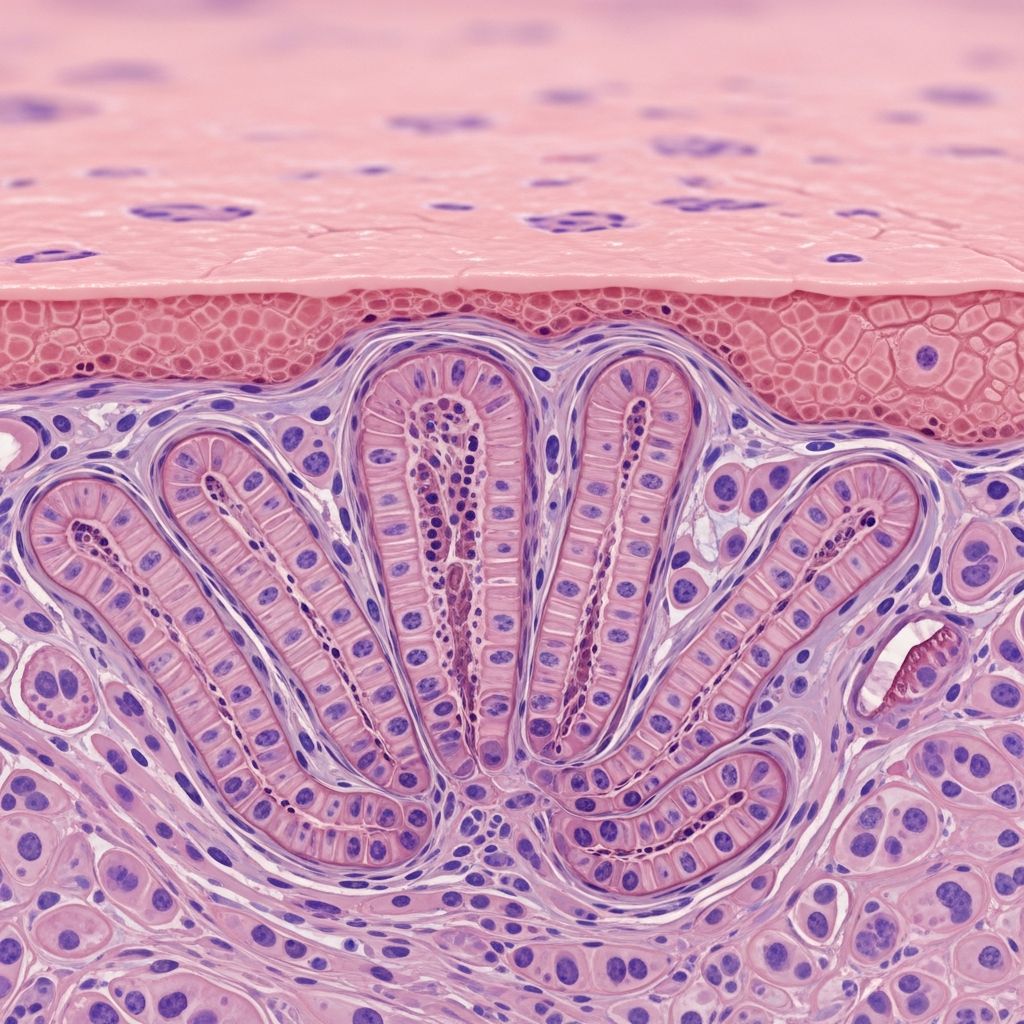
Low-power examination reveals a well-circumscribed, symmetrical dermal tumour embedded in a sclerotic fibrous stroma, with rare connections to the overlying epidermis. The neoplasm comprises variably sized dilated ducts and tubulo-papillary structures lined by two or more layers of bland cuboidal epithelial cells. Prominent intraluminal papillae project into the ductal lumina, supported by fibrovascular cores. The lumina often contain eosinophilic amorphous material, and some epithelial cells exhibit eosinophilic cytoplasm with minimal mitotic activity. No cytological atypia, necrosis, or infiltrative growth is observed.
Special stains and immunohistochemistry
- S-100: Positive in luminal cells, supporting eccrine differentiation (not always uniform)
- CEA (carcinoembryonic antigen): Highlights ductal lumina
- EMA (epithelial membrane antigen): Positive in epithelial lining
- Alpha-SMA: Stains myoepithelial outer layer
- Keratin 8/14: Confirms eccrine origin
- Amylophosphorylase: Positive (eccrine marker); acid phosphatase negative (distinguishes from apocrine)
These markers confirm sweat gland secretory epithelium differentiation and aid in distinguishing PEA from mimics.
Differential diagnosis
PEA’s papillary architecture can resemble several adnexal neoplasms, necessitating careful histological scrutiny.
| Entity | Key Distinguishing Features |
|---|---|
| Aggressive digital papillary adenocarcinoma | Infiltrative; atypia, mitoses, necrosis; digits of elderly; local invasion |
| Eccrine carcinoma | Infiltrative growth, atypia, vascular/perineural invasion |
| Syringocystadenoma papilliferum | Epidermal connection, plasma cell-rich stroma, thicker papillae |
| Hidradenoma papilliferum | Apocrine (labia majora, females); decapitation secretion |
| Tubular apocrine adenoma | Scalp; shorter papillae, decapitation secretion |
| Metastatic adenocarcinoma | Marked atypia, desmoplasia |
PEA is distinguished by its symmetry, perpendicular orientation to epidermis, lack of atypia, and well-defined stroma. Mohs surgery may be useful for precise excision in challenging locations.
Management
Complete surgical excision with 2–4 mm margins is the treatment of choice to prevent recurrence. Mohs micrographic surgery is ideal for digits or recurrent lesions to preserve function. No adjuvant therapy is required given its benign nature. Follow-up monitors for local recurrence, particularly in incompletely excised cases.
Frequently asked questions
Q: What is eccrine papillary adenoma?
A: A rare benign tumour of eccrine sweat glands presenting as a dermal nodule with papillary ductal structures on histopathology.
Related Stories



Q: Is eccrine papillary adenoma malignant?
A: No, it is entirely benign with no metastatic potential, though recurrence occurs if not fully excised.
Q: How is it diagnosed?
A: By histopathological examination showing dilated papillary ducts; immunohistochemistry (S-100, CEA, EMA) supports eccrine differentiation.
Q: What are common sites?
A: Primarily extremities (hands, feet); less often trunk or face.
Q: What is the treatment?
A: Surgical excision; Mohs for high-risk areas.
Prognosis
Excellent following complete excision; local recurrence risk is low with clear margins. No reports of malignant transformation exist.
References
- Papillary eccrine adenoma — Indian Journal of Dermatology, Venereology and Leprology. 2009. https://ijdvl.com/papillary-eccrine-adenoma/
- Papillary Eccrine Adenoma — Perri Dermatology. 2011-04-14. https://perridermatology.com/dr-perris-blog/eccrine-neoplasms-papillary-eccrine-adenoma/
- A Recurrent Case of Papillary Eccrine Adenoma — PMC / National Library of Medicine. 2024. https://pmc.ncbi.nlm.nih.gov/articles/PMC11346817/
- Papillary Eccrine Adenoma — Basic Medical Key. N/A. https://basicmedicalkey.com/papillary-eccrine-adenoma/
- Papillary Eccrine Adenoma: A Recent Review of Literature — American Journal of Medical and Clinical Research. 2017. https://pubs.sciepub.com/ajmcr/4/9/3/index.html
- Eccrine papillary adenoma pathology — DermNet NZ. 2023. https://dermnetnz.org/topics/eccrine-papillary-adenoma-pathology
Similar Articles








Read full bio of medha deb