Eccrine Porocarcinoma: Diagnosis, Treatment, Prognosis Guide
Rare malignant sweat gland tumour with potential for local recurrence and metastasis requiring early diagnosis and wide excision.
Author: Reviewed by specialists in dermatology. Topic: Cutaneous adnexal tumours — Sweat gland tumours. Synonyms: Malignant eccrine poroma, eccrine poroepithelioma, malignant acrospiroma, poroepithelioma, epithelial-myoepithelial carcinoma of the skin.
What is eccrine porocarcinoma?
Eccrine porocarcinoma is a rare malignant skin tumour originating from the intraepidermal portion of eccrine sweat glands. It represents less than 0.01% of all cutaneous malignancies and about 10% of sweat gland carcinomas. Despite its rarity, it can be aggressive, with potential for local recurrence in 20% of cases and metastasis in up to 31% of patients, primarily to regional lymph nodes (58.5% of metastases), lungs (12.8%), and other sites. The tumour often arises from a pre-existing benign eccrine poroma in 25–50% of cases, evolving slowly over years before malignant transformation.
Histogenetically, it derives from poral cells lining the intradermal eccrine duct. Genetic alterations, such as YAP1 fusions, have been identified in recent years, aiding in precise diagnosis and potential targeted therapies. Early detection is crucial as prognosis is favourable in localized disease (5-year survival ~96% for stages I-II) but poor in metastatic cases (mortality 60–70%, 5-year survival ~75% overall but drops significantly with nodal involvement).
Who gets eccrine porocarcinoma?
Eccrine porocarcinoma affects individuals across all ages but predominantly older adults, with average onset between 60–80 years (range: 13–100 years). There is no strong gender predilection, though some series report slight female predominance. Risk factors remain poorly defined due to rarity, but associations include:
- Pre-existing eccrine poroma (25–50% of cases).
- Chronic sun exposure or immunosuppression (anecdotal).
- Possible genetic mutations like YAP1-MAMLD1 fusions.
It can occur anywhere on the body but favours lower extremities (35–50%), head and neck (20–30%), trunk (15–20%), and upper extremities (10–15%). No racial predilection is established.
What causes eccrine porocarcinoma?
The exact aetiology is unknown. Malignant transformation from benign eccrine poroma is common, with tumours enlarging or ulcerating after years of indolence. Recent genomic studies reveal recurrent fusions involving YAP1 gene (e.g., YAP1-MAMLD1, YAP1-SS18), driving oncogenesis via Hippo pathway dysregulation. Other mutations in TP53, PIK3CA, and KIT have been noted. Ultraviolet radiation may contribute in sun-exposed sites, but evidence is limited. No viral or hereditary syndromes are definitively linked.
What are the clinical features of eccrine porocarcinoma?
Tumours are typically slow-growing over months to years, mimicking benign lesions and delaying diagnosis. Clinical presentation includes:
- Appearance: Solitary, firm, erythematous or skin-coloured nodule, plaque, or verrucous tumour (1–12 cm, average 2–6 cm). May be ulcerated, crusted, or polypoid.
- Surface: Smooth, warty, or eroded; rarely pigmented.
- Symptoms: Often asymptomatic; pain, bleeding, or pruritus if ulcerated.
- Size and growth: Slow expansion; sudden growth signals malignancy.
- Regional nodes: Palpable lymphadenopathy in 20–30% at diagnosis indicates metastasis.
Differential diagnoses: Squamous cell carcinoma, basal cell carcinoma, amelanotic melanoma, pyogenic granuloma, verruca, or benign poroma. Dermatoscopy shows atypical vascular patterns (polymorphous vessels, irregular loops) and milky-red globular structures on light brown background, aiding early suspicion.
How is eccrine porocarcinoma diagnosed?
Diagnosis requires histopathological examination of a full-thickness biopsy. Clinical suspicion prompts punch or incisional biopsy; excision biopsy is preferred for small lesions.
Pathology
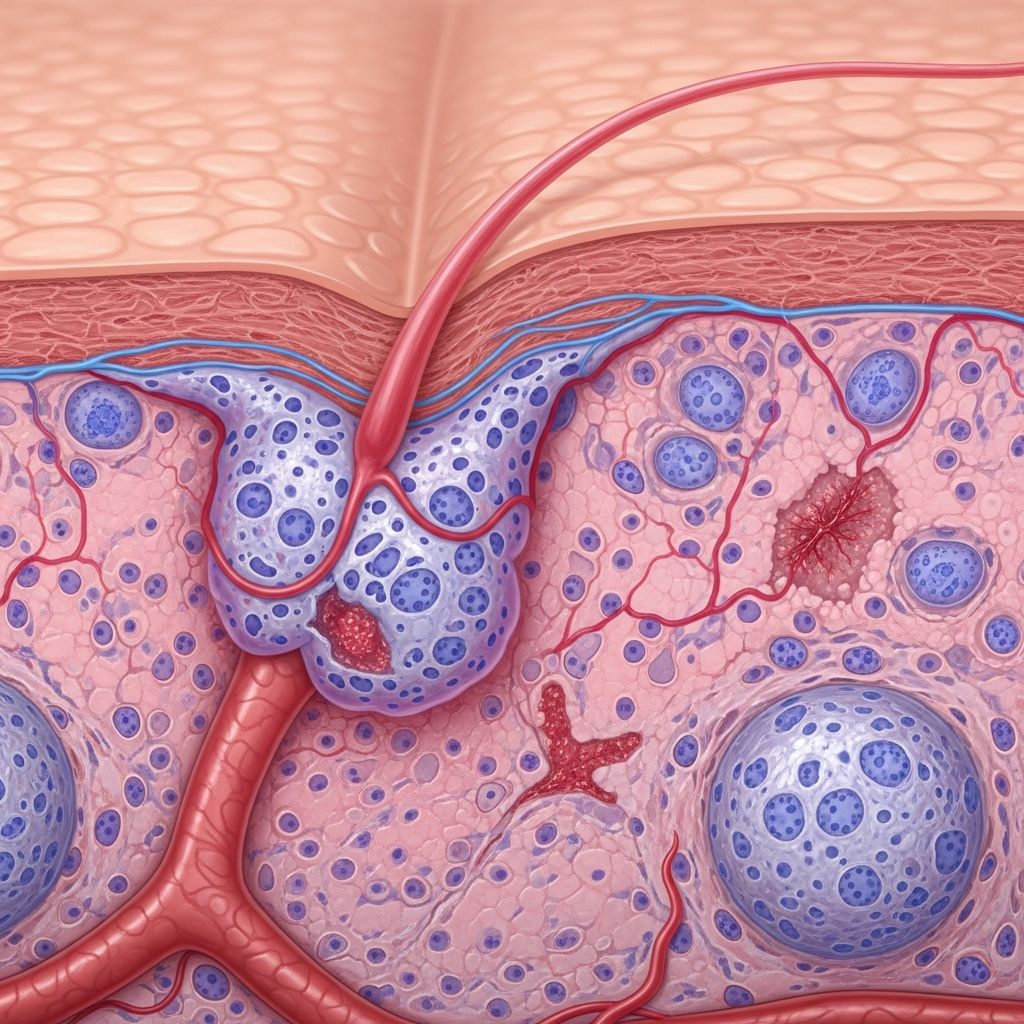
Microscopic features: Intraepidermal proliferation of atypical poroid cells (small, basophilic, cuboidal) extending into dermis. Key patterns:
- Poroid type: Uniform small cells with round nuclei, eosinophilic cytoplasm.
- Squamoid type: Larger cells with eosinophilic cytoplasm, intercellular bridges.
- Clear cell type: Cells with glycogen-rich clear cytoplasm.
Related Stories



Tumour depth >7 mm, lymphovascular invasion, high mitotic rate (>14/HPF), necrosis correlate with poor prognosis. Ductal differentiation (intra- or extracellular lumina) confirmed by positive CEA staining.
Immunohistochemistry
Panel includes:
| Marker | Staining in EPC | Utility |
|---|---|---|
| CK5/6, p63 | Positive | Squamous/basal differentiation |
| CEA, EMA | Positive (ductal) | Confirms eccrine differentiation |
| CD117 (c-KIT) | Positive | Differentiates from SCC (negative) |
| S100, SOX10 | Negative | Excludes melanoma |
| HER2 | Occasional amplification | Targeted therapy potential |
YAP1 rearrangement via FISH useful for confirmation.
Investigations
- Skin ultrasound or MRI for depth/invasion.
- Sentinel lymph node biopsy (SLNB) controversial but considered for high-risk features.
- CT/PET-CT for staging if nodes or metastases suspected.
What is the treatment for eccrine porocarcinoma?
Primary treatment: Wide local excision (WLE) with 1–2 cm margins, ensuring clear histological margins. Mohs micrographic surgery achieves high cure rates (70–80%) with tissue sparing.
- Low-risk (superficial, <7 mm depth, no LVSI): WLE sufficient.
- High-risk: Add SLNB or complete lymph node dissection (CLND) if nodal involvement.
Adjuvant therapy: No standard; radiotherapy considered for close margins, recurrence, or nodal disease to reduce local relapse.
Metastatic/advanced disease: Multimodal; chemotherapy (platinum-based, taxanes, 5-FU), radiotherapy. Emerging: Pembrolizumab (PD-1 inhibitor) shows promise; EGFR inhibitors, HER2-targeted agents in trials. Acitretin reported anecdotally.
What is the prognosis for eccrine porocarcinoma?
Variable: Excellent for localized disease (80% cure with surgery, 5-year OS 96% stages I-II). Local recurrence 20–30%; metastasis 10–31% at diagnosis (nodes 67% mortality if positive). Distant metastases worsen prognosis (OS 5–24 months). Poor prognostic factors:
- Tumour depth >7 mm.
- Lymphovascular invasion.
- High mitotic rate.
- Nodal/distant metastasis.
- Incomplete excision.
Overall 5-year OS ~75%; early intervention key.
Clinical images of eccrine porocarcinoma
(Descriptions based on typical presentations): Image 1: Erythematous nodular tumour on lower leg with ulceration. Image 2: Verrucous plaque on foot. Image 3: Histology showing intraepidermal poroid cells with ductal structures.
Frequently Asked Questions
Q: Is eccrine porocarcinoma curable?
A: Yes, in 70–80% of localized cases with wide excision. Metastatic disease has poorer outcomes requiring multimodal therapy.
Q: How fast does eccrine porocarcinoma grow?
A: Typically slow over years, but accelerated growth or ulceration signals malignancy.
Q: Can eccrine porocarcinoma spread?
A: Yes, 20–30% recur locally; 10–31% metastasize, mainly to lymph nodes.
Q: Is sentinel node biopsy necessary?
A: Controversial; recommended for high-risk features but survival benefit unclear.
Q: What does eccrine porocarcinoma look like under dermatoscopy?
A: Atypical vascular patterns and milky-red globules on brown background.
References
- Diagnosis and Management of Porocarcinoma — Tsuchiya S et al. PubMed/PMC. 2022-11-10. https://pubmed.ncbi.nlm.nih.gov/36358649/
- Diagnostic Pitfalls of Eccrine Porocarcinoma with Extensive Squamoid Differentiation — ACM Case Reports. 2023-06. https://acmcasereport.org/wp-content/uploads/2023/06/ACMCR-v6-1550.pdf
- Diagnosis and Management of Porocarcinoma — Tsuchiya S et al. PMC-NIH. 2022. https://pmc.ncbi.nlm.nih.gov/articles/PMC9659280/
- Eccrine Porocarcinoma: A Challenging Diagnostic and Therapeutic Challenge — Karger Case Reports in Oncology. 2021-05-26. https://karger.com/cro/article/14/2/700/820820/Eccrine-Porocarcinoma-A-Challenging-Diagnostic-and
- Eccrine porocarcinoma — DermNet NZ (official dermatology resource). Last updated 2023. https://dermnetnz.org/topics/eccrine-porocarcinoma
- Eccrine Porocarcinoma: A Rare Cutaneous Tumor — Dermatology Times. 2023. https://www.dermatologytimes.com/view/eccrine-porocarcinoma-a-rare-cutaneous-tumor
Similar Articles








Read full bio of medha deb