Eccrine Spiradenocarcinoma Pathology: Diagnosis & Treatment
Comprehensive pathology of eccrine spiradenocarcinoma: rare sweat gland malignancy arising from benign spiradenoma.
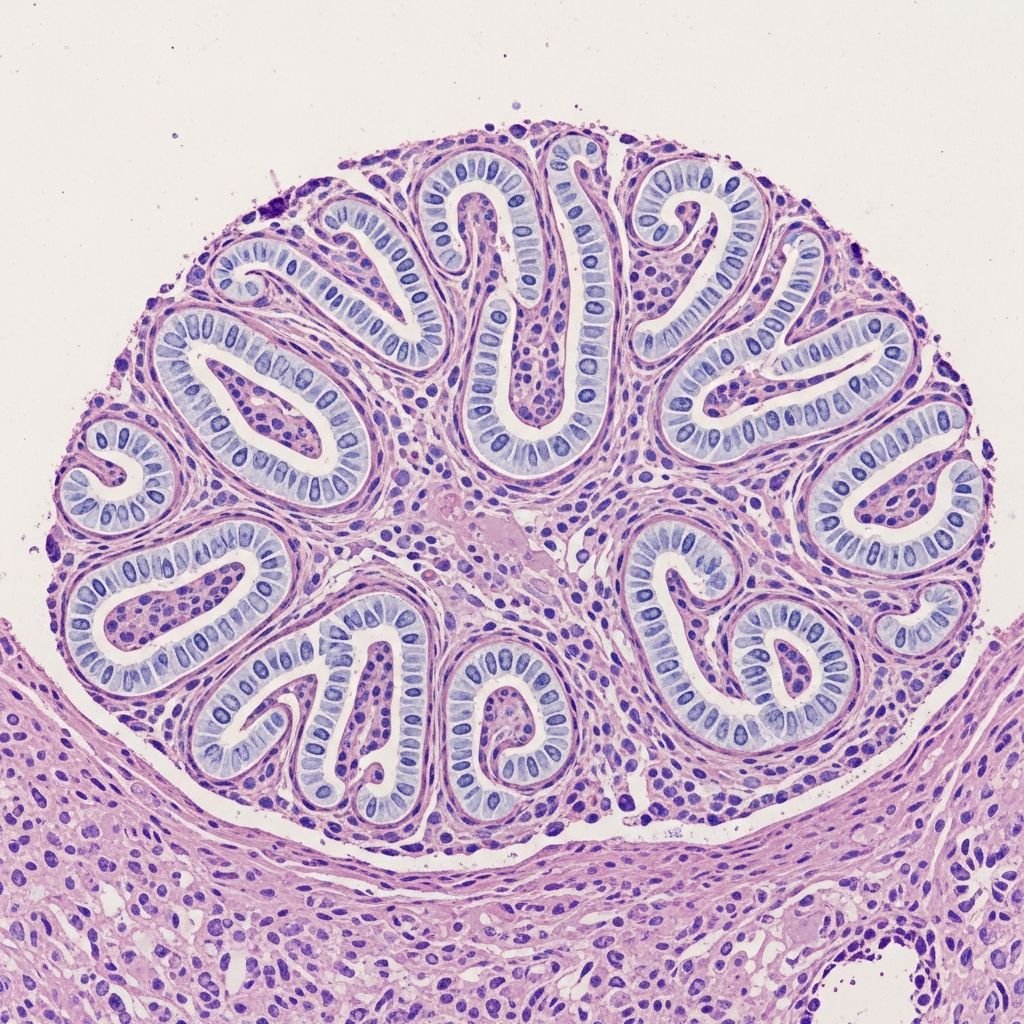
Eccrine spiradenocarcinoma is a rare malignant sweat gland tumour that typically arises within a pre-existing benign eccrine spiradenoma present for many years. This adnexal carcinoma originates from eccrine or apocrine sweat gland structures, often showing a biphasic pattern with benign and malignant components.
Clinical Features
Clinically, eccrine spiradenocarcinoma presents as a slowly growing, firm nodule or mass, frequently on the trunk, extremities, or head and neck. It often develops from a long-standing benign spiradenoma, with sudden rapid enlargement, ulceration, pain, or bleeding signaling malignant transformation. Lesions measure 1-6 cm, may appear blue-red or skin-colored, and can be tender or fixed to underlying tissue.
- Common sites: trunk (most frequent), upper extremities, head/neck.
- Age: typically middle-aged to elderly adults, though reported across ages.
- Warning signs of malignancy: rapid growth after years of stability, ulceration, satellite nodules, or metastases.
Risk factors include prior benign spiradenoma (up to 50% of cases), with malignant transformation rare but reported in ~8 cases historically. Multiple or segmental lesions raise suspicion for syndromes like Brooke-Spiegler.
Histopathology
Microscopically, eccrine spiradenocarcinoma displays a distinctive transition from benign eccrine spiradenoma to malignant areas. The benign component shows well-circumscribed dermal nodules of basophilic cells in cords and trabeculae, with small dark basaloid cells peripherally surrounding larger pale cells centrally, eosinophilic hyaline material, and lymphocytic infiltrates.
Malignant regions exhibit abrupt morphological change, with carcinomatous or sarcomatous differentiation. Carcinomatous areas feature marked nuclear pleomorphism, hyperchromasia, prominent nucleoli, high mitotic activity, and necrosis. Sarcomatous components may show spindled cells with atypia.

Figure 1: Low power view of eccrine spiradenocarcinoma showing benign spiradenoma with abrupt transition to malignant areas.
- Benign features: Biphasic cellular pattern (dark peripheral/small cells, pale central/large cells), hyaline droplets/bands, vascular stroma, lymphocytes.
- Malignant features: Pleomorphic nuclei, mitoses (>5/10 HPF), invasion, necrosis.
Overlapping histology with cylindroma (jigsaw puzzle pattern) may occur, suggesting shared folliculosebaceous-apocrine lineage.
Cytology
Cytologically, smears reveal basaloid cells in clusters with high nuclear-to-cytoplasmic ratio, coarse chromatin, and prominent nucleoli in malignant areas. Benign regions show uniform small cells with scant cytoplasm amid hyaline material. Ductal lumina positive for CEA; cells express cytokeratins, S-100, and occasionally SMA.
Histological Variants
Variants include pure carcinomatous, sarcomatous, or mixed forms. Rare presentations involve external auditory canal or segmental distribution. Association with cylindroma or trichoepithelioma in Brooke-Spiegler syndrome features multiple adnexal tumors.
Diagnosis
Diagnosis requires biopsy showing benign-to-malignant transition. Imaging (MRI/CT) assesses depth, invasion, and metastases; PET-CT for staging. Differential includes basal cell carcinoma, adnexal carcinomas (porocarcinoma, microcystic adnexal), cylindroccarcinoma, and metastasis. Immunohistochemistry aids: CK7+, p63+, S-100 variable, Ki-67 high in malignant areas.
| Differential Diagnosis | Key Distinguishing Features |
|---|---|
| Benign Spiradenoma | No atypia, mitoses, or invasion; symmetric biphasic pattern |
| Porocarcinoma | Ductal differentiation, pagetoid spread, less hyaline material |
| Cylindroccarcinoma | Jigsaw puzzle architecture, uniform basaloid islands |
| Metastatic Carcinoma | Primary elsewhere, no benign component |
Related Stories



Treatment
Wide local excision with 1-2 cm margins is standard, often with Mohs micrographic surgery for conservation. Lymph node dissection if palpable adenopathy; sentinel node biopsy considered. Adjuvant radiation for high-risk features (positive margins, large size); chemotherapy (platinum-based) or targeted therapy for metastases rare. Long-term surveillance due to recurrence risk.
Prognosis
Poor prognosis with metastases (lungs, lymph nodes, bone); 5-year survival ~30-50% for advanced cases. Early detection via monitoring longstanding spiradenomas improves outcomes. Recurrence post-incomplete excision; sarcomatous variants aggressive.
Frequently Asked Questions
What is eccrine spiradenocarcinoma?
A rare malignant transformation of benign eccrine spiradenoma, a sweat gland tumor.
How common is malignant transformation?
Extremely rare; only ~8 cases linked to head/neck spiradenoma historically.
What are symptoms of malignant change?
Rapid growth, pain, ulceration, bleeding, or nodules.
Is surgery curative?
Wide excision curative for localized disease; metastases worsen prognosis.
Who is at risk?
Patients with longstanding spiradenomas, especially multiple or syndromic.
Related Topics
References
- A Rare Adnexal Tumor of Head & Neck: Eccrine Spiradenoma — ClinMed Journals. 2020. https://clinmedjournals.org/articles/ijdrt/journal-of-dermatology-research-and-therapy-ijdrt-7-102.php?jid=ijdrt
- A Rare Case of Multiple Segmental Eccrine Spiradenomas — Journal of Clinical and Aesthetic Dermatology. 2021. https://jcadonline.com/a-rare-case-of-multiple-segmental-eccrine-spiradenomas/
- Eccrine spiradenoma pathology — DermNet NZ. 2023. https://dermnetnz.org/topics/eccrine-spiradenoma-pathology
- Eccrine spiradenocarcinoma pathology — DermNet NZ. 2023. https://dermnetnz.org/topics/eccrine-spiradenocarcinoma-pathology
- Malignant Eccrine Spiradenoma of the External Auditory Canal — PMC/NCBI. 2021-01-28. https://pmc.ncbi.nlm.nih.gov/articles/PMC7813981/
Similar Articles








Read full bio of Sneha Tete