Echocardiogram: Heart Ultrasound Test Guide
Complete guide to echocardiogram tests: understanding how ultrasound imaging diagnoses heart conditions.
What Is an Echocardiogram?
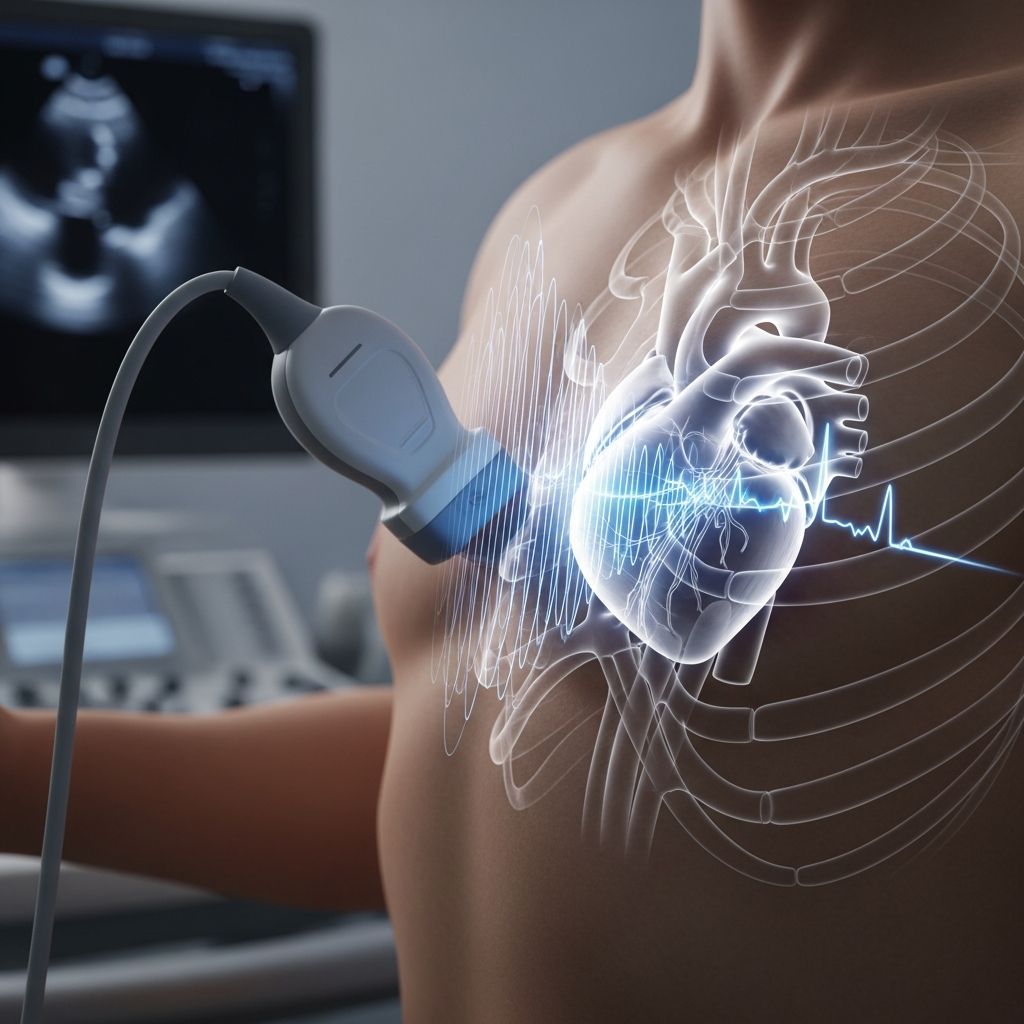
An echocardiogram, commonly referred to as an echo, is a noninvasive ultrasound imaging test that creates detailed moving pictures of your heart. This diagnostic procedure uses high-frequency sound waves to produce images of the heart’s structure and function, allowing healthcare providers to evaluate how well your heart is working and detect various cardiac conditions. Unlike many medical imaging procedures, echocardiograms do not involve radiation exposure and typically cause no side effects, making them a safe and effective diagnostic tool for patients of all ages.
The echocardiogram works by transmitting sound waves through the chest wall to the heart. These sound waves bounce off the heart’s structures and are converted into moving images displayed on a monitor in real time. This allows your healthcare provider to observe the heart’s chambers, valves, and blood flow patterns while the heart is actively beating, providing comprehensive information about cardiac function and structure.
Why Your Doctor Might Order an Echocardiogram
Echocardiograms are valuable diagnostic tools for detecting and evaluating numerous heart conditions. Your doctor may recommend this test if you have symptoms suggesting heart problems or if you need monitoring for a known cardiac condition. The test can help identify structural abnormalities, functional problems, and various disease states affecting the heart.
Common reasons for ordering an echocardiogram include:
- Evaluating symptoms such as chest pain, shortness of breath, or irregular heartbeat
- Diagnosing heart valve disease and assessing valve function
- Detecting heart failure and evaluating heart muscle strength
- Identifying blood clots or tumors within the heart
- Assessing damage following a heart attack
- Evaluating pulmonary hypertension
- Diagnosing congenital heart disease in infants and children
- Monitoring the effects of heart medications or treatments
- Assessing pericardial conditions, including inflammation or fluid accumulation
What an Echocardiogram Can Reveal
During an echocardiogram, your healthcare provider can visualize and assess multiple aspects of your cardiac anatomy and function. The test provides detailed information about your heart’s structure, how effectively it pumps blood, and whether blood flow patterns are normal. Specifically, an echocardiogram enables your doctor to see:
- The size and thickness of the heart’s chambers
- How well the heart valves are functioning
- The direction and pattern of blood flow through the heart
- Any blood clots present within the heart chambers
- Areas of damaged or weakened cardiac muscle tissue
- Problems affecting the pericardium, the fluid-filled sac surrounding the heart
- The overall pumping strength and efficiency of the heart
- Any structural abnormalities or defects
Types of Echocardiograms
Several different types of echocardiograms exist, each providing specific diagnostic information. Your healthcare provider will determine which type is most appropriate based on your symptoms and clinical needs.
Transthoracic Echocardiogram
The transthoracic echocardiogram is the most common type of echo and is performed externally through the chest wall. During this noninvasive procedure, a small handheld transducer is moved across the chest surface to create images. This type is suitable for most patients and provides excellent visualization of the heart’s structure and function.
Transesophageal Echocardiogram
A transesophageal echocardiogram (TEE) involves passing a small probe down the esophagus to the level of the heart. This positioning provides exceptionally clear images of posterior cardiac structures and is particularly useful for detecting blood clots, evaluating valve problems, assessing structural defects, and imaging the back of the heart. The procedure is performed under mild sedation to ensure patient comfort.
Related Stories



Stress Echocardiogram
During a stress echocardiogram, the heart’s function is assessed during physical exertion or with medication that simulates exercise. The sonographer performs an initial echocardiogram at rest, then the patient either exercises on a treadmill or bicycle or receives medication intravenously that increases heart rate and contractility. Another echocardiogram is performed during peak stress to evaluate how the heart responds to increased demands.
3D Echocardiogram
Three-dimensional echocardiography creates detailed volumetric images of the heart, allowing providers to assess complex cardiac structures from multiple angles. This advanced imaging technique is particularly useful for evaluating heart valve function in patients with heart failure, diagnosing heart problems in infants and children, planning cardiac surgery, and visualizing intricate cardiac anatomy.
Doppler Echocardiogram and Color Flow Imaging
Doppler echocardiography measures blood flow velocity and direction within the heart and blood vessels by analyzing changes in sound wave frequency as they reflect off moving blood cells. Color flow imaging displays blood movement in color on the monitor, making it easier to identify valve leakage and abnormal blood flow patterns. These techniques provide quantitative information about cardiac hemodynamics.
Preparing for Your Echocardiogram
Preparation for a transthoracic echocardiogram is minimal, as the procedure is noninvasive and straightforward. Most patients can eat and drink normally before the test and continue taking their regular medications unless instructed otherwise by their healthcare provider. Wear comfortable, loose-fitting clothing that can be easily removed from the chest area, as you will need to expose your chest during the examination.
If you are scheduled for a transesophageal echocardiogram, you will receive more specific pretest instructions. You will likely need to fast for several hours before the procedure and may be given a mild sedative to help you relax. Arrange for someone to drive you home, as the sedation may affect your alertness for several hours after the test.
What to Expect During the Procedure
Understanding what occurs during an echocardiogram can help reduce anxiety and allow you to prepare appropriately for the test.
Transthoracic Echocardiogram Procedure
When you arrive for your transthoracic echocardiogram, you will be asked to remove your clothing from the waist up and may wear a hospital gown for coverage. You will lie on an examination table, typically positioned on your left side or reclined on your back. The sonographer will apply a water-based lubricating gel to your chest or directly to the ultrasound probe to facilitate sound wave transmission and improve image quality. The probe will be systematically moved across your chest in various positions and angles to capture images of different cardiac structures. The gel is cool but causes no pain or discomfort. You may hear a swishing sound as the probe detects blood flowing through your heart. The entire procedure typically takes 15 to 60 minutes, and you can usually go home immediately afterward.
Transesophageal Echocardiogram Procedure
For a transesophageal echocardiogram, you will lie on a special table and receive a mild sedative through an intravenous line to help you relax. A topical anesthetic may be applied to your throat to reduce discomfort and suppress the gag reflex. Once the sedative takes effect, the sonographer will guide a small transducer on the end of a thin, flexible tube down your throat and esophagus until it reaches the level of the heart. From this position, exceptionally clear images are obtained as the transducer is moved to visualize different cardiac structures. Many patients remain asleep or have minimal awareness during this procedure. After the probe is removed, you should not eat or drink until the numbness in your throat resolves, typically within one to two hours.
Stress Echocardiogram Procedure
During a stress echocardiogram, the sonographer will first attach electrodes to your chest to monitor heart rhythm and rate. An initial resting echocardiogram is performed, and your blood pressure and pulse are recorded. You then begin exercising on a treadmill or stationary bicycle, with the intensity gradually increasing while your heart response is continuously monitored. You exercise until you reach your maximum level or develop symptoms prompting the test to stop. Immediately after exercise ceases, another echocardiogram is quickly performed while your heart rate is elevated, allowing assessment of cardiac function during stress.
Understanding Your Results
Your cardiologist will analyze the echocardiogram images and measurements to assess your heart’s structure and function. The results will be compared against normal values for your age and body size to determine if any abnormalities are present. Your healthcare provider will discuss the findings with you and explain what they mean for your health.
Normal echocardiogram results indicate that your heart chambers are appropriately sized, heart muscle contracts normally, valves open and close properly, and blood flows through the heart in the correct direction without obstruction or leakage. Abnormal results may indicate valve disease, heart failure, structural defects, blood clots, or other cardiac conditions requiring further evaluation or treatment.
Risks and Side Effects
Echocardiograms are among the safest medical diagnostic procedures available. Transthoracic echocardiograms carry virtually no risk of complications or side effects. The procedure involves no radiation exposure, no injections into the heart, and no painful sensations.
Transesophageal echocardiograms carry minimal risk but may cause mild complications in some patients, including:
- Gagging or throat discomfort as the probe is passed
- Sore throat for a few hours after the procedure
- Rare risk of esophageal perforation or bleeding (extremely uncommon)
- Mild reactions to the sedative medication
Stress echocardiograms may cause chest discomfort, shortness of breath, dizziness, or irregular heartbeats during the exercise component, but these symptoms typically resolve quickly after exercise ceases. Your healthcare team monitors you continuously throughout the procedure and is prepared to stop testing if concerning symptoms develop.
Echocardiogram vs. Other Heart Tests
Your healthcare provider may recommend echocardiograms alone or in combination with other cardiac diagnostic tests to obtain comprehensive diagnostic information.
| Test Type | What It Measures | Key Advantages |
|---|---|---|
| Echocardiogram | Heart structure and function using ultrasound | No radiation, real-time imaging, safe for all ages |
| EKG/ECG | Electrical activity of the heart | Quick, simple, identifies arrhythmias |
| Stress Test | Heart function during physical exertion | Evaluates exercise capacity and ischemia |
| Cardiac MRI | Detailed 3D cardiac imaging | High-resolution images, no radiation |
Frequently Asked Questions
Q: Is an echocardiogram painful?
A: No, echocardiograms are painless procedures. You may feel slight pressure from the probe on your chest, and a transesophageal echo may cause mild throat discomfort, but pain is not typically experienced.
Q: How long does an echocardiogram take?
A: Most transthoracic echocardiograms take between 15 and 60 minutes, depending on the complexity of the examination and the clarity of images obtained.
Q: Can I eat before my echocardiogram?
A: For a transthoracic echo, you can eat and drink normally. For a transesophageal echo, you will need to fast for several hours before the procedure as instructed by your healthcare provider.
Q: Will I receive results immediately after my test?
A: Your cardiologist will analyze the images and typically discuss preliminary findings with you. A complete written report will usually be available within a few days.
Q: Is echocardiography safe during pregnancy?
A: Yes, echocardiography is considered safe during pregnancy as it uses ultrasound with no radiation exposure. It can be used to evaluate the fetus for congenital heart conditions.
Q: How often do I need echocardiograms?
A: The frequency depends on your cardiac condition and healthcare provider’s recommendations. Some patients may need yearly echoes for monitoring, while others may require them only periodically or as symptoms develop.
References
- What is an echocardiogram? Uses, procedure, and results — Medical News Today. 2023. https://www.medicalnewstoday.com/articles/326727
- Echocardiogram — National Health Service (NHS). 2024. https://www.nhs.uk/tests-and-treatments/echocardiogram/
- What to Expect During an Echocardiogram — WebMD. 2024. https://www.webmd.com/heart-disease/diagnosing-echocardiogram
- Echocardiogram (Echo) — American Heart Association. 2024. https://www.heart.org/en/health-topics/heart-attack/diagnosing-a-heart-attack/echocardiogram
- Understanding the echocardiogram – Cardiology Explained — National Center for Biotechnology Information (NCBI). 2024. https://www.ncbi.nlm.nih.gov/books/NBK2215/
Similar Articles








Read full bio of medha deb