Ecthyma Images: 5 Clinical Photos For Accurate Diagnosis
Comprehensive visual guide to ecthyma skin infections: Identify crusted ulcers, causes, and treatment through detailed clinical images.
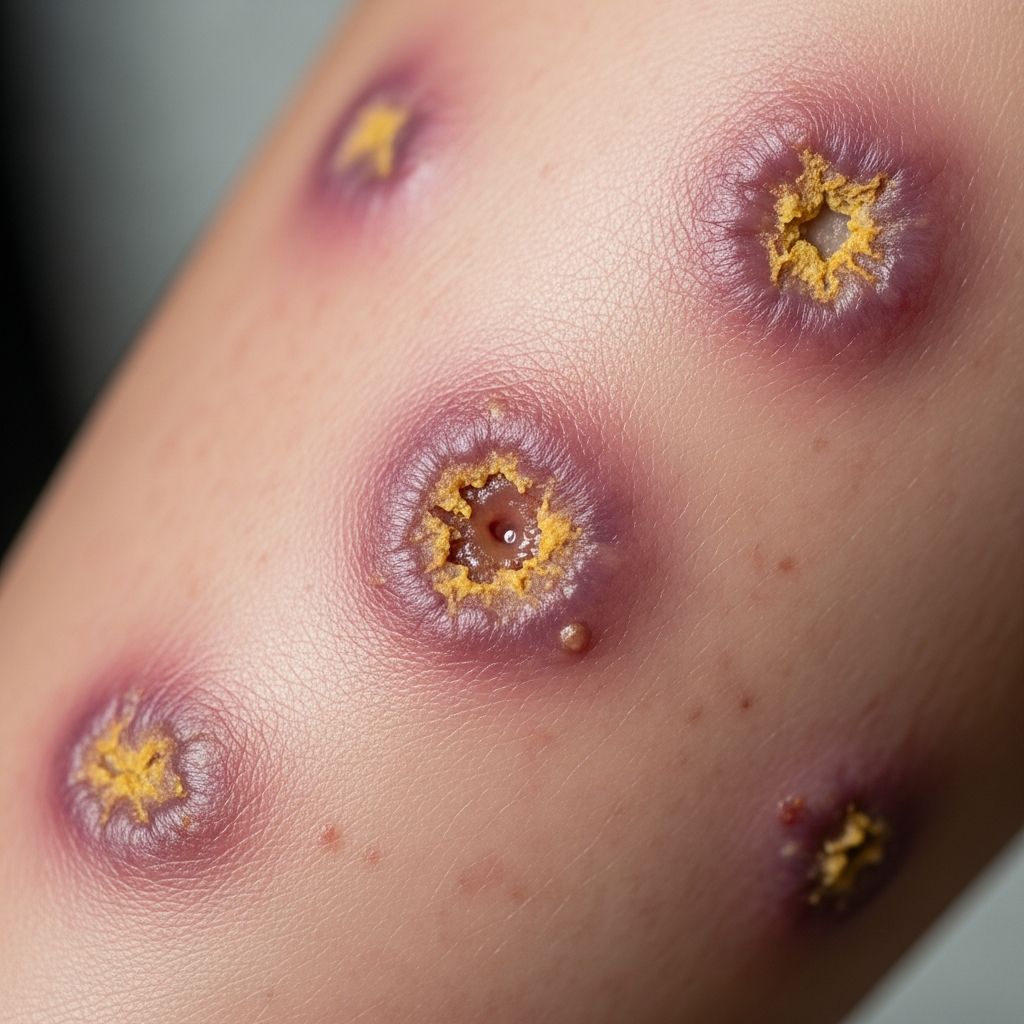
Ecthyma represents a deeper, more invasive form of impetigo, characterized by crusted sores that evolve into painful ulcers penetrating the dermis. This bacterial skin infection, primarily caused by Streptococcus pyogenes or Staphylococcus aureus, requires prompt recognition through visual identification for effective treatment.
What is Ecthyma?
Ecthyma is an ulcerative pyoderma, often termed ‘adult impetigo,’ distinguishing it from superficial childhood impetigo by its involvement of the epidermis and dermis layers. Lesions typically manifest as vesicles or pustules on inflamed skin, progressing to thick, adherent crusts overlying shallow ulcers. Unlike superficial impetigo, ecthyma erodes deeper into the skin, leaving scars upon healing.
Clinically, ecthyma begins as a small blister or pustule, which ruptures to form a crusted sore. Beneath the crust, a punched-out ulcer develops, measuring 0.5–3 cm in diameter with raised, violaceous edges. Common sites include the lower legs, ankles, feet, buttocks, and thighs, areas prone to minor trauma or poor hygiene.
Demographics and Risk Factors
Ecthyma affects individuals across all ages, sexes, and races, but certain groups face heightened risk. Children, elderly patients, and immunocompromised individuals—such as those with diabetes, neutropenia, malignancy, HIV, or on immunosuppressive therapy—experience higher incidence.
Key predisposing factors include:
- Poor hygiene and crowded living conditions
- Minor skin trauma, insect bites, or scratches
- Underlying skin conditions like dermatitis, scabies, or eczema
- Chronic edema or lymphedema
- Immunosuppression from medications or disease
- Nutritional deficiencies, particularly in malnourished populations
In congregate settings like nursing homes or prisons, transmission occurs via skin-to-skin contact, emphasizing the contagious nature of this infection.
Clinical Features and Signs
The hallmark of ecthyma is a vesicle or pustule on erythematous skin that rapidly crusts over. The crust, grayish-yellow and adherent, conceals a dermal ulcer. Surrounding skin shows inflammation, and regional lymphadenopathy may occur if infection spreads.
Lesions are often painful and pruritic, particularly on lower extremities. In darker skin tones, erythema may be subtle, with postinflammatory hyperpigmentation prominent during healing. Multiple lesions can coalesce, forming larger ulcerated areas.
Images of Ecthyma Lesions
Visual diagnosis is crucial. Below are descriptions of representative clinical images showcasing ecthyma at various stages (note: actual images available in DermNet image library):
- Early lesion: Vesicle on lower leg with surrounding erythema, beginning to crust.
- Established ecthyma: Thick, honey-colored crust over punched-out ulcer on ankle, violaceous rim.
- Multiple lesions: Scattered crusted ulcers on thighs and buttocks in a child with poor hygiene.
- Healing phase: Scarred ulcer post-crust removal, with re-epithelialization edges.
- Severe case: Extensive ulceration on foot with lymphadenitis in diabetic patient.
These images highlight the characteristic evolution from pustule to necrotic ulcer, aiding differentiation from similar conditions.
Complications
Untreated ecthyma can lead to serious sequelae:
- Permanent scarring, often hypopigmented or hypertrophic
- Secondary bacterial superinfection
- Cellulitis or lymphangitis
- Bacteremia or sepsis in vulnerable patients
- Rarely, glomerulonephritis from streptococcal strains
Related Stories



In immunocompromised hosts, progression to deeper tissue invasion increases morbidity.
Differential Diagnosis
| Condition | Key Features | Differentiator from Ecthyma |
|---|---|---|
| Impetigo | Superficial bullae/crusts | No dermal ulceration; resolves without scarring |
| Herpes simplex/zoster | Vesicles in dermatome | Tzanck smear shows multinucleated cells; viral culture positive |
| Cutaneous anthrax | Painless black eschar | History of animal exposure; painless |
| Ecthyma gangrenosum | Rapid necrotic ulcer | Immunocompromised; Pseudomonas on Gram stain |
| Pyoderma gangrenosum | Rapidly enlarging ulcer | Associated with IBD; biopsy shows neutrophilic infiltrate |
Investigations
Diagnosis is primarily clinical, supported by:
- Swab for Gram stain, culture, and sensitivity (reveals Gram-positive cocci in chains/clusters)
- Skin biopsy for refractory cases (shows dermal necrosis with bacterial colonies)
- Screen for underlying conditions (e.g., blood glucose, HIV serology)
Tetanus prophylaxis is advised for open wounds.
Treatment
Treatment targets the infection and addresses predisposing factors.
Local Care
- Vinegar soaks: Mix ½ cup white vinegar in 1L tepid water; apply compress 10 minutes, several times daily to soften crusts.
- Gently debride crusts with saline or antiseptic.
Topical Therapy
For localized lesions:
- Fusidic acid or mupirocin ointment, 3x daily after crust removal.
- Alternatives: Povidone-iodine, hydrogen peroxide cream, or antibacterial Manuka honey.
Systemic Antibiotics
Indicated for extensive, multiple, or non-responsive cases:
| Antibiotic | Dose (Adult) | Duration |
|---|---|---|
| Dicloxacillin/Flucloxacillin | 500mg QID | 7–14 days |
| Cephalexin | 500mg QID | 7–14 days |
| Clindamycin (MRSA coverage) | 300–450mg TID | 7–14 days |
Treatment may extend several weeks for complete resolution. Improve hygiene: regular washing, wound care, treating scabies/dermatitis.
Ecthyma Gangrenosum Variant
Distinct from classic ecthyma, ecthyma gangrenosum arises in septicemia, often Pseudomonas aeruginosa in immunocompromised patients. Lesions start as painless red macules, progressing to hemorrhagic pustules and necrotic ulcers with black eschar and erythematous halo within 12–24 hours. Sites: anogenital, axillae.
Management: Urgent IV antibiotics (e.g., piperacillin + aminoglycoside), blood cultures, biopsy. Mortality high if sepsis untreated.
Prevention
- Maintain hygiene, especially in high-risk groups
- Treat underlying skin barriers (eczema, wounds)
- Avoid sharing towels/razors
- Contact precautions in outbreaks
Frequently Asked Questions (FAQs)
Q: Is ecthyma contagious?
Yes, highly contagious via direct contact or fomites. Isolate lesions and practice hand hygiene.
Q: How long does ecthyma take to heal?
With treatment, 1–3 weeks; scarring common. Untreated, may persist months.
Q: Can ecthyma affect children?
Yes, common in children with poor hygiene; often on legs/buttocks.
Q: When to see a doctor for ecthyma?
If lesions spread, fever develops, or no improvement after 48 hours of topical therapy.
Q: Difference between ecthyma and impetigo?
Ecthyma is deeper, ulcerates dermis, scars; impetigo superficial, no scarring.
References
- Ecthyma — DermNet NZ. 2023. https://dermnetnz.org/topics/ecthyma
- Ecthyma Gangrenosum — DermNet NZ. 2023. https://dermnetnz.org/topics/ecthyma-gangrenosum
- Adult female with a painful and pruritic lower extremity skin lesion — Silvers C, Lloyd C. JACEP Open. 2023-04-29. https://pmc.ncbi.nlm.nih.gov/articles/PMC10189074/
- Bacterial Skin Infections — DermNet NZ. 2023. https://dermnetnz.org/topics/bacterial-skin-infections
- Ecthyma Images — DermNet NZ. 2016. https://dermnetnz.org/topics/ecthyma-images
Similar Articles








Read full bio of medha deb