Eggs Vs. Cottage Cheese: Nutrition Comparison & Benefits
Discover how eggs and cottage cheese stack up in protein, calories, and health benefits for weight loss and muscle building.
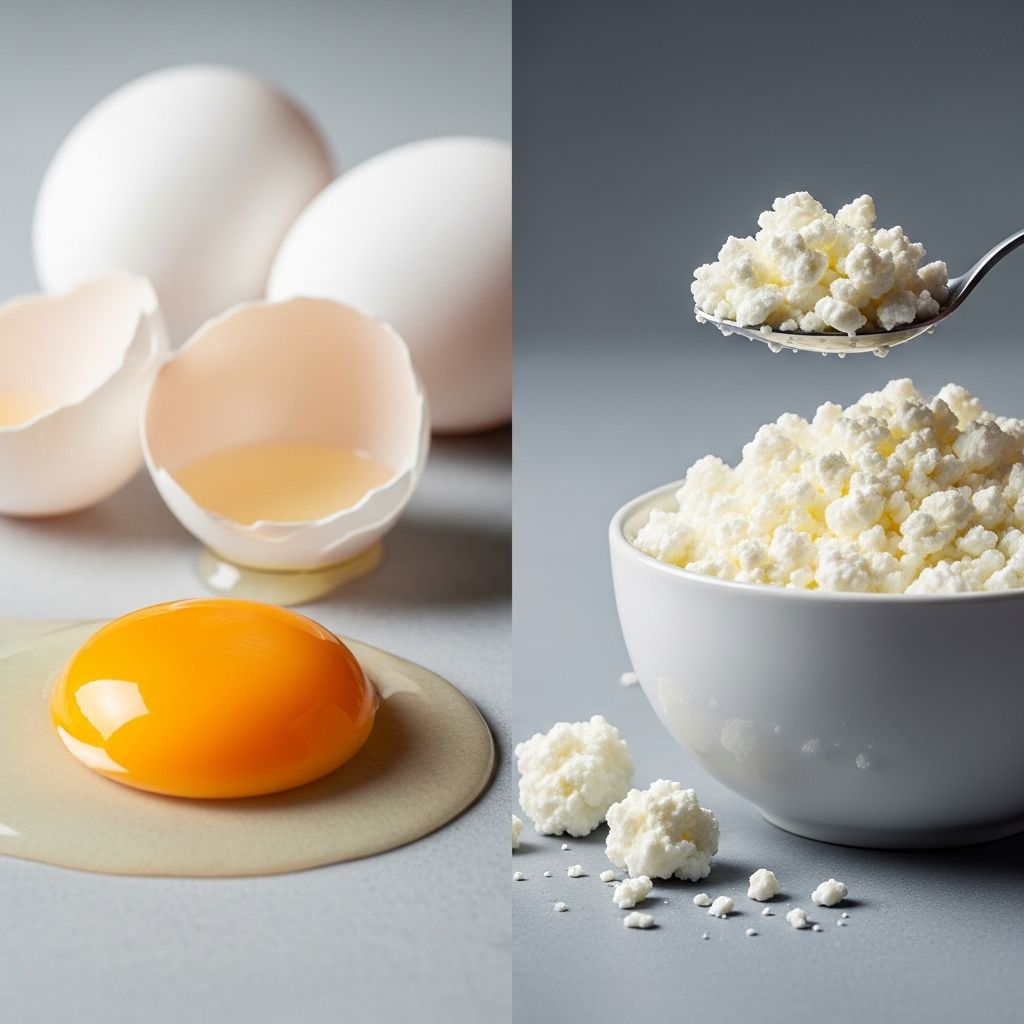
Both
eggs
andcottage cheese
are powerhouse protein sources popular in healthy diets, weight loss plans, and muscle-building routines. Eggs offer complete amino acids and essential vitamins, while cottage cheese provides high protein with fewer calories and added calcium. This article breaks down their nutrition profiles, health benefits, and practical uses to help you decide which fits your goals.Nutrition Comparison: Eggs vs. Cottage Cheese
Eggs and cottage cheese differ significantly in macronutrients and micronutrients. Per 100 grams, eggs have 143 calories compared to cottage cheese’s 98 calories, making cottage cheese 31% lower in calories. For macronutrient ratios from calories, cottage cheese is 46% protein, 14% carbs, and 40% fat, while eggs are 36% protein, 2% carbs, and 62% fat.
| Nutrient (per 100g) | Cottage Cheese | Egg |
|---|---|---|
| Calories | 98 | 143 |
| Protein | 11.1g | 12.6g |
| Carbohydrates | 3.4g | 0.72g |
| Fat | 4.3g (est.) | 9.5g (est.) |
| Saturated Fat | 1.7g | 3.1g |
| Cholesterol | 17mg | 372mg |
Both are low in carbs, with sugars making up 100% of their carb content: 2.7g in cottage cheese vs. 0.37g in eggs. Eggs edge out in protein by 13%, but cottage cheese shines in a typical serving: 11-14g protein per 1/2 cup vs. 6g per large egg.
Micronutrients: Vitamins and Minerals
Eggs excel in fat-soluble vitamins. They provide 332% more
Vitamin A
(160µg vs. 37µg), 26 times moreVitamin D
(82 IU vs. 3 IU), and superior B vitamins like riboflavin, B6 (0.17mg vs. 0.046mg), folate (47µg vs. 12µg), and B12 (0.89µg vs. 0.43µg). Cottage cheese counters with 48% morecalcium
(83mg vs. 56mg), vital for bone health and fat metabolism.Eggs also lead in
iron
(1.8mg vs. 0.07mg) and omega-3s, including DHA (0.058g) and total omega-3 (0.113g). Cottage cheese has higher sodium (up to 459mg per 1/2 cup vs. 62mg per egg), a consideration for low-sodium diets.| Micronutrient (per 100g) | Cottage Cheese | Egg |
|---|---|---|
| Calcium | 83mg | 56mg |
| Iron | 0.07mg | 1.8mg |
| Vitamin A | 37µg | 160µg |
| Vitamin D | 3 IU | 82 IU |
| Omega-3 Total | 0.017g | 0.113g |
Health Benefits of Eggs
**Eggs** are nutrient-dense, providing high-quality complete protein with all essential amino acids. Their choline content supports brain health, and vitamin D aids immunity. Despite high cholesterol (372mg/100g), recent research shows dietary cholesterol has minimal impact on blood cholesterol for most people.
- Eye Health: Lutein and zeaxanthin protect against age-related macular degeneration.
- Muscle Building: 12.6g protein/100g supports repair and growth.
- Weight Management: High satiety from fats and protein reduces overall calorie intake.
- Heart Health: Omega-3 enriched eggs lower inflammation.
Eggs’ versatility—boiled, scrambled, or in omelets—makes them ideal for any meal.
Health Benefits of Cottage Cheese
**Cottage cheese** is a low-calorie, high-protein option with slow-digesting casein, promoting fullness and muscle preservation during weight loss. Its probiotics support gut health, and calcium (111mg/1/2 cup) enhances fat burning.
- Weight Loss: Low calories (81 per 1/2 cup low-fat) with 11-14g protein curbs hunger.
- Bone Health: High calcium strengthens bones.
- Digestion: Probiotics improve gut flora and energy metabolism.
- Muscle Maintenance: Casein releases amino acids steadily overnight.
Related Stories



Low in saturated fat (1.2g/1/2 cup) and cholesterol (12mg), it’s heart-friendly for cholesterol-conscious eaters.
Satiety and Weight Loss: Which Wins?
A study comparing an omelette and cottage cheese (both ~20-30g protein) found similar satiating effects, delaying hunger by 167 minutes and reducing buffet intake. Eggs delayed amino acid delivery, boosting glucagon and GLP-1, while cottage cheese spiked insulin and GIP faster.
For weight loss, cottage cheese’s higher protein per calorie and calcium make it superior, but eggs’ complete nutrition shines. One plan using both yielded 11kg loss in 4 months, better energy, and muscle gains.
| Aspect | Eggs (Large) | Cottage Cheese (1/2 Cup Low-Fat) |
|---|---|---|
| Calories | 74 | 81 |
| Protein | 6g | 11-14g |
| Satiety Effect | High (study-matched) | High (study-matched) |
| Best For | Nutrient density | Low-cal volume |
Taste, Texture, and Versatility
Eggs offer creamy texture when scrambled or fried, with a mild flavor absorbing seasonings. Cottage cheese has a curdled, tangy taste—creamy in full-fat, lumpy in low-fat. Both are versatile: eggs in baking, frying; cottage cheese in salads, smoothies, or as a yogurt swap.
- Eggs: Omelets, boils, deviled.
- Cottage Cheese: With fruit, in pancakes, or baked.
Price and Accessibility
Eggs are typically cheaper per gram of protein and widely available. Cottage cheese varies by fat content but offers good value in bulk. Both are staples in grocery stores.
Potential Downsides and Allergies
Eggs pose allergy risks (common in children) and high cholesterol concerns for some. Cottage cheese’s sodium and lactose may bother sensitive individuals—opt for low-sodium or lactose-free.
Which Should You Choose?
For weight loss: Cottage cheese for volume and calcium.
For muscle gain: Eggs for complete aminos.
Best overall: Rotate both for variety and full nutrients. A combo like scrambled eggs with cottage cheese delivers 17-20g protein.
Frequently Asked Questions (FAQs)
Q: Which has more protein, eggs or cottage cheese?
A: Cottage cheese has more per serving (11-14g per 1/2 cup vs. 6g per egg), though eggs have slightly more per 100g (12.6g vs. 11.1g).
Q: Are eggs or cottage cheese better for weight loss?
A: Both excel due to high satiety, but cottage cheese’s lower calories and higher calcium give it an edge. Studies show similar fullness effects.
Q: Can I eat eggs and cottage cheese together?
A: Yes! Mix for 17-20g protein in one meal, like scrambled eggs with cottage cheese.
Q: Is cottage cheese good for muscle building?
A: Yes, its casein protein sustains amino acid release, ideal post-workout or bedtime.
Q: Do eggs raise cholesterol?
A: Minimal impact for most; focus on overall diet. Limit if you have hypercholesterolemia.
Q: How much of each should I eat daily?
A: Aim for 1.2-1.6g protein/kg body weight. E.g., 2-3 eggs or 1 cup cottage cheese contributes significantly.
References
- Cottage Cheese Vs Egg – Nutrition Comparison — Souper Sage. 2023. https://www.soupersage.com/compare-nutrition/cottage-cheese-vs-egg
- Eggs vs Cottage Cheese: Best Protein for Weight Loss — Catchealth. 2024. https://catchealth.com/blog/protein-power-for-weight-loss/
- The satiating effects of eggs or cottage cheese are similar in healthy … — PubMed (Physiol Behav. 2015). 2015-03-20. https://pubmed.ncbi.nlm.nih.gov/25772196/
Similar Articles








Read full bio of Sneha Tete