Elastofibroma Pathology: 5 Hallmark Histological Features
Comprehensive guide to the pathology, clinical features, and management of elastofibroma, a benign soft tissue tumour.
Introduction
Elastofibroma, also known as elastofibroma dorsi, is a rare benign soft tissue tumour primarily affecting the subscapular region. First described in 1961 by Jarvi and Saxen, it typically presents as a slow-growing, ill-defined mass at the inferior pole of the scapula. Despite its name suggesting a neoplastic process, current understanding leans towards it being a reactive fibro-elastic proliferation rather than a true neoplasm. This lesion is most common in older adults, particularly women over 50 years of age, with a female-to-male ratio of approximately 10:1. The tumour’s aetiology remains uncertain but is strongly associated with repetitive mechanical friction from shoulder movements, such as in manual labourers or those engaging in overhead activities.
Clinically, patients often report a painless swelling or mass beneath the scapula, sometimes accompanied by snapping sensations, stiffness, or mild discomfort during shoulder motion. The mass is usually unilateral but bilateral cases occur in up to 30-50% of patients. Imaging plays a crucial role in diagnosis, with MRI being the modality of choice, revealing characteristic heterogeneous signal intensity due to interspersed fat and fibrous tissue. While historically surgical excision was standard, conservative management is increasingly considered for asymptomatic cases.
Clinical Features
- Location: Inferior pole of scapula (90% of cases), most commonly subscapular region of the right shoulder
- Demographics: Predominantly females (female:male ratio 10:1), peak incidence 50-70 years
- Presentation: Slow-growing mass (average 5-10 cm), painless swelling, mechanical symptoms (snapping, restricted motion)
- Bilateral involvement: 30-50% of cases
- Rare sites: Other locations including oral cavity, hands, feet, and thoracic wall
The clinical triad of subscapular mass in an elderly woman with mechanical shoulder symptoms is highly suggestive. Physical examination reveals a firm, non-tender mass that becomes more prominent with arm abduction. Systemic symptoms are absent, and laboratory investigations are typically normal.
Histopathology
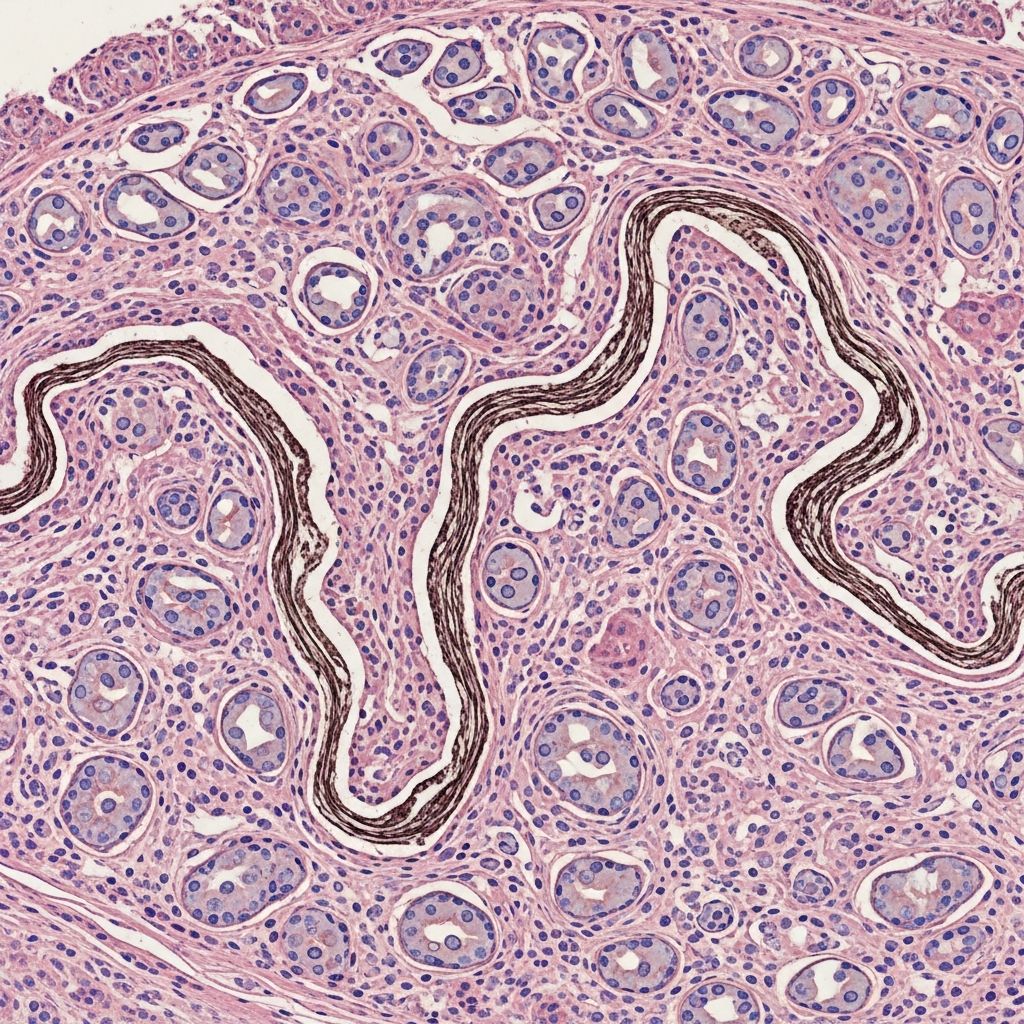
Microscopic examination reveals a distinctive pattern of thick, eosinophilic elastic fibres interspersed among bland fibroblastic cells. The tumour exhibits a lobular architecture with fibrous bands and mature adipose tissue. Key histopathological features include:
- Elastic fibres: Coarse, beaded, frayed elastic fibres (hallmark feature) randomly distributed throughout the lesion
- Cellular component: Bland stellate and spindle-shaped fibroblasts with minimal atypia or mitoses
- Matrix: Abundant collagen bundles and variable fat entrapment
- Architecture: Poorly circumscribed, infiltrative growth pattern without encapsulation
- Vascularity: Paucity of blood vessels
At low power, the lesion appears as an unencapsulated mass blending imperceptibly with surrounding skeletal muscle and fibrous tissue. Higher magnification reveals the diagnostic elastic fibres that demonstrate branching, globoid, and serrated morphology on routine H&E staining. These fibres are Verhoeff-van Gieson positive and show characteristic ‘beads on a string’ appearance.
Histological Variants
While classic elastofibroma predominates, rare variants exist:
- Hypocellular variant: Predominance of hyalinized collagen with sparse elastic fibres
- Cellular variant: Increased fibroblastic cellularity without atypia
- Myxoid variant: Focal myxoid degeneration (rare)
Special Stains
Ancillary studies confirm the diagnosis:
| Stain | Result | Significance |
|---|---|---|
| Verhoeff-van Gieson | Strong black staining of coarse elastic fibres | Diagnostic hallmark |
| Elastic van Gieson | Beaded, frayed elastic fibres | Characteristic morphology |
| Masson trichrome | Red collagen fibres, black elastic fibres | Highlights fibrous component |
| Alcian blue | Negative | Excludes myxoid lesions |
These stains are crucial for confirming the elastotic nature and distinguishing from mimics.
Immunohistochemistry
Immunohistochemical profile is non-specific but helpful in differential diagnosis:
Related Stories



- Positive: Vimentin (diffuse), CD34 (focal in fibroblasts), factor XIIIa (histiocytes)
- Negative: S-100, desmin, SMA (rules out neural, muscular lesions), ALK-1, CD117 (excludes inflammatory myofibroblastic tumour)
- Proliferation: Low Ki-67 (<5%)
The lack of specific markers supports the reactive rather than neoplastic nature of elastofibroma.
Differential Diagnosis
| Diagnosis | Key Distinguishing Features |
|---|---|
| Desmoplastic fibroblastoma | More cellular, fewer elastic fibres, stellate cells in myxocollagenous stroma |
| Pleomorphic fibroma | Epidermal attachment, multinucleated giant cells, viral inclusions |
| Fibroma of tendon sheath | Slit-like spaces, tendon attachment, less elastosis |
| Nodular fasciitis | High cellularity, tissue culture-like vessels, rapid growth history |
| Low-grade fibromyxoid sarcoma | Alternating fibrous/myxoid areas, MUC4+, ARCIMA gene fusion |
| Schwannoma | S-100+, Verocay bodies, hyalinized vessels |
The combination of clinical presentation, characteristic elastic fibres on special stains, and appropriate immuno profile reliably distinguishes elastofibroma from mimics.
Imaging Features
- MRI (gold standard): Lenticular mass, iso/hypointense T1, heterogeneous T2 (due to fat/fibrosis), delayed enhancement
- CT: Attenuation similar to muscle with linear fat strands
- Ultrasound: Hyperechoic mass with posterior shadowing
Radiological-pathological correlation is essential for pre-operative diagnosis, often obviating biopsy.
Treatment and Prognosis
Surgical excision is curative for symptomatic lesions with recurrence rates <5%. Marginal excision suffices due to the lesion’s paucicellularity and lack of aggressive behaviour. Conservative management is appropriate for asymptomatic cases. Post-operative complications include seroma (10-15%), haematoma (5%), and superficial infection (<5%). Long-term functional outcomes are excellent with significant pain reduction.
The prognosis is uniformly excellent. No malignant transformation reported in literature. Regular follow-up not required post-excision.
Frequently Asked Questions (FAQs)
Q: Is elastofibroma cancerous?
A: No, elastofibroma is a benign lesion with no reported cases of malignant transformation. It behaves in an entirely indolent fashion.
Q: Do all elastofibromas require surgery?
A: No. Asymptomatic lesions can be safely observed. Surgery is reserved for symptomatic cases causing pain, mechanical symptoms, or diagnostic uncertainty.
Q: What causes elastofibroma?
A: Most evidence supports a reactive aetiology from repetitive microtrauma and friction at the scapular border, particularly in manual workers.
Q: Can elastofibroma occur in young patients?
A: Extremely rare. >95% occur in patients over 40 years, peaking in 6th-7th decades.
Q: Is biopsy always necessary?
A: No. Classic clinical and MRI findings are diagnostic. Biopsy reserved for atypical presentations or diagnostic uncertainty.
Conclusion
Elastofibroma represents a distinctive clinicopathological entity where recognition of the characteristic coarse elastic fibres on histopathology, combined with classic subscapular location in older adults, enables confident diagnosis. Awareness prevents misdiagnosis as sarcoma and unnecessary aggressive treatment. The lesion exemplifies reactive fibroplasia rather than neoplasia, underscoring the importance of clinicopathological correlation in soft tissue tumour diagnosis.
References
- Elastofibroma dorsi: management, outcome and review of literature — Nagamine N, et al. PubMed/NCBI. 2010-02-01. https://pubmed.ncbi.nlm.nih.gov/20130320/
- Dermatofibroma – StatPearls — NCBI Bookshelf/NIH. 2023-07-17. https://www.ncbi.nlm.nih.gov/books/NBK470538/
- Fibromatosis — DermNet NZ. 2024. https://dermnetnz.org/topics/fibromatosis
Similar Articles








Read full bio of medha deb