Elastosis: Causes, Symptoms, Diagnosis, And Treatment
Understanding degenerative skin conditions involving abnormal elastin deposition from sun damage and other causes.
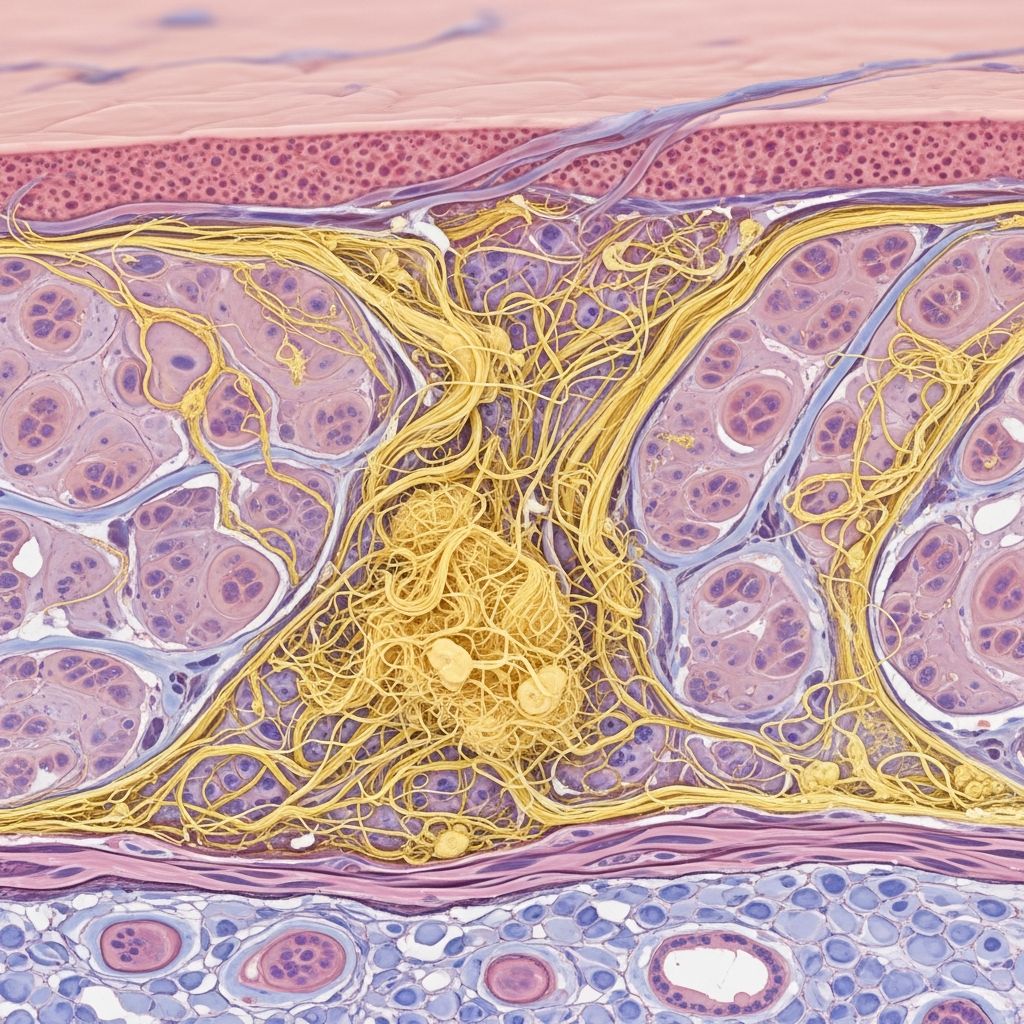
Elastosis refers to degenerative changes in the dermal tissue characterized by increased deposition of elastin material. It is a prominent feature of several skin conditions, distinguished by their clinical presentations and histopathological findings on skin biopsy.
What is elastosis?
Elastosis involves the abnormal accumulation and degeneration of elastic fibers in the dermis, the skin’s supportive layer. This leads to loss of skin elasticity, resilience, and a characteristic aged or damaged appearance. While intrinsic aging contributes to some elastotic changes, extrinsic factors like chronic ultraviolet (UV) radiation exposure are primary culprits in most cases.
The term encompasses a spectrum of disorders where elastic tissue proliferates abnormally or degrades, replacing normal dermal architecture. Common manifestations include yellowish thickening, wrinkling, and textural irregularities, particularly in sun-exposed areas.
Types of elastosis
Several distinct forms of elastosis exist, each with unique clinical features:
- Solar elastosis (actinic elastosis): The most common type, resulting from long-term sun exposure. Skin appears yellow, thickened, furrowed, or bumpy on sun-exposed sites like the face, neck, and arms.
- Favre-Racouchot syndrome (nodular elastosis): Features cysts, comedones, and thickened yellow plaques in sun-damaged skin, often around the eyes, nose, neck, or ears.
- Linear focal elastosis: Rare condition with asymptomatic, palpable or atrophic yellow lines or striae-like bands, typically on the back, trunk, thighs, arms, or breasts.
- Elastosis perforans serpiginosa (EPS): Involves transepidermal elimination of abnormal elastic fibers, presenting as serpiginous (snake-like) groups of red papules.
- Elastoma: Isolated dermal accumulation of elastin, classified as a connective tissue nevus.
Solar elastosis
Who gets solar elastosis?
Solar elastosis primarily affects middle-aged to elderly individuals with a history of prolonged sun exposure. Outdoor workers such as farmers, sailors, golfers, and tennis players are at higher risk, especially those with fair skin types that burn easily. It manifests in chronically exposed areas: face, neck, dorsal hands, and forearms.
What causes solar elastosis?
Chronic UV radiation from sunlight is the primary cause. UV rays induce elastic fiber hyperplasia, followed by fragmentation, coarsening, and clumping into basophilic masses in the papillary and upper reticular dermis. Pathophysiology involves a biphasic process: initial accumulation of normal fibers, then degradation with elastolysis.
Inflammation plays a role, with perivenular lymphohistiocytic infiltrates and mast cell degranulation releasing enzymes that degrade collagen and elastin. A subepidermal grenz zone of newly synthesized collagen forms above the elastotic material due to dermal crowding. Genetic factors influencing skin type and repair capacity modulate severity.
What are the clinical features of solar elastosis?
Skin texture becomes rough, thickened, and wrinkled with a yellow or sallow hue. Common signs include:
- Yellowish or bluish discoloration
- Skin thickening and leathery texture
- Bumpy or cobblestone appearance
- Deep furrows and fine wrinkles
- Dryness and fine scaling
- Hyperpigmentation, liver spots, or scaly patches
Severity correlates with cumulative UV dose; advanced cases show plaques studded with comedones in Favre-Racouchot syndrome.
Diagnosis
Diagnosis is clinical, based on history of sun exposure and characteristic morphology in photoaged skin. Confirmation requires skin biopsy showing:
- Subepidermal grenz zone
- Fragmented, basophilic elastotic material in dermis
- Loss of normal collagen and elastic networks
Histology distinguishes it from other elastoses.
Management and treatment of solar elastosis
No cure exists; management focuses on prevention and cosmetic improvement:
- Prevention: Broad-spectrum sunscreen (SPF 30+), protective clothing, avoiding peak sun hours.
- Topical therapies: Retinoids (tretinoin) to stimulate collagen; antioxidants like vitamin C.
- Procedures: Chemical peels, microdermabrasion, dermabrasion for resurfacing; lasers (fractional CO2, erbium) or intense pulsed light to remodel dermis.
Treatments promote extracellular matrix turnover but cannot fully reverse advanced elastosis.
Related Stories



Favre-Racouchot syndrome
This condition overlays solar elastosis with dilated pilosebaceous orifices, comedones, and keratinous cysts in yellow plaques. Predominant in males on periorbital, malar, nasal, neck, or retroauricular skin. Weakened follicular support from photodamage causes ductal dilation and keratin retention.
Treatment mirrors solar elastosis, with added comedone extraction or retinoids.
Linear focal elastosis
A rare, acquired disorder with symmetric, indurated, yellowish-red striae on the mid-to-lower back. Biopsy reveals wavy, fragmented, basophilic elastic fibers in the reticular dermis. No systemic associations; etiology unclear but may relate to mechanical stress or mild elastosis variant.
It is asymptomatic and often requires no treatment, though cosmetic options like lasers may be considered.
Elastosis perforans serpiginosa
Rare perforating disorder where altered elastic fibers traverse the epidermis, forming arcuate or serpiginous papules on the neck, arms, or trunk. May be idiopathic, associated with connective tissue diseases (e.g., Ehlers-Danlos, Marfan), or induced by drugs like penicillamine. Biopsy shows focal elastic fiber elimination.
Treatment includes topical retinoids, cryotherapy, or excision for symptomatic lesions.
Elastoma
Benign connective tissue nevus with focal elastin accumulation in the dermis. Presents as firm, skin-colored papules or plaques, often congenital or early-onset. Histology confirms increased, normal-appearing elastic fibers.
Observation suffices unless cosmetic concern prompts excision.
Complications and associations
Elastosis increases skin cancer risk (actinic keratosis, squamous cell carcinoma) due to field cancerization from photodamage. It also impairs wound healing, exacerbating scars and striae by disrupting elastic networks.
Clinical images
(Description: Images typically depict yellowed, wrinkled facial skin with telangiectasias; linear bands on the back; serpiginous papules; and comedone-filled plaques around eyes.)
Frequently Asked Questions
What is the main cause of solar elastosis?
Chronic UV exposure from the sun, leading to elastic fiber degeneration and dermal remodeling.
Can solar elastosis be reversed?
Not fully, but treatments like lasers and peels can improve appearance by stimulating new collagen.
Who is at risk for elastosis?
Fair-skinned individuals with outdoor occupations or recreational sun exposure over decades.
Does solar elastosis lead to skin cancer?
Yes, it indicates severe photodamage, raising risk for actinic keratoses and squamous cell carcinomas.
How is elastosis diagnosed?
Clinically via history and exam; biopsy confirms elastotic material in dermis.
References
- Solar Elastosis Explained: Causes, Symptoms, and Treatment Options — Radiant Dermatology TX. 2023-05-15. https://www.radiantdermtx.com/post/what-is-solar-elastosis-and-how-is-it-treated
- Actinic (solar) elastosis (Other chronic dermatitis due to solar radiation) — Dermatology Advisor. 2024-02-10. https://www.dermatologyadvisor.com/home/decision-support-in-medicine/dermatology/actinic-solar-elastosis-other-chronic-dermatitis-due-to-solar-radiation/
- Elastosis – DermNet — DermNet NZ. 2023-11-20. https://dermnetnz.org/topics/elastosis
- Actinic (solar) elastosis – understanding & treatment — ENRICH Clinic. 2024-01-08. https://www.enrichclinic.com.au/actinic-solar-elastosis-understanding-treatment/
- Clinical Relevance of Elastin in the Structure and Function of Skin — PMC (NCBI). 2021-07-01. https://pmc.ncbi.nlm.nih.gov/articles/PMC8239663/
- Linear focal dermal elastosis — NORD (rarediseases.org). 2023-09-12. https://rarediseases.org/mondo-disease/linear-focal-dermal-elastosis/
Similar Articles








Read full bio of medha deb