Elbow Joint: Anatomy, Function & Common Conditions
Complete guide to elbow joint anatomy, movements, and how to keep it healthy and functioning.
Understanding the Elbow Joint
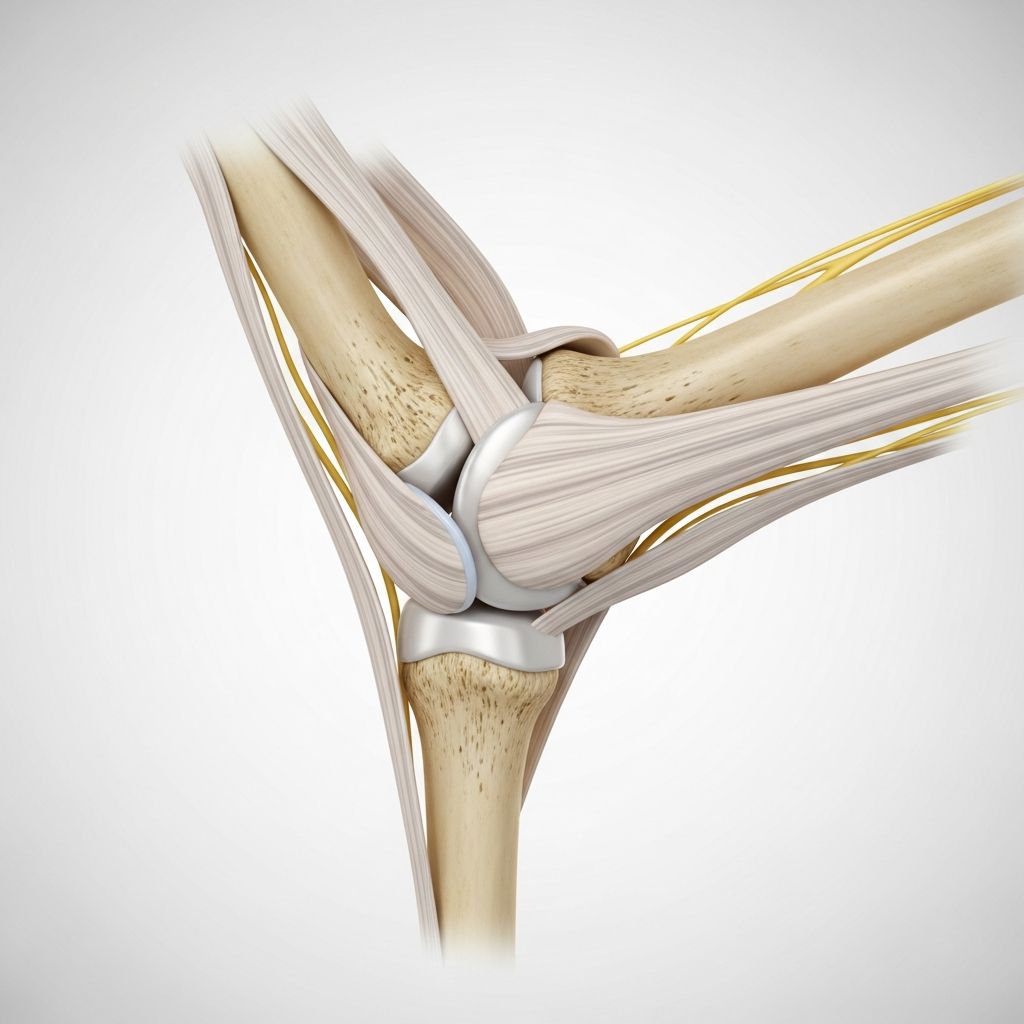
The elbow joint is one of the most frequently used joints in your body, connecting your upper arm to your forearm and enabling a wide range of movements throughout the day. Although it doesn’t bear weight like your knees or hips, the elbow joint is remarkably complex and plays a crucial role in everyday activities such as lifting, reaching, throwing, and manipulating objects. This synovial joint demonstrates both hinge-like and pivot-like characteristics, making it unique among the body’s articulations.
Your elbow allows you to perform basic movements and fine motor tasks with precision. Understanding its anatomy and how it functions can help you appreciate its complexity and recognize when something might be wrong. Whether you’re an athlete, office worker, or anyone in between, the health of your elbow joint directly impacts your quality of life and functional abilities.
Anatomy of the Elbow Joint
The elbow joint is formed by the meeting of three major bones that work together to create a sophisticated articulation. Each bone plays a specific role in enabling movement and providing stability to this important junction between your upper and lower arm.
The Three Bones of the Elbow
Your elbow joint consists of three bones that interact to create its unique structure and function. Understanding each bone’s role helps explain how the elbow achieves its remarkable range of motion:
The Humerus is the bone of your upper arm. The lower end of the humerus expands to form two distinct structures: the lateral condyle, which is dome-shaped, and the trochlea, which resembles a spool or pulley. These surfaces articulate with the bones of your forearm, creating the primary elbow joint.
The Ulna is the larger of the two forearm bones, located on the pinky side of your forearm. It features a distinctive structure called the olecranon, which resembles a scoop or wrench. The olecranon contains a notch called the trochlear notch that wraps around the trochlea of the humerus, acting as the primary pivot point during flexion and extension movements.
The Radius is the smaller forearm bone, located on the thumb side. Its head features a shallow depression that articulates with the lateral condyle of the humerus. The radius is crucial for rotational movements of the forearm, enabling pronation and supination of your palm.
Cartilage: The Joint Cushion
Cartilage is a strong, flexible tissue that protects your joints and acts as a shock absorber throughout your body. Specifically, your elbows are lined with hyaline cartilage, the most common type of cartilage in the human body. Also called articular cartilage, this tissue has a smooth, slippery surface that allows the bones of your elbow to move smoothly past each other without friction. The hyaline cartilage covers the surfaces of your humerus, ulna, and radius where they meet, enabling fluid and painless movement.
Related Stories



Ligaments: Supporting Your Elbow
Ligaments are tough, fibrous cords that connect bones together and provide crucial stability to your elbow joint. The primary stability of the elbow joint comes from the osseous (bone) articulations themselves, but ligaments provide additional reinforcement that prevents excessive movement and injury.
There are three main ligaments in your elbows that work together to maintain stability:
The Medial Collateral Ligament (MCL) is located on the inner side of your elbow and provides medial stability. The anterior oblique ligament, part of the MCL complex, is the strongest and most important medial stabilizer of the elbow joint, protecting against excessive valgus forces (inward bending). The posterior oblique ligament runs posteriorly to insert onto the olecranon, while the transverse ligament passes between these structures.
The Lateral Collateral Ligament (LCL) is located on the outer side of your elbow and prevents excessive lateral motion. This ligament is particularly important in activities involving throwing or gripping.
The Annular Ligament is a thick band of tissue that wraps around the upper part of the radius, holding it firmly in place and maintaining the proper relationship between the radius and ulna bones. This ligament is essential for proper pronation and supination movements.
Joint Capsule and Synovial Membrane
As a synovial joint, the elbow has specialized structures that enable smooth, lubricated movement. Your elbow contains a joint capsule, which is a fibrous sac that encloses the joint, and a synovial membrane that lines the interior of this capsule.
The synovial membrane is a fluid-filled sac that lubricates and protects your joint. This membrane secretes synovial fluid, which bathes the joint surfaces and allows the bones to move with minimal friction and wear. Fat pads located between the synovial membrane and the joint capsule are positioned superficial to areas of stress, including the olecranon, coronoid, and radial fossae. During flexion and extension movements, these fat pads are pulled away by attachments to the brachialis and triceps brachii muscles, allowing space for bony processes to move freely.
Muscles That Move Your Elbow
Your elbow is controlled by several groups of muscles that enable flexion, extension, pronation, and supination. These muscles work in coordinated patterns to produce smooth, controlled movements.
Flexor Muscles
Muscles that control flexion allow you to bend your lower arm toward your body. The primary flexor muscles include:
– Biceps brachii: Located on the front of your upper arm, this muscle is responsible for most of your elbow flexion and is the primary muscle for supination (turning your palm up). It has two distal attachments at the elbow joint, with one tendon inserting on the proximal radius and an aponeurosis continuing into the fascia of the proximal forearm.
– Brachialis: Located beneath the biceps, this muscle is also responsible for elbow flexion and works synergistically with the biceps.
– Brachioradialis: Located in the forearm, this muscle assists with elbow flexion, particularly when your forearm is in a neutral position.
Extensor Muscles
Two extensor muscles allow you to move your lower arm out, away from your body:
– Triceps brachii: Located on the back of your upper arm, this is the primary extensor muscle of the elbow, responsible for straightening your arm. The triceps receives innervation from the radial nerve.
– Anconeus: A small muscle on the back of your elbow that assists with extension.
Rotational Muscles
Muscles that control supination (rotating your palm upward) and pronation (rotating your palm downward) are essential for fine motor control and manipulation of objects.
– Supinator muscles: These enable rotation of your forearm to turn your palm upward, with the biceps brachii being the primary supinator.
– Pronator muscles: These help rotate your forearm to turn your palm downward.
Nerves of the Elbow
Multiple nerves cross the elbow joint, providing sensation and controlling the muscles that move your arm. The main nerves include:
– Musculocutaneous nerve: Although this nerve does not cross the elbow joint itself, it innervates the biceps brachii and brachialis muscles, which are crucial for elbow flexion and supination.
– Radial nerve: This nerve starts medially in the proximal humerus, spirals posteriorly and laterally through the spiral groove, and crosses the elbow joint as it courses laterally. The radial nerve innervates five muscles affecting the elbow joint, including the brachialis (lateral portion), anconeus, supinator muscle, brachioradialis, and triceps brachii.
– Ulnar nerve: This nerve develops a tunnel at the posterior aspect of the medial epicondyle and runs along the medial side of your elbow.
– Median nerve: This nerve also crosses the elbow joint and provides both motor and sensory innervation to structures in the forearm and hand.
Blood Vessels of the Elbow
The brachial artery is the main vessel supplying blood to the muscles in your upper arm and elbow joint. This artery serves as an important landmark in clinical examinations and is often used to measure blood pressure. The superficial nature of most neurovasculature structures at the elbow means they are relatively exposed, which is an important consideration when injuries occur.
How the Elbow Moves
The elbow is functionally both a hinge joint and a pivot joint, a combination known as a trochoginglymus joint. This dual functionality enables a remarkable range of movements that most people use without thinking.
Hinge-Like Movement
As a hinge joint, your elbow bends and straightens your arm much like the hinges on a door. The primary movement is flexion (bending) and extension (straightening). The trochlear notch of the ulna wraps around the trochlea of the humerus, and this tight conforming of the two structures adds to the stability while allowing controlled hinging motion. Flexion and extension movements are achieved through contractions of the biceps and triceps muscles, respectively, and primarily involve only the humerus and ulna.
Pivot-Like Movement
As a pivot joint, your elbow allows rotational movements of the radius and ulna that enable pronation and supination of your forearm. When you turn your palm up (supination) or down (pronation), the radius rotates around its attachment point while the ulna remains relatively stationary. This rotational capability is essential for manipulating objects with precision and is what distinguishes the elbow from simple hinge joints found elsewhere in your body.
Common Elbow Conditions and Concerns
The elbow is especially susceptible to stress injuries despite its surrounding capsule containing cushioning synovial membranes reinforced by ligaments. Understanding common conditions can help you recognize problems early and seek appropriate care.
One notable condition involves the annular ligament, which is responsible for holding the radius and ulna in close proximity at the proximal radioulnar joint. In certain injuries, neither the bone nor the ligament may be damaged; instead, they slip out of their normal positioning. Upon such an injury, patients typically experience severe pain that usually subsides quickly.
Frequently Asked Questions
Q: What makes the elbow joint so complex?
A: The elbow is complex because it combines multiple types of movement—hinge-like flexion and extension, plus pivot-like rotational movements—all controlled by numerous muscles, ligaments, nerves, and blood vessels. This complexity enables remarkable functional capability but also means there are many components that can be injured.
Q: Why is the synovial membrane important?
A: The synovial membrane secretes synovial fluid that lubricates your joint, allowing bones to move smoothly with minimal friction and wear. Without this fluid-filled sac, your elbow would experience excessive wear and tear.
Q: What’s the difference between the radius and ulna?
A: The ulna is the larger forearm bone on the pinky side and forms the primary articulation with the humerus through the trochlear notch. The radius is smaller, located on the thumb side, and is crucial for rotational movements of the forearm.
Q: How do pronation and supination work?
A: These rotational movements occur when the radius rotates around its attachment while the ulna remains relatively stationary. Supination (palm up) is primarily controlled by the biceps brachii, while pronation (palm down) involves pronator muscles.
Q: Which ligament is most important for elbow stability?
A: The anterior oblique ligament, part of the medial collateral ligament complex, is the strongest and most important medial stabilizer of the elbow joint, protecting against excessive valgus forces.
References
- Anatomy, Shoulder and Upper Limb, Elbow Joint — National Center for Biotechnology Information (NCBI). 2024. https://www.ncbi.nlm.nih.gov/books/NBK532948/
- Elbow Joint: Anatomy, Function & Common Conditions — Cleveland Clinic. 2024. https://my.clevelandclinic.org/health/body/elbow-joint
- Elbow: Joints, Muscles, Movements — Encyclopedia Britannica. 2024. https://www.britannica.com/science/elbow-anatomy
- Synovial Membrane: What It Is, Function & Structure — Cleveland Clinic. 2024. https://my.clevelandclinic.org/health/body/25002-synovial-membrane
Similar Articles








Read full bio of medha deb