Electrosurgery in Dermatology: Techniques and Applications
Master electrosurgery techniques for treating skin lesions, removing growths, and controlling bleeding.
Electrosurgery in Dermatology: A Comprehensive Overview
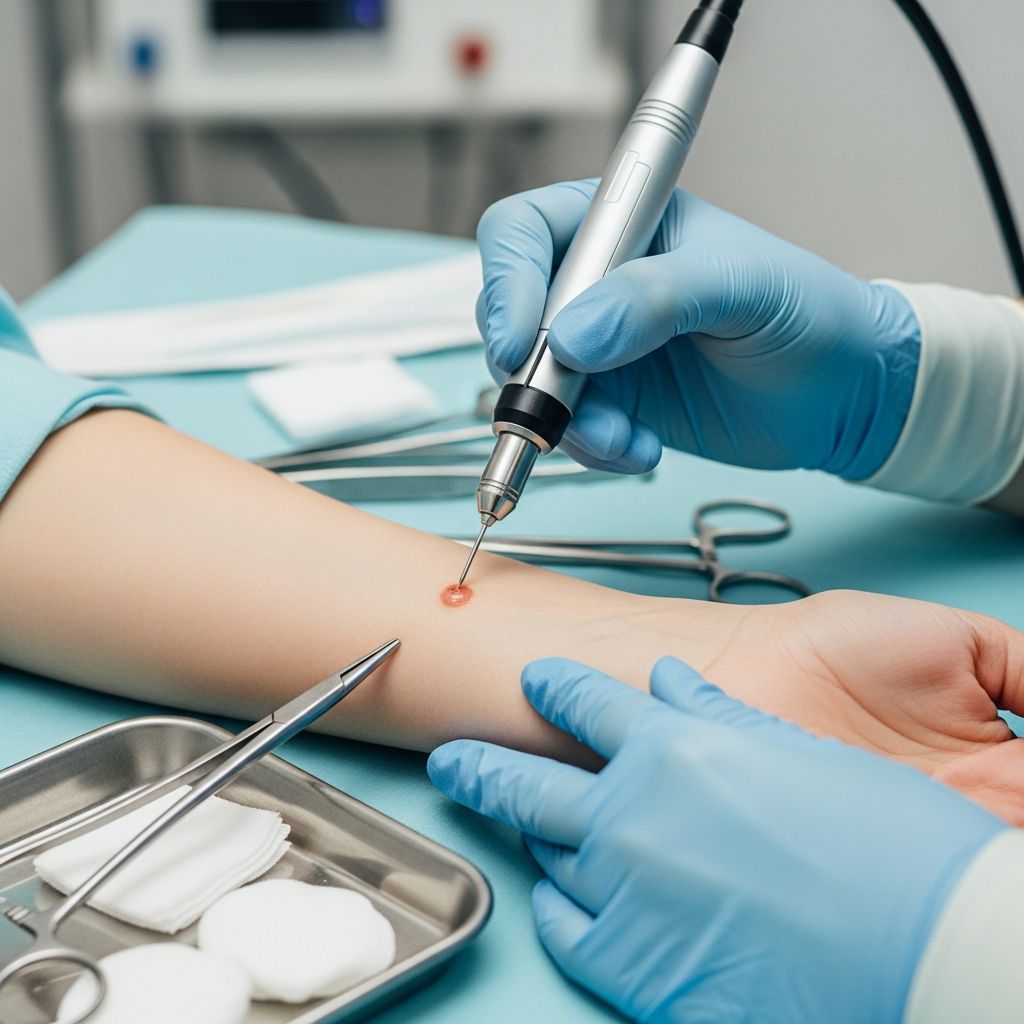
Electrosurgery is a fundamental technique used in dermatological procedures to achieve haemostasis (stop bleeding) and destroy abnormal skin growths. During electrosurgery, high-frequency alternating electric current at voltages ranging from 200 to 10,000 volts is passed through the skin to generate heat. The procedure requires a power supply and a handpiece with one or more electrodes, controlled via a switch on the handpiece or a foot switch.
Understanding Electrosurgery Terminology
The terminology surrounding electrosurgery can be confusing, particularly regarding the distinction between electrosurgery and diathermy. The primary aim of electrosurgery is cauterisation, a term derived from Latin meaning to brand, which refers to the coagulation or destruction of tissue by heat or caustic substance. Electrosurgery is sometimes incorrectly called diathermy, which means ‘dielectrical heat’—the effect produced by microwave ovens. In diathermy, heat is produced by the rotation of molecular dipoles in a high-frequency alternating electric field, whereas in electrosurgery, heat generation occurs through the passage of electric current through tissue resistance.
Key Classifications of Electrosurgery
Electrosurgery can be classified according to several parameters:
- Electrode configuration: Monoterminal, monopolar, or bipolar systems
- Waveform generation: Different waveforms are produced by electrosurgery machines for specific procedures
- Current type: Alternating current (AC) or direct current (DC)
- Application method: Contact, non-contact, or spray techniques
Waveforms in Electrosurgery
The electrosurgery machine generates different waveforms tailored to achieve specific clinical outcomes. These waveforms determine the depth of tissue penetration, the extent of peripheral heat damage, and the overall effectiveness of the procedure. The selection of appropriate waveforms is critical to minimizing complications and maximizing treatment efficacy. Damped and undamped wavetrains can be blended to achieve simultaneous cutting and haemostasis during certain procedures.
Electrofulguration and Electrodessiccation
Electrofulguration and electrodessiccation are techniques specifically designed to destroy superficial lesions that are unlikely to bleed profusely when disturbed, such as viral warts and seborrhoeic keratoses. These methods use a single electrode to produce high voltage and low amperage current. The current accumulates in the patient but produces minimal tissue damage.
Safety Considerations
Unless bipolar output is used, the patient must be positioned on an insulated table, as burns may result from current passing between the patient and earth-ground. Electrofulguration and electrodessiccation should only be performed on conscious patients who would feel the burn from an unwanted earth-ground path, providing an additional safety mechanism. The electrode is applied across the lesion until slightly pink to pale coagulation occurs. Coagulated tissue has greater resistance to electrical current than normal skin, which limits the amount of damage.
Electrocoagulation
Electrocoagulation is a widely used electrosurgical technique that produces tissue coagulation and haemostasis. This method is particularly effective for treating bleeding vessels and preventing excessive blood loss during surgical procedures. However, electrocoagulation may result in permanent scarring and white marks (hypopigmentation) at the treatment site. The extent of these side effects depends on the depth of tissue penetration and the skill of the operator.
Electrosection
Electrosection is employed to simultaneously cut skin and seal bleeding vessels by blending damped and undamped wavetrains. This technique is well-suited for excision of large, relatively vascular lesions, including benign dermal naevi (moles), skin tags, seborrhoeic keratoses, folliculitis keloidalis nuchae, and rhinophyma.
Related Stories



Technical Advantages
Electrosection requires almost no manual pressure from the operator as the electrode glides through tissue with minimal resistance. The technique uses a monopolar electrode to produce low-voltage and high-amperage current at higher power than is used for electrocoagulation. The current is highly focused to vaporise tissue with minimal peripheral heat damage. The electrode is usually a fine tungsten wire or loop.
Mechanism of Tissue Destruction
The destruction of chemical bonds or decomposition of tissue in electrosection arises through two mechanisms: thermolysis (heat-induced) and electrolysis (via direct current electrical action). The main component of tissue is water, which is broken down into its components, hydrogen and oxygen. Radiofrequency devices are often used for electrosection, such as the Ellman Surgitron®, which produce little heat and therefore cause minimal collateral tissue damage. An assortment of single-use or disposable electrodes are available for the Surgitron system.
Thermocautery
Thermocautery is utilized for pinpoint haemostasis during surgical procedures or to eliminate small blood vessels (telangiectasias). Unlike electrosurgery, direct electric current is used in thermocautery to heat the surgical element, which then causes thermal injury through direct heat transference to the tissue. In contrast, in electrosurgery, the treating electrode remains cold.
Clinical Applications and Advantages
Portable and disposable thermocautery devices are available powered by penlight batteries, offering convenience and accessibility. The Shaw Hemostatix® Scalpel is a specialized form of thermocautery in which a heated disposable copper alloy blade is used to cut tissue with reduced bleeding in highly vascular areas. A significant clinical advantage is that thermocautery is suitable for patients with an implanted pacemaker or defibrillator, making it an excellent alternative when other electrosurgical methods might pose electrical risks.
Clinical Applications of Electrosurgery
Electrosurgery has diverse applications across dermatology and related surgical specialties. It can be used for incisional techniques that produce full-thickness excision of nevi, for shave techniques that produce partial-thickness removal of superficial lesions, and for removing vascular lesions such as hemangiomas or pyogenic granulomas. Dermatologists commonly use electrosurgery to remove unwanted growths, destroying benign (noncancerous) lesions like skin tags or warts. Some forms of electrosurgery also treat skin cancer.
Malignant Skin Lesions
Electrodessication and curettage (ED&C) is particularly effective for treating squamous cell carcinoma and basal cell carcinoma. During this combined procedure, a dermatologist uses a sharp tool to scrape away the lesion (curettage), and then applies electrosurgery to destroy any remaining cancer cells. Research indicates that electrosurgery and curettage cure basal cell carcinomas and squamous cell carcinomas 90% to 95% of the time.
Procedural Advantages
Electrosurgery offers significant clinical advantages compared to traditional scalpel techniques. It can remove atypical tissue without physical cuts from a scalpel, allowing healthcare providers to:
- Precisely target and destroy abnormal tissue
- Achieve immediate haemostasis and reduce bleeding
- Minimize trauma to surrounding healthy tissue
- Reduce operative time through efficient tissue removal
- Improve patient comfort during the healing process
Risks and Safety Considerations of Electrosurgery
Despite its many advantages, electrosurgery carries potential risks that must be understood and mitigated. The risks of electrosurgery include electric shock, electrical burns, thermal burns, transmission of infection, and production of toxic gases.
Electric Shock Prevention
Electric shock can be minimized through proper patient preparation, ensuring the patient is positioned on an insulated table, and using appropriate bipolar output when necessary. Healthcare providers must ensure that all electrical equipment is properly maintained and that patients are not in contact with conductive materials that might complete an unwanted electrical circuit.
Burn Prevention
Electrical and thermal burns can be minimized by:
- Using appropriate power settings for the specific procedure and lesion type
- Maintaining proper electrode contact and technique
- Avoiding prolonged application in a single area
- Ensuring proper grounding mechanisms are in place
- Using radiofrequency devices that produce minimal collateral heat damage
- Following manufacturer guidelines for electrode use and power settings
Infection Control and HPV Transmission
Electrosurgery may be used to treat viral warts; however, thermolysis will generate smoke and fumes which may contain human papillomavirus (HPV) particles that can be transmitted to the operator who breathes in or comes into contact with the fume. When working with HPV-related lesions, it is essential to minimize the risk of transmission through proper ventilation, use of protective equipment, and smoke evacuation systems.
Curettage and Cautery Procedure
Curettage and cautery is a specialized type of electrosurgery in which a skin lesion is scraped off and heat is applied to the skin surface. The doctor first injects local anaesthetic into the area surrounding the lesion to be treated, making the skin numb so no pain is felt during the procedure. The skin lesion is scraped off with a curette, which is like a small spoon with very sharp edges.
Procedural Steps
The lesion should be sent to a pathology laboratory for analysis. The wound surface is then cauterised with a hot wire beaded tip or electrosurgical unit (diathermy). This stops bleeding and helps destroy any remaining skin tumour cells. This procedure is usually repeated twice for malignant skin lesions (serial curettage and cautery).
Scarring and Aftercare
Patients should be counseled regarding the potential for scarring and post-operative care requirements. Proper wound care, including keeping the area clean and following physician instructions, is essential for optimal healing and minimizing permanent marks.
Frequently Asked Questions
Q: What is the difference between electrosurgery and diathermy?
A: Electrosurgery uses high-frequency alternating electric current passing through tissue to generate heat for cutting or coagulating tissue. Diathermy produces heat through the rotation of molecular dipoles in a high-frequency alternating electric field, similar to how microwave ovens function. While the terms are sometimes used interchangeably, they describe different mechanisms of heat generation.
Q: Is electrosurgery safe for patients with pacemakers?
A: Most electrosurgical techniques carry risk for patients with pacemakers due to potential electrical interference. However, thermocautery is a suitable alternative, as it uses direct heat rather than electrical current, making it safe for patients with implanted pacemakers or defibrillators.
Q: What is the success rate of electrosurgery and curettage for skin cancer treatment?
A: Electrosurgery and curettage cure basal cell carcinomas and squamous cell carcinomas 90% to 95% of the time, making it a highly effective treatment option for these common skin cancers.
Q: Can electrosurgery be used to treat viral warts?
A: Yes, electrosurgery can be used to treat viral warts. However, the procedure generates smoke and fumes that may contain HPV particles, potentially transmitting infection to the operator. Proper ventilation and smoke evacuation systems should be used to minimize transmission risk.
Q: What types of skin lesions can be treated with electrosurgery?
A: Electrosurgery can treat various skin lesions including benign growths (skin tags, warts), seborrhoeic keratoses, dermal naevi (moles), vascular lesions (hemangiomas, pyogenic granulomas), and malignant lesions (basal cell carcinoma, squamous cell carcinoma).
Q: Does electrosurgery cause scarring?
A: While electrosurgery can result in scarring and hypopigmentation (white marks), proper technique and appropriate power settings can minimize these effects. The extent of scarring depends on the depth of tissue penetration and the skill of the operator.
References
- Electrosurgery — DermNet. 2024. https://dermnetnz.org/topics/electrosurgery
- Electrosurgery for the Skin — Hainer et al., Semantic Scholar. 2024. https://www.semanticscholar.org/paper/Electrosurgery-for-the-skin.-Hainer/a3d4a151d9f1102eea6f253331dd85227f274e5b
- Electrosurgery: What Is It, Types & Uses — Cleveland Clinic. 2024. https://my.clevelandclinic.org/health/treatments/electrosurgery
- Curettage and Cautery (Electrosurgery) — DermNet. 2024. https://dermnetnz.org/topics/curettage-and-cautery
- Electrosurgery — StatPearls, National Center for Biotechnology Information (NCBI). 2024. https://www.ncbi.nlm.nih.gov/books/NBK482380/
Similar Articles








Read full bio of Sneha Tete