Emerging Therapies For AMD In 2025: Key Advances
Discover the latest breakthroughs in age-related macular degeneration treatments, from gene therapies to retinal implants, offering new hope for vision preservation.
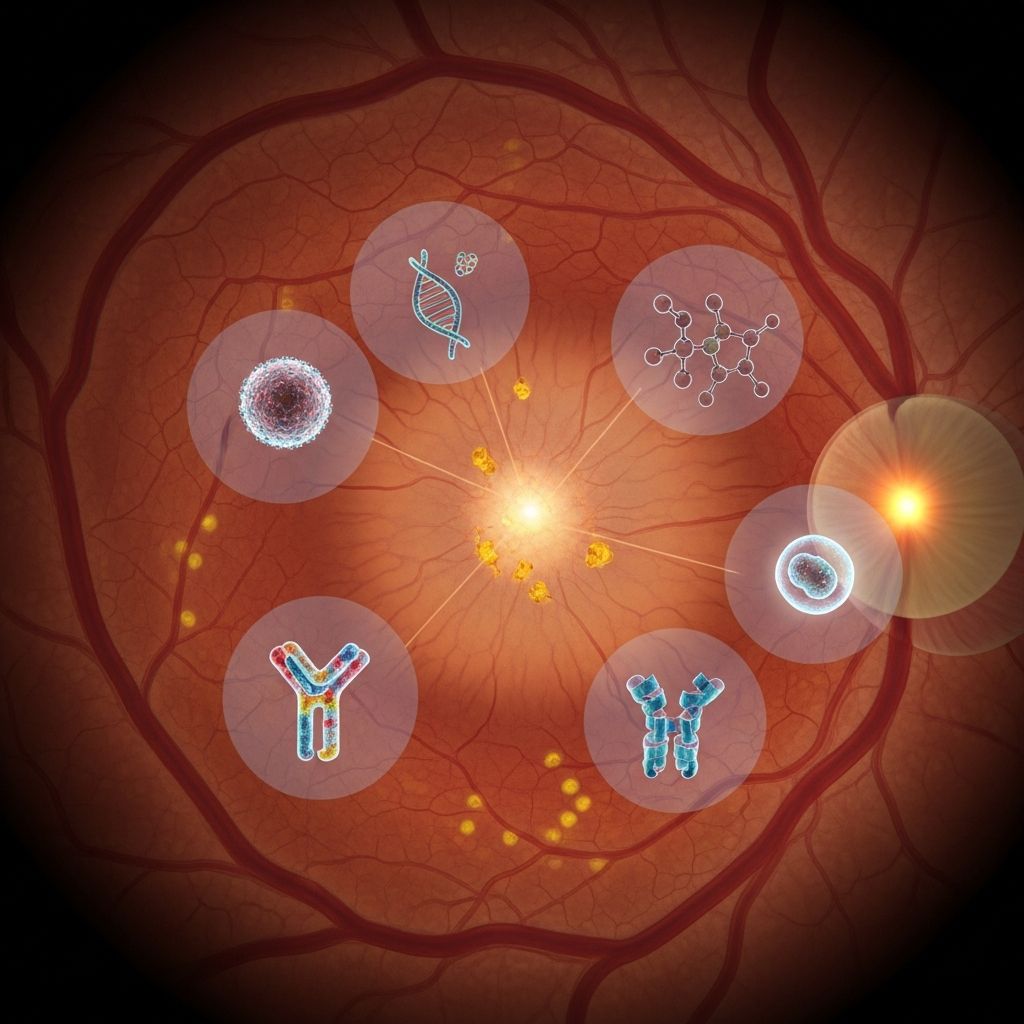
Age-related macular degeneration (AMD) remains the primary cause of irreversible vision loss among individuals over 60 in developed nations. Affecting the macula—the retina’s central area responsible for sharp, detailed vision—AMD manifests in two forms: dry (atrophic) and wet (neovascular). Dry AMD, comprising about 85-90% of cases, progresses slowly through retinal cell degeneration, often culminating in geographic atrophy (GA). Wet AMD, though less common, advances rapidly due to abnormal blood vessel growth beneath the retina, leading to leakage and scarring. Recent clinical advancements have introduced therapies that not only slow these processes but, in some cases, restore functional vision, transforming patient outcomes.
Understanding the AMD Landscape
AMD’s prevalence is staggering: millions worldwide grapple with its effects, impairing daily activities like reading, driving, and recognizing faces. Risk factors include advanced age, smoking, genetics, and cardiovascular issues. Traditional management for wet AMD relies on frequent anti-vascular endothelial growth factor (anti-VEGF) injections, such as aflibercept or ranibizumab, which stabilize vision but demand lifelong commitment—often every 4-12 weeks. Dry AMD has historically lacked effective interventions until recent FDA approvals. Today’s pipeline brims with gene therapies, stem cell innovations, complement inhibitors, and bioelectronic devices, addressing root causes rather than symptoms.
Breakthroughs in Dry AMD Management
Dry AMD’s advanced stage, GA, destroys photoreceptors and supporting cells, creating blind spots. Two landmark FDA approvals in 2023—pegcetacoplan (Syfovre) and avacincaptad pegol (Izervay)—target the complement system, a key inflammatory pathway in GA progression. Pegcetacoplan, administered monthly or bi-monthly via intravitreal injection, reduced GA lesion growth by up to 36% over 24 months in phase 3 trials (OAKS and DERBY). It binds complement protein C3, halting downstream damage. Avacincaptad pegol, dosed monthly, similarly curbed growth by 35% at 12 months (GATHER2 trial), inhibiting C5. Both carry risks like intraocular inflammation and retinal vasculitis, yet offer the first disease-modifying options for GA.
Beyond pharmacology, light therapy devices like Valeda (LumiThera), approved in 2024, use multi-wavelength photobiomodulation to enhance mitochondrial function in retinal cells. In LIGHTSITE III, patients aged 50+ with intermediate dry AMD gained significant best-corrected visual acuity (BCVA) improvements sustained over 24 months.
Stem Cell Innovations for Retinal Regeneration
Regenerative medicine holds transformative potential. A pioneering trial transplants adult stem cells derived from peripheral blood into the subretinal space for advanced dry AMD. Initial low-dose cohorts (50,000 cells) demonstrated safety and vision gains in treated eyes, with ongoing monitoring of higher doses (150,000-250,000 cells). This approach aims to repopulate lost retinal pigment epithelium (RPE). Similarly, ASP7317—stem cells differentiated into RPE-like cells—is injected submacularly in GA patients, with phase 1/2 trials assessing safety, tolerability, and vision metrics.
Revolutionizing Wet AMD Treatment
Wet AMD’s hallmark—leaky neovascularization—responds well to anti-VEGFs, but treatment burden leads to non-adherence. Newer agents extend intervals: Faricimab (Vabysmo), FDA-approved in 2022, dually inhibits VEGF-A and angiopoietin-2, reducing vascular leakage and inflammation. Phase 3 trials (TENAYA, LUCERNE) showed comparable BCVA gains to aflibercept, with 59% maintaining 16-week dosing. Side effects mirror standard anti-VEGFs: endophthalmitis, retinal detachment.
Sustained-delivery systems alleviate injection frequency. Susvimo, an implantable port for high-dose ranibizumab, refills every 6+ months. Post-LADDER refinements minimized early vitreous hemorrhage risks; FDA-approved in 2021 for prior anti-VEGF patients.
Gene Therapy: A One-Time Solution
ABBV-RGX-314 (RGX-314), a one-time subretinal gene therapy, delivers a transgene for sustained anti-VEGF production. Phase 1/2 trials in wet AMD patients show durable VEGF suppression, potentially eliminating repeat injections. It’s advancing in phase 3 for neovascular AMD, targeting the 2 million affected in the US, Europe, and Japan. Other candidates like 4D-150 explore AAV vectors for macular neovascularization.
Related Stories



Bionic Implants: Restoring Lost Vision
For end-stage dry AMD, bioelectronic prostheses bypass degenerated photoreceptors. The PRIMA implant—a 2x2mm wireless subretinal array—acts as artificial photoreceptors, electrically stimulating remaining bipolar cells. Unlike progression-slowing drugs, PRIMA restored functional vision in GA patients: trial participants regained reading ability, with an NEJM editorial hailing it as the first such achievement for over 5 million globally affected. Measuring just 30µm thick, it integrates seamlessly, transmitting signals to the brain.
Pipeline Therapies and Clinical Trials
Ongoing trials promise further gains. JNJ-81201887 (AAVCAGsCD59), a gene therapy expressing CD59 complement inhibitor, reduced GA lesion growth versus sham in phase 2. Pozelimab + cemdisiran, subcutaneous complement inhibitors, target GA in ages 50-85. These complement-focused strategies build on Syfovre/Izervay successes.
| Treatment | Type | Target | Status | Key Benefit |
|---|---|---|---|---|
| Pegcetacoplan (Syfovre) | Injection (C3 inhibitor) | Dry AMD/GA | FDA-approved 2023 | Slows lesion growth 30-36% |
| Avacincaptad pegol (Izervay) | Injection (C5 inhibitor) | Dry AMD/GA | FDA-approved 2023 | Reduces growth ~35% |
| Faricimab (Vabysmo) | Anti-VEGF/Ang-2 | Wet AMD | FDA-approved 2022 | Extended dosing intervals |
| RGX-314 | Gene therapy | Wet AMD | Phase 3 | Potential one-time treatment |
| PRIMA Implant | Bionic prosthesis | Dry AMD/GA | Clinical trials | Restores functional vision |
| ASP7317 | Stem cell RPE | Dry AMD/GA | Phase 1/2 | Cell replacement |
Challenges and Future Directions
Despite promise, hurdles persist: injection-related risks (inflammation, vasculitis), access disparities, and long-term safety for novel modalities. Stem cell therapies require immunosuppression; gene therapies face immune responses to vectors. Combination approaches—e.g., complement inhibition plus neuroprotection—may yield superior results. Patient selection via biomarkers (genetics, imaging) will optimize outcomes. Regulatory momentum is strong, with FDA Breakthrough designations accelerating reviews.
Frequently Asked Questions (FAQs)
- What is the difference between wet and dry AMD? Dry AMD involves gradual retinal thinning; wet features sudden vessel leakage. Dry affects most patients but progresses slower.
- Are new GA treatments curative? No, Syfovre and Izervay slow progression but don’t reverse damage. Implants like PRIMA restore some function.
- How often are injections needed for wet AMD now? Newer drugs like Vabysmo allow 12-16 week intervals versus monthly.
- Who qualifies for gene therapy trials? Typically those 50+ with active wet AMD unresponsive to standard care; check sites like UCLA or UCSD.
- Can lifestyle slow AMD? Yes—quit smoking, eat leafy greens, exercise, control blood pressure.
These innovations signal a paradigm shift from palliation to preservation and restoration. Patients should consult retina specialists for personalized risk-benefit assessments and trial eligibility.
References
- New Stem Cell Therapy Trial Offers Hope for Millions Living with Untreatable Advanced Dry Macular Degeneration — Macular Hope Org. 2025 (approx., recent trial update). https://macularhope.org/new-stem-cell-therapy-trial-offers-hope-for-millions-living-with-untreatable-advanced-dry-macular-degeneration/
- UCLA Macular Degeneration Clinical Trials — UCLA Health (.edu). Recent (2025+). https://ucla.clinicaltrials.researcherprofiles.org/macular-degeneration
- UCSD Macular Degeneration Clinical Trials for 2025 — UCSD (.edu). 2025. https://clinicaltrials.ucsd.edu/macular-degeneration
- A new treatment round-up for AMD and GA — Optometry Times. Recent (2024-2025). https://www.optometrytimes.com/view/a-new-treatment-round-up-for-amd-and-ga
- In Editorial, The New England Journal of Medicine Calls Science PRIMA… — Science.xyz (NEJM reference). Recent. https://science.xyz/news/new-england-journal-of-medicine-prima-editorial/
Similar Articles








Read full bio of Sneha Tete