Endocrine Mucin-Producing Sweat Gland Carcinoma Pathology
Comprehensive pathology overview of EMPSGC: rare eyelid tumor with neuroendocrine features and mucin production in elderly women.
Endocrine mucin–producing sweat gland carcinoma (EMPSGC) is a rare, low-grade cutaneous adnexal neoplasm that predominantly affects the eyelid skin of elderly women. It exhibits morphological and immunohistochemical similarities to endocrine ductal carcinoma in situ and solid papillary carcinoma of the breast, often progressing to associated invasive mucinous carcinoma with neuroendocrine differentiation.
Clinical features
EMPSGC typically presents as a slow-growing, asymptomatic nodule or cyst-like lesion on the eyelid or periorbital skin. Patients are usually women over 60 years old, though cases in men and younger individuals have been documented. The tumor measures 0.5–2 cm in diameter, appears as a flesh-colored papule, nodule, or plaque, and may show surface telangiectasia or crusting. It is dermally based with an intact overlying epidermis, mimicking benign lesions like hydrocystoma.
In rare instances, EMPSGC demonstrates aggressive behavior with local recurrence, lymph node metastasis, or even distant skin metastasis. A documented case involved a primary eyelid tumor progressing to chest wall recurrence and scapular skin metastasis, highlighting the potential for transformation into mucinous carcinoma components.
Histopathology
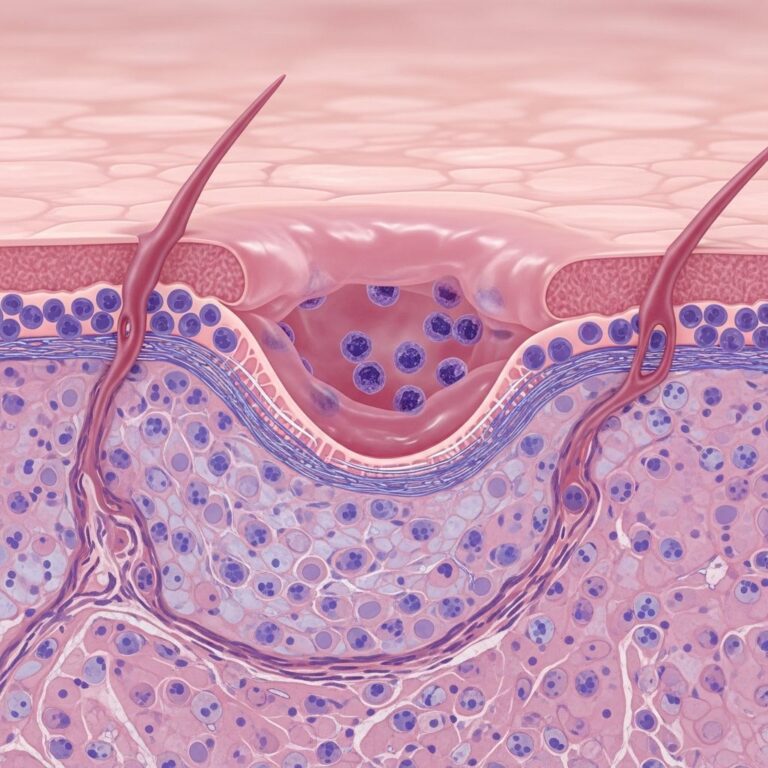
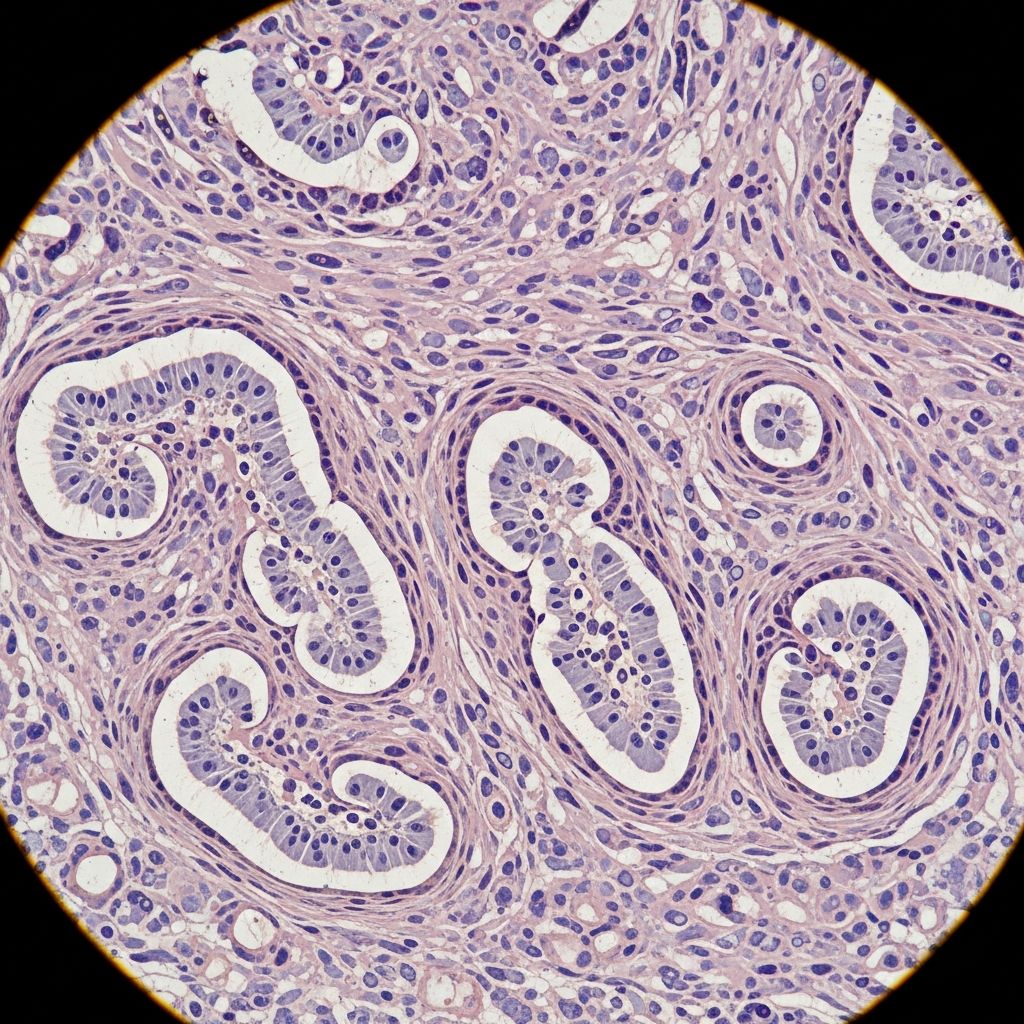
Microscopic examination reveals a well-circumscribed, multinodular tumor confined to the dermis, often with cystic spaces resembling hydrocystoma. The tumor comprises uniform round-to-oval cells with abundant pale eosinophilic cytoplasm, distinct cell borders, and low-grade nuclei featuring fine chromatin and small nucleoli—indicative of neuroendocrine differentiation. Intracytoplasmic and extracellular mucin production is characteristic, with cells arranged in solid, papillary, or cribriform patterns.
Transition zones to invasive mucinous carcinoma are frequent, where tumor islands float in abundant extracellular mucin pools. These areas show sieve-like or solid nests of relatively uniform epithelial cells with visible nucleoli. Stroma may contain fibrous proliferation and chronic inflammation. No distinct capsule is present, with blurred boundaries in advanced cases.
Key histopathological features:
- Dermally based nodules and cystic spaces under intact epidermis
- Uniform cells with pale cytoplasm and neuroendocrine nuclei
- Abundant intracytoplasmic and extracellular mucin
- Patterns: solid, papillary, cribriform, transitioning to mucin pools
- Low mitotic activity; mild atypia
Cytology description
Cytological smears from fine-needle aspiration or scrapings display cohesive clusters of bland epithelial cells with abundant mucinous background. Cells have moderate pale cytoplasm, round nuclei with stippled chromatin, and inconspicuous nucleoli. Mucin droplets within cells and extracellular pools are prominent, aiding distinction from benign adnexal lesions.
Microscopic (histologic) images
Representative images demonstrate:
– Low-power view: Multinodular dermal tumor with cysts (H&E, 40x).
– Intermediate power: Nodules of uniform cells with mucin (H&E, 100x).
– High power: Pale cells with neuroendocrine chromatin and mucin (H&E, 400x).
– Transition to mucinous carcinoma: Tumor islands in mucin lakes (H&E, 200x).
– Metastatic lesion: Solid/cord-like tumor clusters in dermis (H&E, 200x).
Immunohistochemistry
EMPSGC shows a distinctive immunoprofile mirroring breast analogues. Tumor cells are diffusely positive for:
- Estrogen receptor (ER): Strong nuclear positivity in nearly all cases
- Progesterone receptor (PR): Variable, often positive
- Neuroendocrine markers: Synaptophysin, chromogranin (dot-like or diffuse)
- GCDFP-15 (BRST-2): Frequently positive, indicating apocrine differentiation
- CK7: Positive; CK20 negative
Related Stories



Negative stains include S100, SOX10 (ruling out melanocytic lesions), and p63 (basal layer marker). ER/PR positivity persists in recurrent and metastatic lesions, suggesting potential therapeutic targeting.
| Marker | Staining Pattern | Significance |
|---|---|---|
| ER | Strong nuclear (+) | Consistent; akin to breast DCIS |
| PR | Variable nuclear (+) | Supports hormonal influence |
| Synaptophysin/Chromogranin | Cytoplasmic (+) | Confirms neuroendocrine differentiation |
| GCDFP-15 | Cytoplasmic (+) | Apocrine/sweat gland origin |
| CK7 | Diffuse (+) | Epithelial marker |
| S100/SOX10 | Negative | Excludes melanoma |
Associated mucinous carcinoma
EMPSGC is spatially associated with invasive primary cutaneous mucinous carcinoma (PCMC) in 35.7% of cases, considered its precursor. Associated PCMC displays neuroendocrine features, with tumor nests in mucin pools showing ER/PR positivity. Recurrence rate for neuroendocrine PCMC is 12.3%, lower than non-neuroendocrine PCMC (30%). Metastasis is exceedingly rare (one locoregional case in 190 EMPSGCs).
In progression, EMPSGC transitions to mucinous areas with abundant extracellular mucin, floating epithelial nests, and sieve-like patterns. Metastatic deposits retain EMPSGC morphology or show pure mucinous carcinoma.
Differential diagnosis
EMPSGC may be misdiagnosed as benign cysts or basal cell carcinoma due to its rarity. Key differentials include:
- Hidrocystoma: Lacks atypia, mucin, neuroendocrine features; ER negative
- Basal cell carcinoma: Peripheral palisading, retraction artifact, BerEP4+; ER/Syn-
- Mucinous eccrine carcinoma (non-neuroendocrine PCMC): No neuroendocrine markers or ER
- Metastatic breast carcinoma: Clinical correlation; similar IHC but systemic disease
- Adnexal carcinoma NOS: Lacks specific mucin/neuroendocrine profile
IHC for ER, synaptophysin, and chromogranin is crucial for accurate diagnosis.
Prognosis and management
EMPSGC behaves indolently with low metastatic potential but recurs locally in up to 50% if incompletely excised, especially with associated PCMC. Wide local excision with 5-mm margins is standard. Mohs micrographic surgery ensures clear margins for eyelid lesions. Sentinel lymph node biopsy is considered for high-risk features (size >2 cm, lymphovascular invasion). ER positivity suggests potential for tamoxifen or aromatase inhibitors in unresectable/recurrent cases. Regular follow-up monitors for recurrence/metastasis.
Frequently Asked Questions (FAQs)
What is endocrine mucin-producing sweat gland carcinoma?
A rare, low-grade sweat gland tumor with mucin production and neuroendocrine differentiation, primarily on the eyelid.
Who is at risk for EMPSGC?
Elderly women (>60 years); slight female predominance.
Does EMPSGC metastasize?
Rarely; one case of distant skin metastasis reported, with lymph node involvement in transitional cases.
How is EMPSGC treated?
Wide local excision or Mohs surgery; hormonal therapy for advanced cases.
What does EMPSGC look like under the microscope?
Dermal nodules of pale cells with mucin, neuroendocrine nuclei, transitioning to mucin pools.
Recent advances
Recent studies confirm EMPSGC as a precursor to neuroendocrine mucinous sweat gland carcinoma, with genetic overlaps to breast solid papillary carcinoma (e.g., PIK3CA mutations). Multi-omics analyses reveal apocrine origin and hormonal driver pathways. A 2024 case report documented dual-component metastasis, emphasizing vigilant surveillance.
References
- Metastatic endocrine mucin-producing sweat gland carcinoma with two distinct carcinoma components — Frontiers in Oncology. 2024. https://www.frontiersin.org/journals/oncology/articles/10.3389/fonc.2024.1449270/full
- Endocrine mucin–producing sweat gland carcinoma pathology — DermNet NZ. 2023. https://dermnetnz.org/topics/endocrine-mucinproducing-sweat-gland-carcinoma-pathology
- An Update on Endocrine Mucin-Producing Sweat Gland Carcinoma — PMC / National Library of Medicine. 2021-03-01. https://pmc.ncbi.nlm.nih.gov/articles/PMC7953758/
- Endocrine mucin‐producing sweat gland carcinoma and associated neuroendocrine primary cutaneous mucinous carcinoma — Wiley Online Library / Journal of Cutaneous Pathology. 2021-02-16. https://onlinelibrary.wiley.com/doi/10.1111/cup.13983
Similar Articles








Read full bio of medha deb