Endometriosis Stages: 4 Stages, Symptoms, And Treatment
Understand the four stages of endometriosis, from minimal to severe, and how staging guides diagnosis and treatment options.
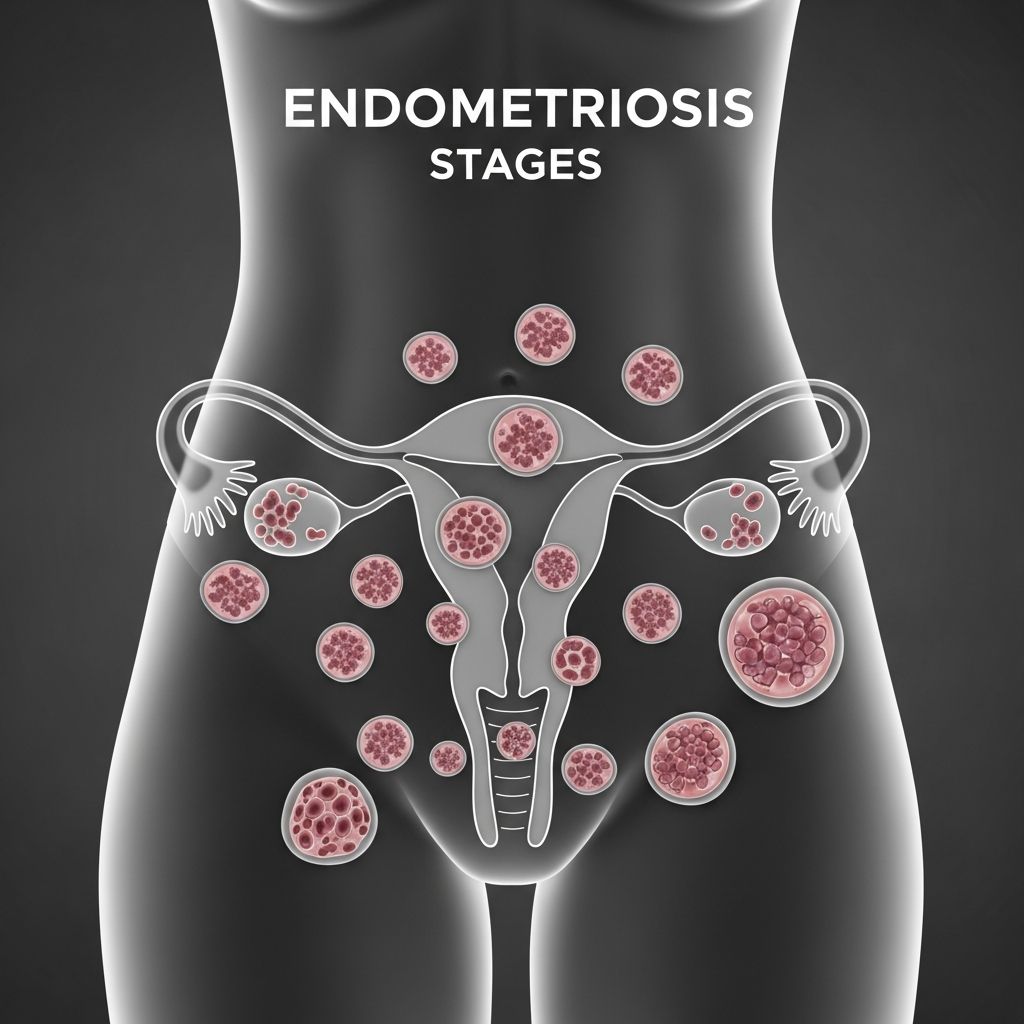
Endometriosis is a chronic condition where tissue similar to the uterine lining grows outside the uterus, often causing pelvic pain, infertility, and other symptoms. It is classified into four stages based on the location, extent, depth of endometrial implants, presence of adhesions, and ovarian endometriomas, as determined during laparoscopy using the American Society for Reproductive Medicine (ASRM) system.
What Are the Stages of Endometriosis?
The stages of endometriosis—labeled as stage I (minimal), stage II (mild), stage III (moderate), and stage IV (severe)—reflect the disease’s progression but do not always correlate directly with symptom severity. Staging helps clinicians plan treatment and predict outcomes like fertility success rates.
- Stage I (Minimal): Few superficial implants, no significant adhesions.
- Stage II (Mild): More implants, still superficial, minimal adhesions.
- Stage III (Moderate): Deep implants, small cysts on ovaries, filmy adhesions.
- Stage IV (Severe): Deep implants, large cysts, dense adhesions involving multiple organs.
This classification system, revised by the ASRM, scores lesions from 1-150 points, with higher scores indicating advanced stages. However, pain levels can be intense even in early stages due to inflammation and cytokine release in the peritoneal cavity.
Stage 1 Endometriosis
Stage 1, or minimal endometriosis, involves small, superficial implants (less than 5 mm deep) on the peritoneum or ovaries, totaling a score of 1-5 points. There are typically no endometriomas or significant adhesions. Women may experience mild pelvic pain during periods or no symptoms at all, but infertility affects up to 30-50% of cases across all stages.
Diagnosis requires laparoscopy, as imaging like ultrasound often misses these tiny lesions. Treatment focuses on pain management with NSAIDs or hormonal therapies like combined oral contraceptives to suppress estrogen-driven growth.
Stage 2 Endometriosis
In stage 2, mild endometriosis, there are more implants (still superficial) and possibly light adhesions, scoring 6-15 points. Symptoms include dysmenorrhea (painful periods), dyspareunia (painful intercourse), and chronic pelvic pain. Inflammation markers like IL-6 and TNF-α are elevated locally.
Conservative management is common, including progestins or GnRH agonists to reduce lesion activity. Laparoscopic excision can remove implants, improving fertility rates in mild cases.
Stage 3 Endometriosis
Stage 3, moderate endometriosis (score 16-40), features deep infiltrating implants (>5 mm), small endometriomas (<3 cm) on one or both ovaries, and filmy adhesions. This stage often distorts pelvic anatomy, contributing to infertility via tubal blockage or ovarian dysfunction.
Symptoms intensify, with heavy periods and bowel/bladder involvement possible. Treatment may involve surgery to ablate lesions and adhesiolysis, combined with IVF for fertility preservation. Hyperestrogenic environments exacerbate growth.
Stage 4 Endometriosis
The most advanced, stage 4 (severe, score >40), includes numerous deep implants, large endometriomas (>3 cm), and dense adhesions binding organs like bowels, bladder, and ureters. This can cause organ dysfunction, severe pain, and high infertility rates.
Hysterectomy or oophorectomy is considered in refractory cases, though it increases cardiovascular risks due to early menopause. Long-term risks include clear cell and endometrioid ovarian cancers (HR up to 3.77 for low-grade serous).
How Is Endometriosis Staged?
Related Stories



Staging occurs during diagnostic laparoscopy, the gold standard, where surgeons visualize and biopsy lesions. The ASRM system assigns points: superficial implants (1-2 points), deep (4-6), small cysts (16-20), large (20+), with multipliers for adhesions. Limitations include subjectivity and poor correlation with pain.
Emerging tools like MRI for deep infiltrating endometriosis or biomarkers (CA-125) aid but do not replace surgery.
Symptoms by Stage
Symptoms do not strictly align with stages due to individual factors like lesion location and inflammation:
| Stage | Common Symptoms | Prevalence |
|---|---|---|
| 1-2 (Minimal/Mild) | Mild dysmenorrhea, infertility | Subtle, often asymptomatic |
| 3 (Moderate) | Moderate pain, bloating, dyspareunia | 50-70% report pain |
| 4 (Severe) | Severe pain, GI issues, fatigue | Nearly 90% symptomatic |
Inflammation drives prostaglandins and cytokines, worsening pain regardless of stage.
Diagnosis and Tests
No non-invasive test confirms endometriosis; transvaginal ultrasound detects larger cysts, while laparoscopy with histology is definitive. Staging integrates visual findings and histopathology.
Treatment Options by Stage
- Early Stages (I-II): Hormonal suppression (OCPs, progestins), NSAIDs, lifestyle changes.
- Moderate/Severe (III-IV): Laparoscopic surgery, GnRH antagonists, aromatase inhibitors; assisted reproduction.
Treatments modulating estrogen may alter cancer risks.
Does Stage Affect Fertility?
Yes, advanced stages reduce natural conception (5-10% per cycle in stage IV vs. 20-30% in I-II), but surgery improves odds. IVF success drops with endometriomas.
Long-Term Risks and Complications
Beyond pain, endometriosis links to ovarian cancer (especially clear cell/endometrioid), autoimmune diseases like SLE (OR 1.4-2.0), and CVD, partly mediated by treatments like oophorectomy.
Frequently Asked Questions (FAQs)
What is the most common stage of endometriosis?
Stage IV is often diagnosed due to severe symptoms prompting surgery, though milder stages may go undetected.
Can endometriosis stages regress?
Yes, with hormonal therapy or pregnancy, but recurrence is common without ongoing management.
Is staging based on pain levels?
No, it’s anatomical; pain varies due to inflammation and nerve involvement.
How accurate is ultrasound for staging?
It’s limited for early stages but detects 80-90% of deep lesions in advanced cases.
Does hysterectomy cure all stages?
No, extra-uterine disease persists; it’s for severe, refractory cases only.
References
- Long-term Health Consequences of Endometriosis — Nezhat et al., National Library of Medicine, National Institutes of Health (PMC). 2021-02-15. https://pmc.ncbi.nlm.nih.gov/articles/PMC7864355/
- Endometriosis: revised American Society for Reproductive Medicine classification of endometriosis — ASRM. 1997 (authoritative standard, remains foundational for staging). https://www.asrm.org/globalassets/asrm/asrm-content/news-and-publications/practice-guidelines/for-non-members/endometriosis_revised_2012.pdf
- Endometriosis — World Health Organization. Updated 2023. https://www.who.int/news-room/fact-sheets/detail/endometriosis
- Revised American Society for Reproductive Medicine classification of endometriosis — Fertility and Sterility Journal (ASRM publication). 1996-11-01. https://doi.org/10.1016/S0015-0282(97)00398-X
Similar Articles








Read full bio of medha deb