Endovascular Coiling: Treatment for Brain Aneurysms
Minimally invasive endovascular coiling offers effective treatment for cerebral aneurysms with faster recovery than surgery.
Endovascular Coiling: A Minimally Invasive Treatment for Brain Aneurysms
Endovascular coiling is a minimally invasive medical procedure used to treat cerebral aneurysms, which are weakened areas in blood vessel walls within the brain that can rupture and cause life-threatening bleeding. This procedure has become one of the two primary treatment options for brain aneurysms, alongside surgical clipping. Unlike traditional open surgery, endovascular coiling is performed through small catheters threaded through the blood vessels, making it less traumatic to the body and offering patients faster recovery times with reduced complications.
What is Endovascular Coiling?
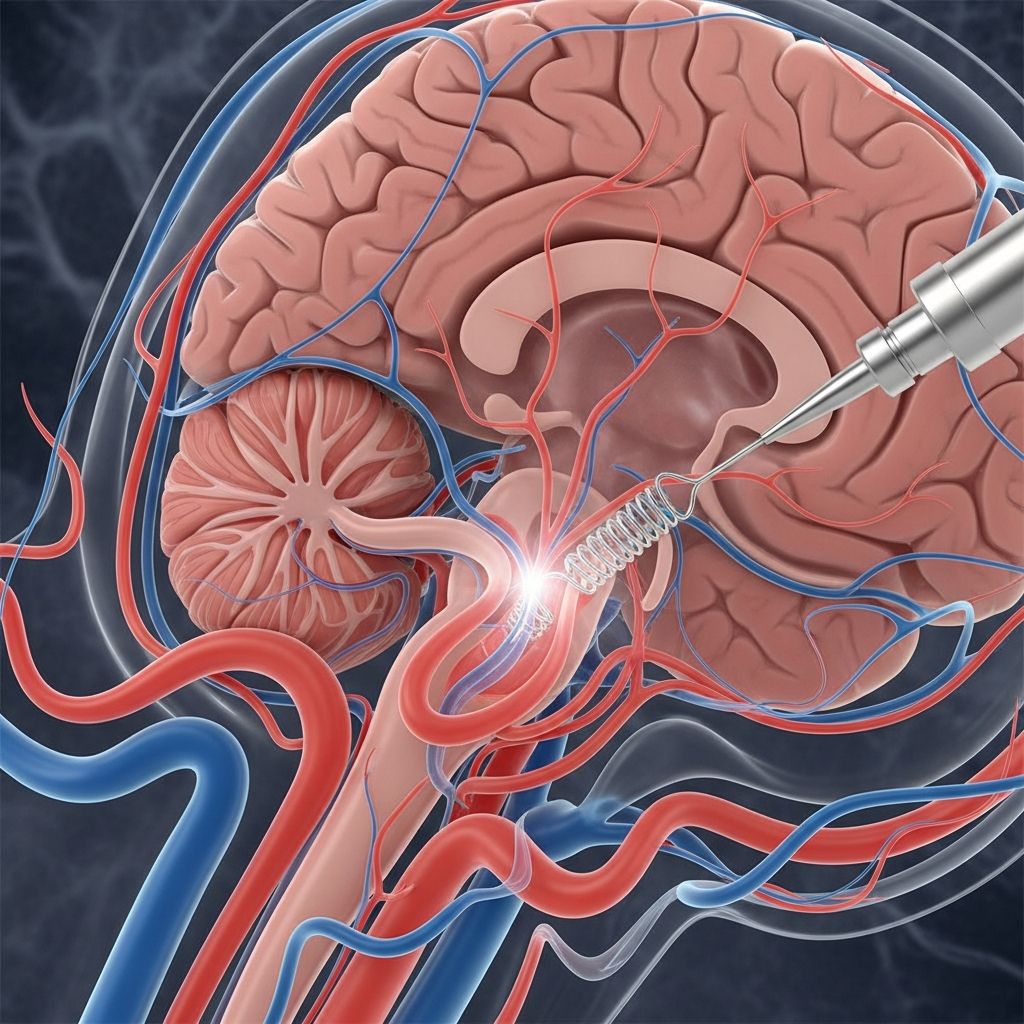
Endovascular coiling is an endovascular treatment that reduces blood circulation to an aneurysm by implanting detachable platinum wires (coils) directly into the abnormal blood vessel. The clinician carefully inserts one or more coils into the aneurysm until blood flow within the aneurysm space is significantly diminished or stopped completely. This procedure represents a major advancement in neurovascular medicine, offering patients an alternative to more invasive surgical approaches that require opening the skull.
The goal of endovascular coiling is twofold: preventing rupture in unruptured aneurysms and preventing rebleeding in aneurysms that have already ruptured. By limiting blood circulation to the aneurysm space, the procedure reduces the risk of catastrophic bleeding that could cause stroke, brain damage, or death.
How Does Endovascular Coiling Work?
The mechanism of endovascular coiling relies on promoting blood clotting (thrombosis) within the aneurysm to eventually seal it from normal blood flow. This is accomplished through several interconnected processes:
Hemodynamic Changes: The coils work by decreasing the amount of blood flowing into the aneurysm, which increases the time blood remains in the aneurysm space (residence time) and reduces blood velocity. This change in blood flow dynamics reduces wall shear stress on the aneurysm wall, creating conditions favorable for clot formation.
Several critical factors influence the success of thrombosis formation within the coiled aneurysm:
– Aneurysm type and configuration- Aneurysm position relative to blood flow direction- Coil packing density within the aneurysm- Angle of parent vessel curvature- Size of the aneurysm neck
It is important to note that while coils provide the appropriate physical conditions for thrombosis to occur, the actual clotting process depends on the body’s natural biological responses. The coils essentially set the stage, but biological processes must complete the sealing of the aneurysm.
The Endovascular Coiling Procedure
Endovascular coiling is typically performed by an interventional neuroradiologist or neurosurgeon with specialized training in endovascular techniques. The entire procedure is performed under general anesthesia and requires continuous fluoroscopic imaging guidance to visualize blood vessels and guide the instruments accurately.
Step-by-Step Procedure Overview
1. Catheter Placement: A guiding catheter is inserted through the femoral artery in the groin and carefully advanced to a position close to the aneurysm. This serves as the main channel through which other instruments and materials will be directed.
2. Angiography and Assessment: Once the guiding catheter is positioned, angiography is performed by injecting contrast dye to visualize and locate the aneurysm precisely. This imaging allows the physician to assess the aneurysm’s size, shape, neck diameter, and relationship to surrounding blood vessels.
Related Stories



3. Microcatheter Navigation: A smaller, more maneuverable microcatheter is then navigated into the aneurysm itself. This delicate instrument allows precise delivery of the coils into the aneurysm space.
4. Coil Deployment: Detachable platinum coils are inserted through the microcatheter into the aneurysm. The first coil is typically positioned along the aneurysm wall to create a framework, which is then filled with progressively smaller coils to achieve adequate packing density.
5. Success Verification: After coil placement, contrast dye is injected into the parent artery while the physician observes under fluoroscopy. If no dye flows into the aneurysm space, the procedure is considered successful and complete.
Types of Coils and Materials
Modern endovascular coiling procedures utilize several types of coils, each with specific advantages:
– Guglielmi Detachable Coils (GDC): Made of platinum, these were among the first successful coils used for aneurysm treatment- Matrix Coils: Platinum coils coated with a biopolymer to enhance thrombogenesis- Hydrogel-Coated Coils: Designed to promote faster clot formation within the aneurysm
Coils are available in various diameters, lengths, and cross-sectional shapes to accommodate different aneurysm sizes and geometries. This variety allows physicians to customize treatment for each patient’s specific anatomy.
Who is a Good Candidate for Endovascular Coiling?
While endovascular coiling can treat many types of aneurysms, certain anatomical features make patients particularly suitable for this procedure:
– Aneurysms with small neck size (preferably less than 4 mm)- Luminal diameter less than 25 mm- Aneurysms that are clearly distinct from the parent vessel
Patients with these characteristics tend to have better outcomes because the smaller neck makes it easier to pack coils effectively without prolapsing into the parent vessel, and the smaller aneurysm size reduces the risk of coil compaction over time.
Special Considerations for Larger Aneurysms: Larger aneurysms present challenges because they require more coils, which can result in looser packing densities and are more susceptible to coil compaction due to higher blood flow forces. However, technological advances, including the use of stent-assisted coiling, have made treatment of many larger aneurysms possible.
Timing of Treatment
In ruptured aneurysms, timing of treatment is critical. Coiling is typically performed as quickly as possible after rupture because of the extremely high risk of rebleeding within the first few weeks following the initial hemorrhage. Rapid intervention significantly reduces the likelihood of a second, often catastrophic bleed.
Advantages of Endovascular Coiling
Endovascular coiling offers several significant advantages over traditional surgical clipping:
– Minimally Invasive: No need to open the skull; procedure performed through blood vessels- Faster Recovery: Patients typically experience significantly faster recovery times than surgical clipping- Reduced Mortality: Studies show a significant decrease in probability of death or dependency compared to traditional neurosurgical approaches- Lower Initial Morbidity: Less tissue trauma means fewer immediate complications and shorter hospital stays- Applicability: Can be performed on patients who may be poor surgical candidates due to age or medical conditions
Limitations and Risks
Recurrence Rates: One of the primary limitations of endovascular coiling is higher recurrence rates compared to surgical clipping. Recanalization—where the aneurysm refills with blood over time—can occur in a significant percentage of coiled aneurysms, requiring long-term follow-up imaging and potentially additional interventions.
Intraoperative Rupture: Due to the delicate nature of aneurysms, intraoperative rupture rates during coiling can reach as high as 7.6%, which is a serious procedural complication.
Coil Compaction: Over time, coils may compact or become displaced, reducing their effectiveness in preventing blood flow into the aneurysm. This is particularly problematic in larger aneurysms with looser packing densities.
Long-Term Follow-up: Because of recurrence risks, patients who undergo endovascular coiling require regular imaging follow-up, often with repeat angiography or advanced imaging studies at specified intervals to monitor for aneurysm regrowth or recanalization.
Endovascular Coiling vs. Surgical Clipping: A Comparison
| Aspect | Endovascular Coiling | Surgical Clipping |
|---|---|---|
| Invasiveness | Minimally invasive; catheter-based | Invasive; requires craniotomy |
| Recovery Time | Faster recovery; shorter hospital stay | Longer recovery; extended hospital stay |
| Permanence | Higher recurrence rates; requires follow-up | More permanent; lower recurrence rates |
| Mortality/Morbidity | Lower immediate complications | Higher initial trauma-related risks |
| Long-term Outcomes | May require repeat interventions | Results tend to be more durable |
| Suitable Anatomy | Best for small-neck aneurysms | Effective for wide-neck aneurysms |
The choice between endovascular coiling and surgical clipping depends on multiple factors including aneurysm anatomy, patient age, medical comorbidities, and institutional expertise. Many modern centers use a multidisciplinary approach, with both interventional radiologists and neurosurgeons collaborating to determine the best treatment strategy for each individual patient.
Clinical Outcomes and Efficacy
Research comparing endovascular coiling to surgical clipping has produced mixed but informative results. The International Subarachnoid Aneurysm Trial (ISAT), a landmark randomized prospective study, initially found favorable results for coiling. However, long-term follow-up data revealed higher recurrence and rehemorrhage rates after endovascular coiling. Studies analyzing these findings have generally concluded:
– Approximately 18 studies found equivalent outcomes between coiling and clipping- Approximately 18 studies found advantages to coiling- Approximately 10 studies found advantages to clipping- Results suggest no single clear consensus, but clinically useful information has emerged for treatment selection
Advancements in Endovascular Technology
While endovascular coiling remains an important treatment option, technology continues to evolve. Stent-assisted coiling has been developed to address some limitations of coiling alone, particularly for wide-necked aneurysms. Additionally, flow diversion devices represent a newer endovascular approach that shows promise for certain aneurysm types. These developments expand the range of aneurysms that can be treated endovascularly and improve long-term durability of treatment.
Recovery and Follow-up Care
Patients who undergo endovascular coiling typically experience faster recovery than those undergoing surgical clipping. Most patients spend one to three days in the hospital, compared to longer stays required after traditional surgery. However, recovery includes the need for regular follow-up imaging to monitor for aneurysm recurrence. Follow-up typically involves MRI or CT angiography at specified intervals, often at 6 months, 1 year, and then periodically thereafter, depending on the aneurysm’s characteristics and initial treatment result.
Frequently Asked Questions
Q: What is the success rate of endovascular coiling?
A: Success rates vary but are generally high in the immediate term, with approximately 80-90% of aneurysms achieving complete or near-complete occlusion initially. However, recurrence rates of 10-30% have been reported over follow-up periods, which is why long-term monitoring is essential.
Q: Is endovascular coiling painful?
A: The procedure is performed under general anesthesia, so patients do not experience pain during the procedure. Some mild discomfort at the groin access site may occur after the procedure, which typically resolves quickly with standard pain management.
Q: How long does the endovascular coiling procedure take?
A: The procedure duration varies depending on aneurysm complexity but typically ranges from one to three hours. More complex cases with difficult anatomy may require longer procedure times.
Q: What are the risks of endovascular coiling?
A: Risks include intraoperative rupture (approximately 7.6%), stroke from thrombus formation, groin hematoma, allergic reactions to contrast dye, and long-term aneurysm recurrence requiring additional treatment. Serious complications occur in approximately 3-5% of procedures.
Q: Will I need surgery if endovascular coiling fails?
A: If endovascular coiling is unsuccessful or if recurrence occurs, surgical clipping or repeat endovascular coiling may be necessary. Treatment decisions are individualized based on anatomy, timing, and clinical status.
Q: How often do I need follow-up imaging after coiling?
A: Follow-up imaging schedules vary but typically include studies at 6 months and 1 year post-procedure, then periodically as recommended by your physician based on aneurysm characteristics and initial treatment completeness.
Conclusion
Endovascular coiling represents a significant advancement in the treatment of cerebral aneurysms, offering patients a minimally invasive alternative to traditional surgical approaches. The procedure’s less invasive nature results in faster recovery, reduced initial morbidity, and lower immediate complication rates compared to surgical clipping. However, the higher recurrence rates associated with coiling necessitate long-term follow-up imaging and patient monitoring. Treatment decisions should be individualized based on aneurysm anatomy, patient factors, and institutional expertise, often involving collaboration between interventional radiologists and neurosurgeons. As technology continues to advance, endovascular approaches are becoming increasingly effective for treating a wider range of aneurysm types and sizes.
References
- Microsurgical Clipping and Endovascular Coiling of Intracranial Aneurysms: A Critical Review of the Literature — U.S. National Library of Medicine, National Institutes of Health. 2008-06. https://pubmed.ncbi.nlm.nih.gov/18824986/
- Endovascular Coiling — Wikipedia. Accessed December 2025. https://en.wikipedia.org/wiki/Endovascular_coiling
- Endovascular Treatment of Aneurysmal Subarachnoid Hemorrhage — Johns Hopkins University Research. https://pure.johnshopkins.edu/en/publications/endovascular-treatment-of-aneurysmal-subarachnoid-hemorrhage-4
- Computational Fluid Dynamics and Biofluids: In Silico Modeling of Flow Diverter Stent Hemodynamics — Johns Hopkins University. 2024-09. https://me.jhu.edu/wp-content/uploads/2024/09/Computational-Fluid-Dynamics-and-Biofluids-Sample-Essay.pdf
- Brain Aneurysms: FAQs with Rafael Tamargo, M.D. — Johns Hopkins Medicine. https://www.youtube.com/watch?v=5ZCGwuaapgs
Similar Articles








Read full bio of Sneha Tete