Eosinophilic Dermatosis of Haematological Malignancy
Rare skin eruption linked to blood cancers: clinical features, diagnosis, and management challenges.
What is eosinophilic dermatosis of haematological malignancy?
Eosinophilic dermatosis of haematological malignancy (EDHM), also known as eosinophilic dermatosis of hematologic malignancy, is a rare cutaneous eruption observed in patients with underlying haematological malignancies, particularly blood cancers. First described as an exaggerated reaction resembling arthropod (insect) bites, EDHM is characterized by prominent tissue eosinophilia— an increased number of eosinophils in the skin. Eosinophils are a type of white blood cell produced in the bone marrow, identifiable by their coarse granules in the cytoplasm. These cells play roles in combating parasitic infections and modulating allergic responses, releasing inflammatory mediators that contribute to the pruritic (itchy) lesions seen in EDHM.
The condition manifests as recurring, itchy or tender skin lesions that can mimic insect bites but occur independently of actual bites. It typically arises in the context of haematoproliferative disorders, with the skin eruption potentially preceding, coinciding with, or following the diagnosis of the malignancy. While rare, recognition is crucial as it may signal underlying blood cancer and influence prognosis.
Who gets eosinophilic dermatosis of haematological malignancy?
EDHM predominantly affects individuals with haematological malignancies. The most common association is with chronic lymphocytic leukaemia (CLL), a slow-progressing cancer of lymphocytes, where it has been most frequently reported. Less commonly, it occurs in patients with:
- Acute myeloid leukaemia (AML)
- Acute lymphoblastic leukaemia (ALL)
- Mantle cell lymphoma
- Multiple myeloma
- Myelofibrosis
- Large cell lymphoma
- Other myeloproliferative disorders
Demographics mirror those of the associated malignancies: typically older adults, with CLL patients often over 60 years. Men may be slightly more affected due to CLL epidemiology, but no strict gender predominance exists for EDHM itself. Patients are often immunocompromised due to their malignancy or treatments, heightening susceptibility to exaggerated inflammatory responses.
What are the clinical features of eosinophilic dermatosis of haematological malignancy?
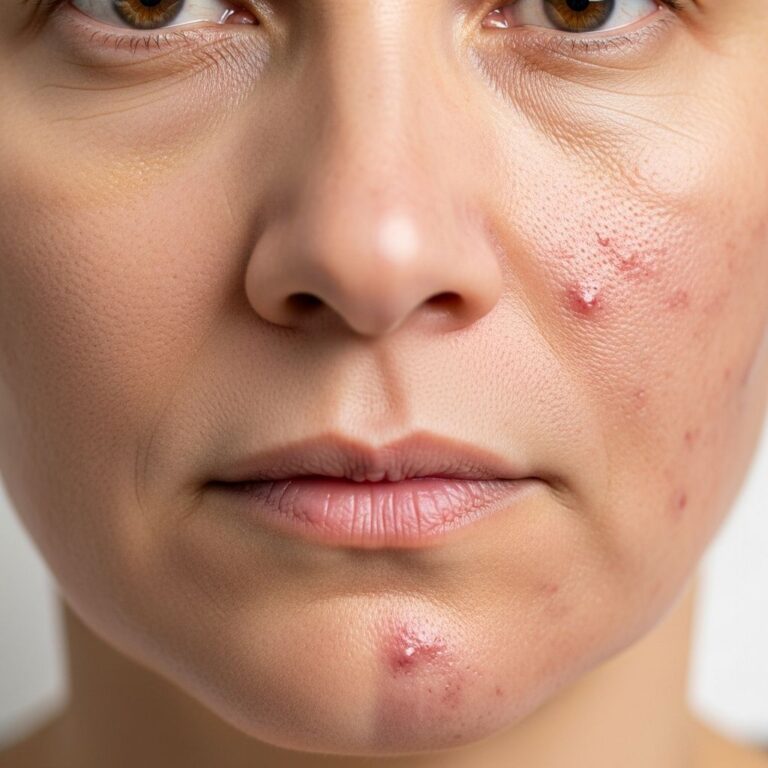
The hallmark of EDHM is a polymorphic (varied) eruption of pruritic or tender papules, nodules, plaques, and occasionally vesicles or blisters. Lesions are often widespread, favouring the trunk, extremities, and face, but can appear anywhere. Key clinical features include:
- Small, dome-shaped papules: Red to violaceous, 2–10 mm, intensely itchy or painful.
- Nodules and plaques: Larger, indurated lumps or coalescing plaques up to several cm.
- Vesicles/pustules: Less common, fluid-filled or pus-like, simulating bites.
- Excoriations and crusting: Due to scratching, leading to secondary infection risk.
- Lesions recur in crops, persisting weeks to months, resolving with hyperpigmentation.
Unlike true insect bites, patients often deny bite history, and lesions lack central puncta. Systemic symptoms like fever or lymphadenopathy relate to the underlying malignancy rather than EDHM.
| Feature | Common | Rare |
|---|---|---|
| Papules/Nodules | >80% cases | Vesicles/Blisters |
| Itch/Tenderness | Universal | Pustules |
| Trunk/Extremities | Primary sites | Mucosal involvement |
What causes eosinophilic dermatosis of haematological malignancy?
The precise aetiology remains elusive, but immune dysregulation from the haematological malignancy is implicated. Proposed mechanisms include:
- Cytokine imbalance: Overproduction of interleukin-5 (IL-5), a key eosinophil growth and recruitment factor, due to dysregulated lymphocytes.
- Hypersensitivity reaction: Exaggerated response to minor triggers like true insect bites, resolving slower in malignancy context.
- Paraneoplastic phenomenon: Skin eruption as a remote effect of cancer, not direct infiltration.
No infectious or allergic triggers are consistently identified, distinguishing it from hypersensitivity to mosquito bites (HMB) syndromes.
How is the diagnosis of eosinophilic dermatosis of haematological malignancy made?
Diagnosis relies on clinicopathological correlation using these criteria:
- Presence of haematological malignancy (known or concurrent).
- Characteristic skin lesions: pruritic papules/nodules/plaques.
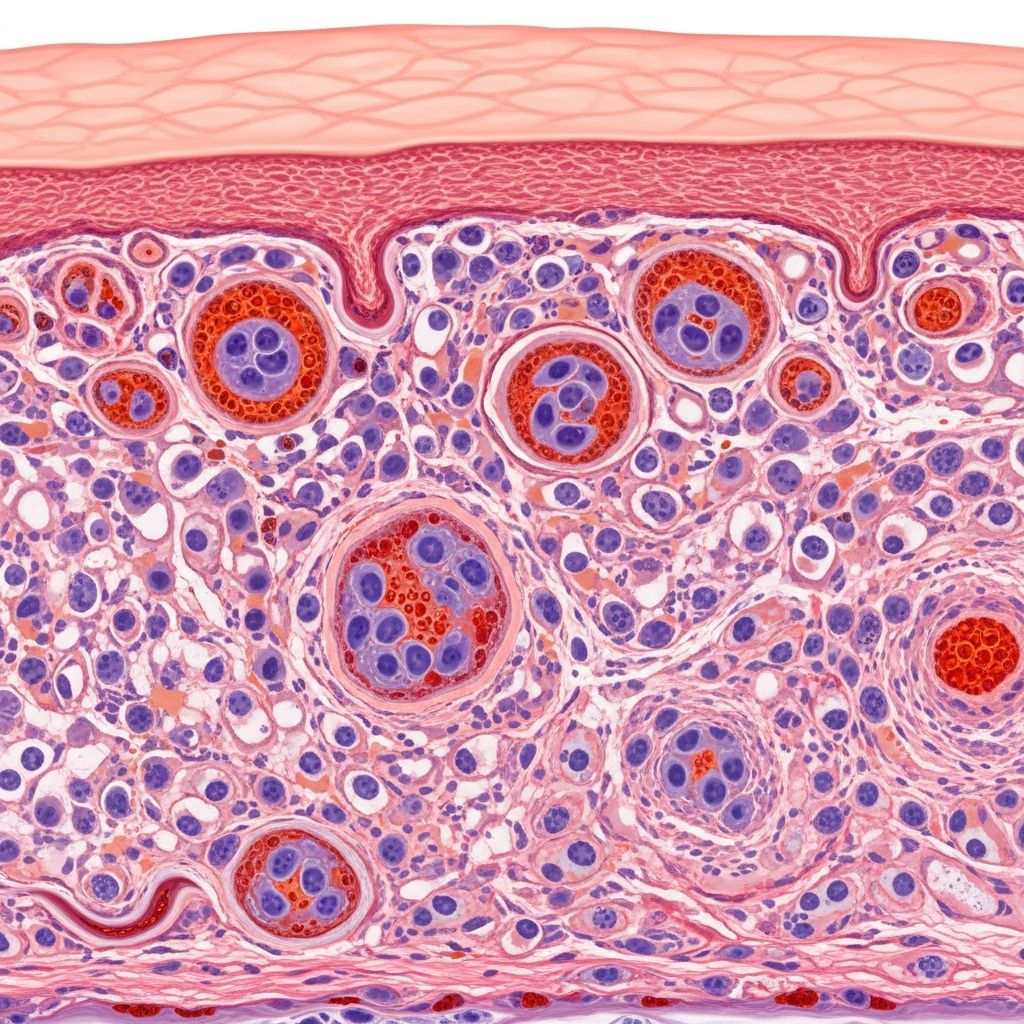
- Histopathology: dense superficial/mid-dermal eosinophilic infiltrate, flame figures (eosinophil degranulation), no vasculitis.
- Peripheral blood eosinophilia (often mild, >0.5 × 10⁹/L).
- Exclusion of mimics (e.g., arthropod bites, drug eruptions, bullous pemphigoid).
Investigations:
- Skin biopsy: Essential, showing eosinophil-rich infiltrate without atypical lymphocytes.
- Blood tests: Eosinophil count, malignancy workup (flow cytometry, bone marrow).
- Immunofluorescence: Negative, ruling out autoimmune bullous diseases.
What is the treatment of eosinophilic dermatosis of haematological malignancy?
Treatment targets symptoms and underlying malignancy, with variable success. Skin-directed therapies include:
- Topical corticosteroids: High-potency (e.g., clobetasol) for mild cases.
- Topical calcineurin inhibitors: Tacrolimus for face.
- Phototherapy: Narrowband UVB, effective in refractory cases.
Systemic options:
- Oral corticosteroids: Prednisone 0.5–1 mg/kg, short-term.
- Hydroxychloroquine: 200–400 mg/day, immunomodulatory.
- Dapsone: 50–100 mg/day, if G6PD normal.
- Indomethacin or other NSAIDs for inflammation.
Recent advances: Dupilumab (IL-4/13 inhibitor) shows promise in eosinophil-driven cases. Treating the malignancy (chemotherapy, ibrutinib for CLL) often improves skin lesions. Responses are disappointing in ~50%.
What is the outcome for eosinophilic dermatosis of haematological malignancy?
EDHM follows the prognosis of the underlying malignancy. Studies suggest poorer outcomes: higher mortality in CLL patients with EDHM vs. without (median survival 12 vs. 48 months in some cohorts). It may indicate aggressive disease or treatment resistance. Lesions wax/wane with malignancy activity; spontaneous remission rare.
Frequently Asked Questions (FAQs)
Q: Is EDHM contagious?
A: No, EDHM is not infectious or contagious; it’s a reactive dermatosis linked to internal malignancy.
Q: Can EDHM appear before cancer diagnosis?
A: Yes, skin lesions can precede haematological malignancy detection by months to years, prompting investigation.
Q: Does treating the cancer cure the skin rash?
A: Often improves or resolves it, but symptomatic treatment may still be needed.
Q: How common is EDHM in CLL patients?
A: Rare, <1% of CLL cases, but underrecognized.
Q: Are there new treatments like biologics?
A: Yes, dupilumab targets eosinophil pathways effectively in recent reports.
Differential Diagnosis
- Arthropod bites
- Hypersensitivity to mosquito bites
- Drug eruptions
- Bullous pemphigoid
- Prurigo nodularis
References
- Eosinophilic dermatosis of hematologic malignancy: a case report — eScholarship. 2015. https://escholarship.org/uc/item/4k8908jb
- Eosinophilic dermatosis of haematological malignancy — DermNet NZ. 2014-07-01. https://dermnetnz.org/topics/eosinophilic-dermatosis-of-haematological-malignancy
- Eosinophilic dermatosis of hematologic malignancy — PubMed (J Cutan Pathol). 2012-07. https://pubmed.ncbi.nlm.nih.gov/22612903/
- Eosinophilic dermatosis of haematological malignancy (EDHM) — Wiley Online Library. 2021. https://onlinelibrary.wiley.com/doi/full/10.1002/jvc2.72
- Eosinophilic Dermatosis of Hematologic Malignancy — Cureus. 2024. https://www.cureus.com/articles/266746-eosinophilic-dermatosis-of-hematologic-malignancy.pdf
- Eosinophilic Dermatosis Associated With Hematologic Disorders — JAMA Dermatology. 2004. https://jamanetwork.com/journals/jamadermatology/fullarticle/479047
Similar Articles








Read full bio of Sneha Tete