Eosinophilic Pustular Folliculitis of Infancy
Rare benign skin condition in infants featuring recurrent sterile pustules on scalp, with eosinophilia and pruritus, typically resolving by age 3.
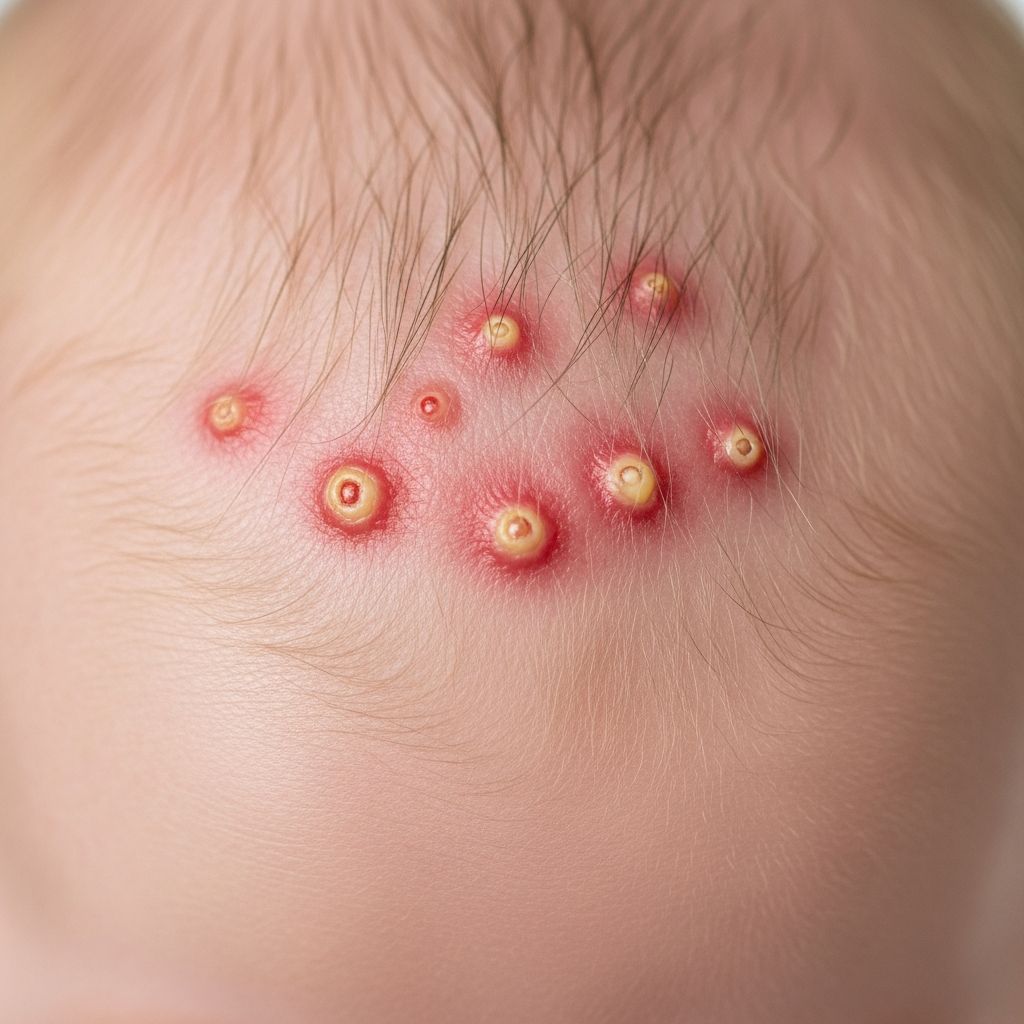
What is eosinophilic pustular folliculitis of infancy?
Eosinophilic pustular folliculitis of infancy (EPFI), also known as infantile eosinophilic pustular folliculitis, is a rare, benign, self-limited inflammatory skin disorder primarily affecting infants younger than 36 months. It is characterized by recurrent crops of sterile, pruritic papulopustules containing eosinophils, often on an erythematous base, predominantly on the scalp but also involving the face, neck, trunk, and extremities in up to two-thirds of cases. Unlike the adult form (Ofuji disease), EPFI lacks annular plaques or halos around lesions and is not associated with HIV. The condition is noninfectious, with negative cultures for bacteria, fungi, and viruses, though secondary bacterial infection with Staphylococcus aureus can occur.
EPFI typically presents in the first year of life, with 70% of cases onset before 6 months and 95% before 14 months; only 5% start after 14 months. It affects males four times more frequently than females and may have a familial tendency, particularly among siblings. Patients remain systemically well, without fever or other signs of illness, though peripheral blood eosinophilia is common during flares (present in the vast majority), normalizing between episodes. Pruritus is a hallmark, causing significant discomfort in affected infants.
The disease follows a relapsing-remitting course, with episodes lasting 1-4 weeks, healing with postinflammatory hyperpigmentation, and recurrences often at prior sites. Spontaneous resolution occurs by age 3 in most cases, though lesions may persist up to 5 years in rare instances. Early recognition is crucial to avoid unnecessary antibiotics, antifungals, or invasive tests, especially in preterm neonates where it can mimic severe infections.
Who gets eosinophilic pustular folliculitis of infancy?
EPFI predominantly affects infants, with peak onset in the neonatal period to early infancy:
- Age: 70% before 6 months; 95% before 14 months; rare beyond 36 months.
- Sex: Male predominance (4:1 male-to-female ratio).
- Familial cases: Reported clustering in families, e.g., brothers, suggesting possible genetic factors.
- Associations: Possible link to atopy or prematurity; frequent in preterm infants with immature immune systems or prior Candida infections. No systemic involvement.
What causes eosinophilic pustular folliculitis of infancy?
The etiology of EPFI remains unknown (idiopathic), but several hypotheses exist:
- Immune dysregulation: Likely role of aberrant T-cell responses or hypersensitivity leading to eosinophil recruitment to hair follicles.
- Genetic factors: Familial cases imply heritability.
- Prematurity link: Common in preterm infants, possibly due to immunological immaturity.
- Other speculations: Hormonal influences, hypersensitivity reactions; no infectious trigger confirmed.
Unlike adult EPF associated with immunosuppression, EPFI occurs in immunocompetent infants.
What are the clinical features of eosinophilic pustular folliculitis of infancy?
EPFI manifests as recurrent outbreaks of crops (isolated or grouped) of 1-3 mm
sterile papulopustules
on an erythematous base, often with peripheral collarette scaling or crusting. Key features include:- Primary site: Scalp (nearly all cases); extends to face, neck, trunk, extremities in 65%.
- Appearance: Pustules evolve to crusts, heal with hyperpigmentation; no scarring.
- Symptoms: Intense
pruritus
(most cases); infants irritable. - Labs: Peripheral
eosinophilia
during flares (vast majority); normal between episodes. Leukocytosis possible. - Course: Flares last 1-4 weeks; recurrences over months-years; resolves <3 years.
| Site | Frequency |
|---|---|
| Scalp | ~100% |
| Face/Neck | ~65% |
| Trunk/Extremities | ~65% |
Related Stories



Diagnosis
Diagnosis is clinical, supported by histopathology and exclusion of infection. Cardinal features: scalp involvement, recurrent sterile pustules, tissue/blood eosinophilia.
- Clinical suspicion: Infant with recurrent scalp pustules + pruritus + eosinophilia.
- Microbiology: Negative cultures (bacteria, fungi, viruses) essential.
- Histopathology: Punch biopsy shows eosinophil-rich pustules in follicular infundibulum/ostium, spongiosis, dermal eosinophilic infiltrate (>20 eosinophils/high-power field); lymphocytes/histiocytes. Folliculitis in ~62%.
- Labs: CBC for eosinophilia (flare-dependent); normal CRP/WBC otherwise.
Differential diagnosis
EPFI mimics bacterial/fungal folliculitis, especially in neonates. Key differentials:
| Condition | Key Distinguishers from EPFI |
|---|---|
| Bacterial folliculitis (S. aureus) | Positive culture; neutrophils > eosinophils; fever possible. |
| Tinea capitis (kerion) | Fungal elements on KOH/PAS; alopecia; responds to antifungals. |
| Langerhans cell histiocytosis | Systemic symptoms; atypical cells on biopsy; purpuric papules. |
| Hyper-IgE syndrome | Chronic staphylococcal infections; high IgE; skeletal anomalies. |
| Infantile acropustulosis | Acral distribution; resolves faster; fewer eosinophils. |
| Erythema toxicum neonatorum | Transient, first week of life; eosinophils but no folliculitis. |
Investigations
- Skin swab/pustule aspiration for Gram stain, culture (bacteria/fungi), viral PCR.
- CBC: Eosinophilia confirms during flare.
- Skin biopsy: Gold standard for histology.
- Consider IgE if HIES suspected (normal in EPFI).
What is the treatment for eosinophilic pustular folliculitis of infancy?
Reassurance is key as EPFI is self-limited; treat symptomatically. No curative therapy.
- First-line: Topical corticosteroids (e.g., low-potency like hydrocortisone or moderate like betamethasone) for flares; resolves lesions quickly.
- Pruritus: Topical antipruritics or emollients.
- Refractory: Topical tacrolimus, oral antihistamines, or low-dose oral steroids short-term.
- Avoid: Systemic antibiotics/antifungals unless culture-positive.
In one case, topical betamethasone/clioquinol led to resolution with minor recurrences.
Clinical outcomes
Excellent prognosis: Spontaneous resolution by age 3 years in most; rare persistence to 5 years. Hyperpigmentation fades; no scarring. Recurrences decrease over time.
Frequently Asked Questions (FAQs)
Q: Is EPFI contagious?
No, EPFI is sterile and noninfectious.
Q: Does EPFI cause permanent damage?
No, it heals without scarring, though temporary hyperpigmentation may occur.
Q: When does EPFI resolve?
Typically by age 3 years; self-limited.
Q: Is biopsy always needed?
Not always; classic cases can be diagnosed clinically after excluding infection.
Q: Can EPFI affect preterm babies?
Yes, common in premies; consider early to avoid overtreatment.
References
- Eosinophilic Pustular Folliculitis of Infancy — DermNet NZ. 2023. https://dermnetnz.org/topics/eosinophilic-pustular-folliculitis-of-infancy
- Eosinophilic pustular folliculitis of infancy: A rare diagnosis in children — PMC/NCBI (Wiley). 2021-04-28. https://pmc.ncbi.nlm.nih.gov/articles/PMC8117823/
- Eosinophilic Pustular Folliculitis of Infancy — Annals of Clinical Case Reports. 2020. https://www.anncaserep.com/open-access/eosinophilic-pustular-folliculitis-of-infancy-4376.pdf
- Eosinophilic pustular folliculitis in infancy — VisualDx. 2023. https://www.visualdx.com/visualdx/diagnosis/eosinophilic+pustular+folliculitis+in+infancy
- Eosinophilic Pustular Folliculitis — StatPearls, NCBI Bookshelf. 2023-08-07. https://www.ncbi.nlm.nih.gov/books/NBK597380/
Similar Articles








Read full bio of Sneha Tete