Epidermoid And Trichilemmal Cyst Images, Clinical Guide
Comprehensive visual guide to epidermoid and trichilemmal cysts: clinical images, pathology, key differences for accurate diagnosis.
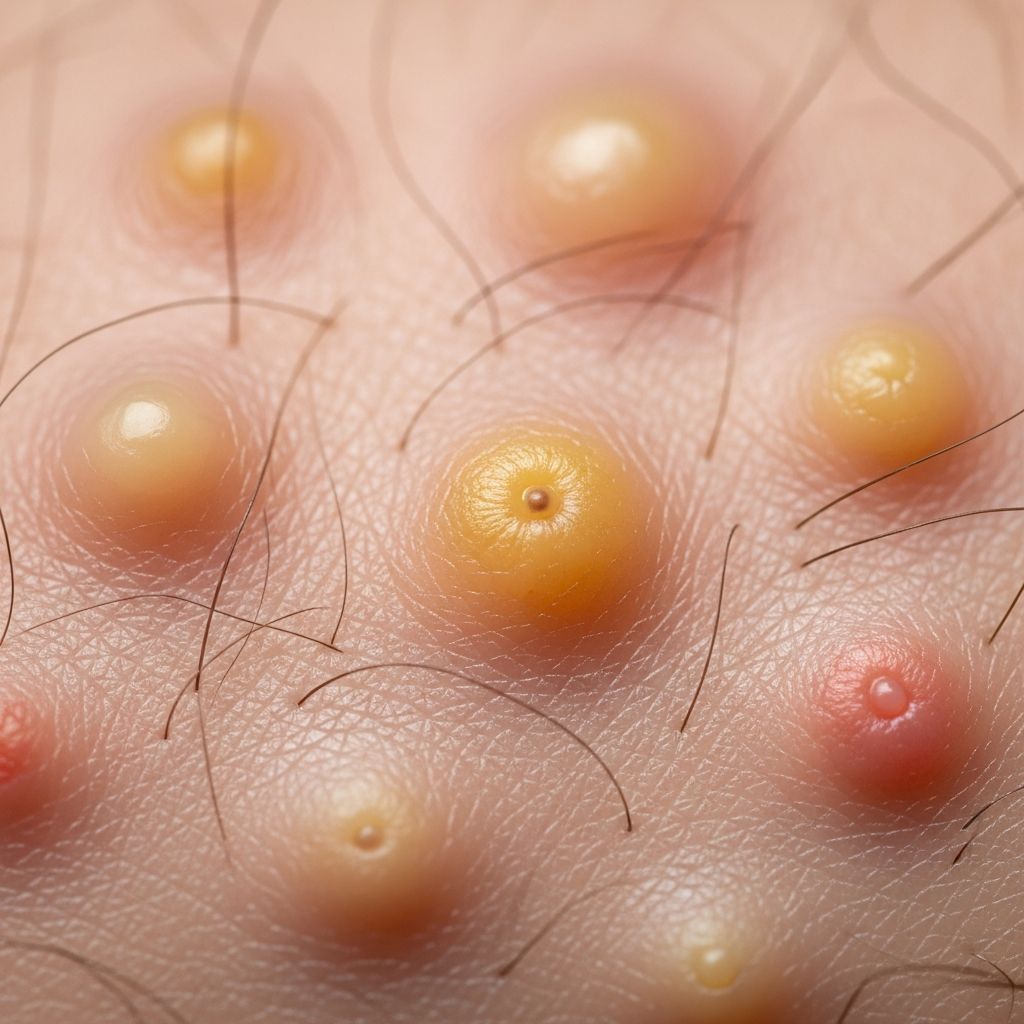
This comprehensive image gallery showcases epidermoid cysts (also known as epidermal inclusion cysts or infundibular cysts) and trichilemmal cysts (also called pilar cysts). These common benign skin lesions are frequently encountered in dermatological practice. Epidermoid cysts arise from the infundibulum of the hair follicle, while trichilemmal cysts originate from the outer root sheath. Understanding their visual characteristics aids in clinical diagnosis and differentiation from other subcutaneous nodules.
What are Epidermoid Cysts?
Epidermoid cysts are benign, encapsulated cysts derived from the infundibulum or upper portion of the hair follicle. They are filled with keratin and lipid-rich debris, forming a sac lined by epidermis-like epithelium. These cysts result from occlusion of the pilosebaceous unit or traumatic implantation of epidermal cells into the dermis.
- Prevalence: Common on the face, trunk, neck, and genitals; more frequent in men aged 20s-30s.
- Appearance: Firm, round, mobile nodules (0.5-5 cm), flesh-coloured to yellow-white, often with a central punctum.
- Symptoms: Usually asymptomatic; may discharge cheesy material if punctured; painful if inflamed or infected.
What are Trichilemmal Cysts?
Trichilemmal cysts, or pilar cysts, are keratin-filled cysts originating from the outer hair root sheath (trichilemma). They are composed of densely packed eosinophilic keratin without a granular layer. These cysts exhibit an autosomal dominant inheritance pattern and are multiple in familial cases.
- Prevalence: Predominantly on the scalp; diagnosed in middle-aged females; familial tendency.
- Appearance: Firm, smooth, subcutaneous nodules (0.5-5 cm); no central punctum; mobile under skin.
- Symptoms: Often painless unless inflamed; can rupture causing giant cell reaction.
Clinical Images of Epidermoid Cysts
Epidermoid cysts typically present as solitary or multiple dome-shaped nodules tethered to the epidermis via a punctum. The following descriptions highlight key visual features from clinical cases:
- Solitary facial epidermoid cyst: A 2 cm yellow-white nodule on the cheek with visible central black punctum, surrounded by mild erythema from recent manipulation.
- Multiple trunk cysts: Several 1-3 cm firm nodules on the chest, some expressing thick, caseous keratin debris upon pressure.
- Inflamed scrotal cyst: Red, tender 4 cm swelling on scrotum with overlying pustule, indicating rupture and secondary infection.
- Palmoplantar variant: Hyperkeratotic cyst on sole causing pain; mimics callus but mobile on deep palpation.
- Vulval epidermoid cyst: Subtle 1.5 cm nodule in labia majora, asymptomatic but cosmetically concerning.
These images demonstrate the variability in size, colour, and location, emphasizing the importance of palpation to confirm mobility and fluctuance.
Clinical Images of Trichilemmal Cysts
Trichilemmal cysts are scalp favourites, appearing as smooth, tense nodules without a punctum. Key image highlights include:
- Solitary scalp pilar cyst: 3 cm smooth, bluish nodule on occiput; firm to touch, non-tender.
- Multiple familial cysts: Cluster of 5-10 cysts (0.5-2 cm) along scalp vertex, inherited autosomal dominantly.
- Inflamed ruptured cyst: Erythematous, crusted lesion on parietal scalp with surrounding granulomatous reaction.
- Giant trichilemmal cyst: 5+ cm mass distorting scalp contour, risking ulceration if neglected.
- Proliferating variant: Rapidly growing scalp nodule mimicking neoplasm; histologically benign but exuberant.
Related Stories



Scalp location and lack of punctum distinguish them from epidermoid cysts visually.
Key Differences: Epidermoid vs Trichilemmal Cysts
| Feature | Epidermoid Cyst | Trichilemmal Cyst |
|---|---|---|
| Location | Face, trunk, genitals, extremities | Scalp (90%) |
| Punctum | Often present (central pore) | Absent |
| Epithelium | Stratum granulosum present | No granular layer; trichilemmal keratinisation |
| Keratin | Loose, laminated | Dense, eosinophilic, cholesterol clefts |
| Inheritance | Rarely familial | Autosomal dominant (familial multiple) |
| Calcification | Rare | Common (~25%) |
This table summarizes diagnostic discriminators; histology confirms when clinical doubt exists.
Histopathology Images
Microscopic views reveal defining features:
- Epidermoid cyst low power: Cyst lined by stratified squamous epithelium with granular layer; lumen filled with orthokeratotic keratin flakes.
- Trichilemmal cyst scan view: Abrupt keratinisation without granular layer; brightly eosinophilic, compact keratin with clefts (Figure 1).
- Ruptured trichilemmal cyst: Foreign body giant cell reaction to extruded keratin (Figure 2).
- Wall detail: Palisaded basal layer resembling outer root sheath; focal calcification (Figure 5).
These pathology slides are crucial for excluding mimics like basal cell carcinoma.
Complications
Both cyst types can rupture, leading to intense inflammation misdiagnosed as abscess.
- Infection: Common pathogens: Staphylococcus aureus, streptococci; treat with incision/drainage ± antibiotics.
- Scarring: Post-rupture fibrosis; preventive excision advised.
- Malignancy: Rare squamous cell carcinoma in epidermoid cysts (<1%); submit excisions for histology.
- Cosmetic/Pain: Scalp cysts cause alopecia; genital cysts impair function.
Treatment Options
Asymptomatic cysts require no intervention; spontaneous resolution occurs occasionally.
- Observation: For small, uncomplicated lesions.
- Incision & Curettage: For inflamed cysts; minimal scarring.
- Complete Excision: Gold standard; removes capsule to prevent recurrence (recurrence <5% if intact).
- Intralesional Steroids: For sterile inflammation.
- Antibiotics: Only if true infection (e.g., flucloxacillin for staphylococci).
Surgical excision under local anaesthesia is outpatient; scalp cysts may need larger incisions due to fibrosis.
Frequently Asked Questions (FAQs)
Are epidermoid and trichilemmal cysts dangerous?
Benign and harmless unless complicated by infection or rare malignancy. Most resolve or remain stable lifelong.
Why is my cyst painful and red?
Likely ruptured, causing dermal irritation or infection. Seek incision/drainage; avoid squeezing.
Do these cysts run in families?
Trichilemmal cysts often do (autosomal dominant); epidermoid less commonly.
Can cysts be removed without scarring?
No surgery leaves no scar; minimal excision techniques reduce visibility. Wait if cosmetic concern only.
What if a cyst is on my face or genitals?
Cosmetic excision viable; genital cysts may need specialist input to preserve function.
Is popping a cyst safe at home?
No; risks severe infection, scarring, recurrence. Professional removal essential.
This FAQ section addresses common patient concerns, promoting informed self-management.
Patient Education
Educate on avoidance of trauma, prompt infection reporting, and genetic counselling for familial cases. Images empower self-monitoring.
References
- Trichilemmal cyst pathology — DermNet NZ. 2023. https://dermnetnz.org/topics/trichilemmal-cyst-pathology
- Trichilemmal cyst — DermNet NZ. 2023. https://dermnetnz.org/topics/trichilemmal-cyst
- Epidermoid cyst — DermNet NZ. 2023. https://dermnetnz.org/topics/epidermoid-cyst
- Epidermoid and Pilar Cysts — Patient.info. 2024-01-15. https://patient.info/doctor/dermatology/epidermoid-and-pilar-cysts-sebaceous-cysts-pro
- Cutaneous cysts and pseudocysts — DermNet NZ. 2023. https://dermnetnz.org/topics/cutaneous-cysts-and-pseudocysts
Similar Articles








Read full bio of medha deb