Epidermolysis Bullosa Pruriginosa: Symptoms And 5 Treatments
Rare dystrophic EB variant marked by intense pruritus, nodular lesions, and scarring primarily on extremities.
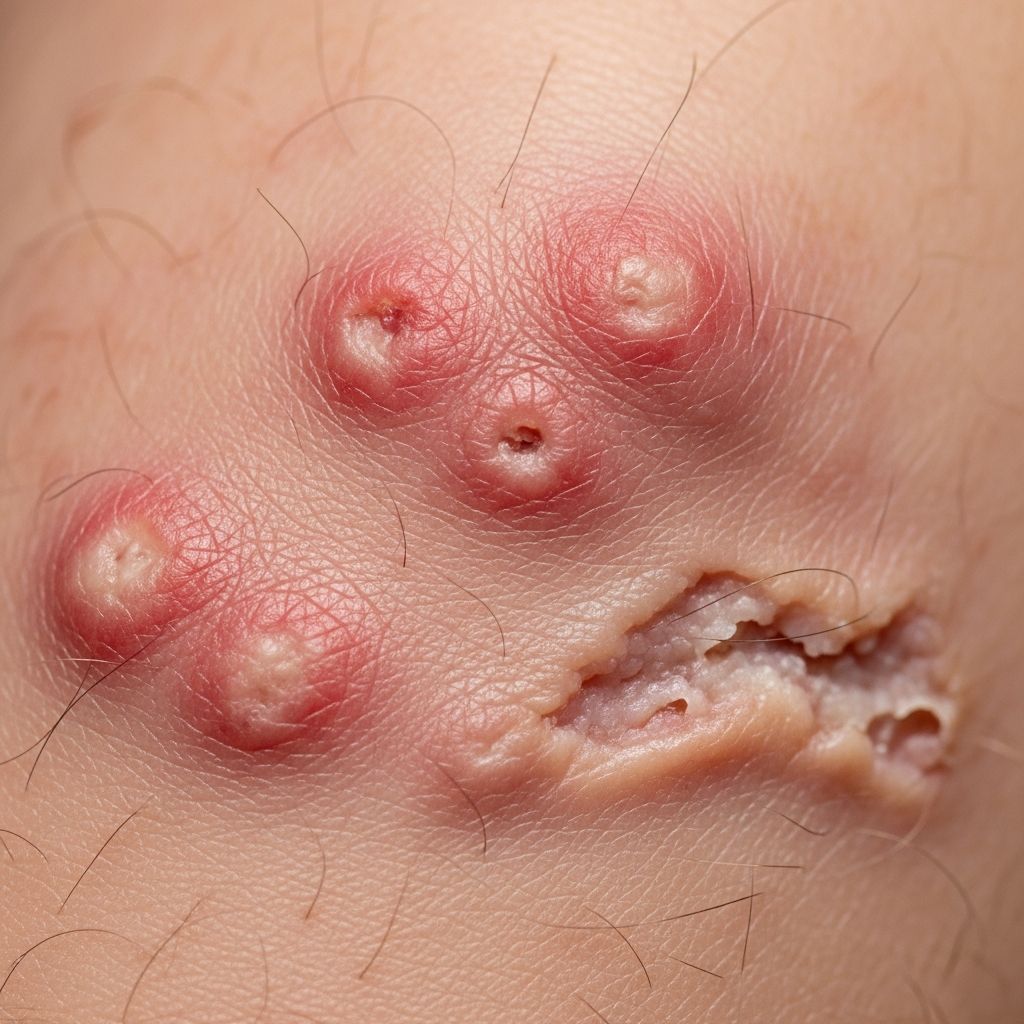
Epidermolysis bullosa pruriginosa (EBP) is a rare subtype of dystrophic epidermolysis bullosa (DEB), a group of inherited skin fragility disorders. It is distinguished by intensely pruritic (itchy) skin lesions that lead to hypertrophic papules, nodules, and plaques, predominantly on the lower extremities such as the shins and thighs. Unlike classical DEB, which often presents with widespread blistering from birth, EBP typically manifests later in life, with pruritus preceding or accompanying visible skin changes. This condition results from mutations in the COL7A1 gene, impairing type VII collagen and anchoring fibrils that secure the epidermis to the dermis.
The hallmark of EBP is severe, intractable itching that drives mechanical trauma through scratching, exacerbating blistering, excoriations, and scarring. Lesions often appear in a linear or nodular pattern due to the Koebner phenomenon, where trauma induces new lesions. While skin fragility is present, the pruriginosa phenotype emphasizes chronic inflammation and lichenification over extensive blistering.
What is epidermolysis bullosa pruriginosa?
Epidermolysis bullosa pruriginosa is classified under dystrophic epidermolysis bullosa, one of four main EB categories: simplex, junctional, dystrophic, and Kindler syndrome. Dystrophic EB arises from sublamina densa cleavage below the basement membrane due to defective type VII collagen, leading to tissue separation upon minor friction or trauma. EBP specifically features a pruriginous (itch-driven) presentation, with lesions resembling acquired inflammatory dermatoses rather than typical ‘cell-poor’ subepidermal blisters seen in standard EB descriptions.
Prevalence is extremely low, with fewer than 100 cases reported worldwide, often in sporadic or familial patterns. It can be autosomal dominant or recessive, but dominant forms predominate in EBP, linked to specific glycine substitutions in COL7A1. Environmental factors and individual itch response may modulate severity, explaining phenotypic variability even within families.
Who gets epidermolysis bullosa pruriginosa?
EBP affects individuals with COL7A1 mutations, typically presenting in adolescence or adulthood, though infantile onset of fragility occurs. Females and males are equally affected. A positive family history is common in dominant cases, but de novo mutations explain sporadic occurrences.
Pruritus may begin years before lesions, worsening the clinical picture. Risk factors include genetic predisposition; no strong links to atopy, IgE elevation, or other triggers have been confirmed.
What causes epidermolysis bullosa pruriginosa?
The primary cause is heterozygous or homozygous mutations in COL7A1 on chromosome 3p21.31, encoding type VII collagen. This protein forms anchoring fibrils essential for dermo-epidermal adhesion. Mutations reduce functional collagen or alter fibril assembly, causing dermal-epidermal separation.
Dominant EBP often involves glycine substitutions (e.g., G2035R), leading to dominant-negative effects. Pruritus pathogenesis is unclear but may involve neurogenic inflammation, cytokine dysregulation (e.g., IL-31), or mechanical stress amplifying itch-scratch cycles. Histology shows subepidermal blisters, fibrosis, milia, and inflammatory infiltrates including eosinophils, atypical for ‘classical’ EB.
What are the clinical features of epidermolysis bullosa pruriginosa?
Clinical features evolve in phases:
Related Stories



- Early phase: Skin fragility with blisters healing to atrophic scars and milia, often on extremities. Nail dystrophy (thickening, loss) is common.
- Pruriginous phase: Intense pruritus triggers hypertrophic papules, nodules, plaques, and lichenified lesions in linear arrangements on shins, thighs, arms, and trunk. Violaceous scarring, excoriations, and albopapuloid lesions appear.
- Chronic phase: Marked scarring, potential contractures, but less severe than other DEB forms. Oral involvement is rare.
Symptoms include intractable itch, pain from erosions, and secondary infection risk. Unlike simplex EB, scarring is prominent; unlike junctional EB, it’s not perinatally lethal.
How is epidermolysis bullosa pruriginosa diagnosed?
Diagnosis combines clinical suspicion, family history, and mechanobullous testing (blisters from friction). Key investigations:
- Skin biopsy: Immunofluorescence mapping shows type VII collagen reduction at dermal-epidermal junction. Routine histology reveals subepidermal blisters, hyperkeratosis, fibrosis, milia, and eosinophilic infiltrates.
- Electron microscopy: Confirms sublamina densa blisters and anchoring fibril abnormalities.
- Genetic testing: Identifies COL7A1 mutations, confirming diagnosis.
Differential includes prurigo nodularis, hypertrophic lichen planus, bullous pemphigoid, and other DEB variants. Inflammatory histology may mislead to autoimmune blistering disorders.
How is epidermolysis bullosa pruriginosa treated?
No cure exists; management is symptomatic and supportive:
- Wound care: Non-adherent dressings, topical antiseptics to prevent infection.
- Pruritus control: Potent topical steroids, calcineurin inhibitors, oral antihistamines, gabapentinoids, or immunosuppressants (e.g., methotrexate). Phototherapy (narrowband UVB) shows promise.
- Anti-itch strategies: Behavioral therapy to break itch-scratch cycle; emollients.
- Surgical: Scar release for contractures.
- Experimental: Gene therapy targeting COL7A1 in trials for DEB.
Multidisciplinary care involving dermatology, pain management, and psychology improves quality of life.
What is the outcome for epidermolysis bullosa pruriginosa?
Prognosis is better than severe DEB; no aggressive squamous cell carcinoma risk like recessive DEB. Persistent pruritus and scarring impair life quality, but life expectancy is near-normal without systemic complications. Early intervention mitigates progression.
Clinical variants
- Dominant EBP: Most common, late-onset pruritus, milder scarring.
- Recessive EBP: Rarer, more extensive blistering.
- Adult-onset: Rare cases starting after age 50.
Diagnosis
See above; table summarizes:
| Method | Findings |
|---|---|
| IFM | Reduced COL7A1 |
| Histology | Subepidermal blister, eosinophils |
| Genetics | COL7A1 mutations |
Management
- Emollients daily.
- Topical corticosteroids for acute flares.
- Systemic gabapentin for neuropathic itch.
- Monitor for infection, malnutrition.
Frequently Asked Questions
Q: Is epidermolysis bullosa pruriginosa curable?
A: No, but symptoms can be managed effectively with multidisciplinary care.
Q: When does pruritus start in EBP?
A: Often in adolescence or adulthood, sometimes years before lesions.
Q: Can EBP lead to skin cancer?
A: Low risk compared to other DEB; monitor chronic wounds.
Q: Is genetic testing necessary?
A: Yes, for confirmation and family counseling.
Q: What triggers worsening?
A: Scratching, friction; avoid irritants.
References
- Epidermolysis bullosa – Symptoms and causes — Mayo Clinic. 2023-10-15. https://www.mayoclinic.org/diseases-conditions/epidermolysis-bullosa/symptoms-causes/syc-20361062
- Epidermolysis Bullosa Pruriginosa: A Case With Prominent… — JAMA Dermatology. 2014-04-16. https://jamanetwork.com/journals/jamadermatology/fullarticle/1680393
- Epidermolysis bullosa pruriginosa — DermNet NZ. 2023. https://dermnetnz.org/topics/epidermolysis-bullosa-pruriginosa
- Epidermolysis Bullosa — StatPearls, NCBI Bookshelf. 2023-07-17. https://www.ncbi.nlm.nih.gov/books/NBK599531/
- Dystrophic epidermolysis bullosa pruriginosa — Orphanet. 2023. https://www.orpha.net/en/disease/detail/89843
Similar Articles








Read full bio of medha deb