Epidermolytic Hyperkeratosis Pathology: A Comprehensive Guide
Detailed histological analysis of epidermolytic hyperkeratosis, its patterns, and clinical associations in dermatological conditions.
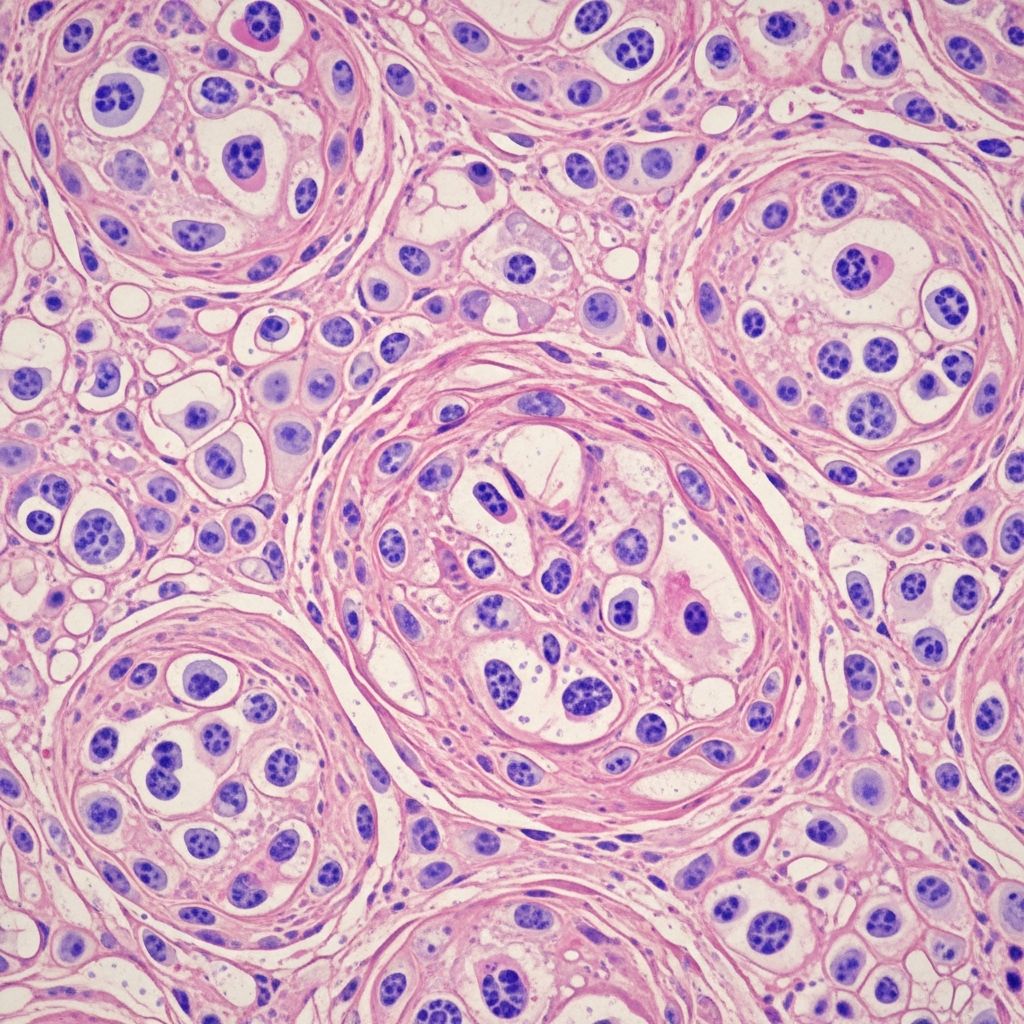
Epidermolytic hyperkeratosis represents a distinctive histological pattern observed in the epidermis, either as an isolated finding or associated with specific dermatological conditions. This pattern is characterized by unique changes in the stratum spinosum and granulosum, making it diagnostically significant in skin biopsies.
Introduction
Epidermolytic hyperkeratosis (EHK), also known as hyperkeratosis palmoplantaris cum epidermolysis, is not a standalone disease but a histopathological reaction pattern. It arises due to genetic mutations affecting keratin proteins, leading to structural instability in keratinocytes. This manifests as vacuolar degeneration, coarse keratohyalin granules, and hyperkeratosis, primarily in the suprabasal layers of the epidermis.
The term encompasses changes seen in congenital ichthyoses, localized lesions, and occasionally incidental findings near other dermatoses. Understanding this pattern is crucial for accurate diagnosis, as it guides clinical correlation and genetic testing.
Histology
At low magnification, biopsies showing epidermolytic hyperkeratosis reveal marked hyperkeratosis and variable epidermal hyperplasia. The epidermis appears thickened with a compact orthokeratotic stratum corneum overlying altered suprabasal layers.
Key diagnostic features include:
- Vacuolar degeneration of keratinocytes in the stratum spinosum and granulosum, creating a reticulated appearance due to clear spaces around nuclei.
- Hypergranulosis with irregular, clumped keratohyalin granules that are larger and coarser than normal.
- Perinuclear eosinophilic halos surrounding degenerated nuclei, often with binucleate or multinucleate cells.
- Compact hyperkeratosis without parakeratosis, distinguishing it from other ichthyotic patterns.
These changes are most prominent in the upper spinous and granular layers, sparing the basal layer. Electron microscopy further reveals tonofilament clumping and intermediate filament disruption, confirming keratin cytoskeletal defects.
Clinical Features and Associations
Epidermolytic hyperkeratosis manifests differently based on its clinical context, ranging from widespread congenital erythroderma to solitary lesions.
Epidermolytic Ichthyosis
Formerly bullous congenital ichthyosiform erythroderma, this is the prototypical systemic condition featuring EHK. Neonates present with generalized erythroderma, fragility, and blistering due to mechanical stress on fragile keratinocytes. Over time, blistering decreases, evolving into thick, ridged hyperkeratosis on flexures, extremities, and intertriginous areas. Palmoplantar involvement (PS-type) correlates with KRT1 mutations, while non-palmoplantar (NPS-type) links to KRT10 mutations.
Infections, odor from bacterial overgrowth, and secondary complications like dehydration or sepsis are common in infancy.
Epidermolytic Acanthoma
This presents as solitary, warty papules or plaques, often on the trunk or genitals. Histology shows focal EHK confined to the lesion, without systemic involvement. Rarely, disseminated forms occur.
Epidermal Naevus (Epidermolytic Variant)
Linear or systematized epidermal naevi may exhibit EHK histology, following Blaschko’s lines. These are mosaic manifestations of the same keratin mutations, presenting as hyperkeratotic streaks from birth.
Epidermolytic Leukoplakia
A rare mucosal variant with epidermolytic changes on non-keratinized surfaces like oral or genital mucosa, showing vacuolization and hypergranulosis.
Incidental Finding
EHK can appear in normal skin adjacent to unrelated lesions, such as melanomas or inflammatory dermatoses, possibly representing a reactive or mosaic phenomenon.
Pathogenesis
EHK stems from heterozygous mutations in KRT1 or KRT10 genes, encoding keratin 1 and 10 proteins. These suprabasal keratins form intermediate filaments that provide mechanical resilience to the epidermis.
Related Stories



Mutations disrupt filament assembly, causing keratin aggregates, cell fragility, and cytolysis upon friction. This triggers compensatory hyperproliferation and hyperkeratosis. About 50% of cases are de novo; inherited cases follow autosomal dominant patterns, with rare recessive KRT10 forms.
Mouse models confirm that partial suppression of mutant alleles via siRNA can ameliorate phenotypes, hinting at gene therapy potential.
| Feature | KRT1 Mutation (PS-type) | KRT10 Mutation (NPS-type) |
|---|---|---|
| Palmoplantar Keratosis | Prominent | Absent |
| Distribution | Body-wide including palms/soles | Body excluding palms/soles |
| Inheritance | Dominant (mostly) | Dominant or recessive |
| Neonatal Blistering | Severe | Severe |
Diagnosis
Diagnosis integrates clinical presentation, family history, and histopathology. Skin biopsy is diagnostic, revealing the classic triad of vacuolization, hypergranulosis, and keratohyalin clumping.
Genetic testing confirms KRT1/KRT10 mutations, essential for prenatal diagnosis via chorionic villus sampling or amniocentesis. Differentiate from epidermolysis bullosa, lamellar ichthyosis, SSSS, and drug eruptions via histology and immunofluorescence.
Treatment
Management is symptomatic:
- Emollients and keratolytics: Urea, lactic acid, salicylic acid to reduce hyperkeratosis.
- Topical retinoids: Tazarotene for localized lesions.
- Antimicrobials: For secondary infections; bleach baths for odor control.
- Systemic agents: Retinoids or beta-carotene in severe cases, though side effects limit use.
Emerging therapies target mutations: siRNA and gene editing show promise in preclinical models.
Frequently Asked Questions (FAQs)
Is epidermolytic hyperkeratosis inherited?
Yes, typically autosomal dominant via KRT1 or KRT10 mutations; 50% are de novo.
What does EHK look like under the microscope?
Vacuolar degeneration, coarse keratohyalin, and perinuclear halos in spinous/granular layers.
Can EHK be cured?
No cure yet; symptomatic treatment. Gene therapy is experimental.
Does EHK affect palms and soles?
Only in KRT1-related PS-type.
Is biopsy always needed for diagnosis?
Yes, for confirmation, especially in atypical presentations.
Prognosis
While neonatal morbidity is high, most survive infancy. Lifelong hyperkeratosis persists, but adaptations improve quality of life. Genetic counseling is recommended.
References
- Getting a handle on epidermolytic hyperkeratosis — Dermatology Times. 2023. https://www.dermatologytimes.com/view/getting-handle-epidermolytic-hyperkeratosis
- Epidermolytic hyperkeratosis — MedlinePlus Genetics (U.S. National Library of Medicine). 2024-01-15. https://medlineplus.gov/genetics/condition/epidermolytic-hyperkeratosis/
- Epidermolytic hyperkeratosis pathology — DermNet NZ. 2023. https://dermnetnz.org/topics/epidermolytic-hyperkeratosis-pathology
- Epidermolytic Ichthyosis — First Skin Foundation. 2024. https://www.firstskinfoundation.org/types-of-ichthyosis/epidermolytic-ichthyosis
- Epidermolytic Hyperkeratosis — StatPearls (NCBI Bookshelf). 2023-07-17. https://www.ncbi.nlm.nih.gov/books/NBK544323/
Similar Articles








Read full bio of medha deb