Epispadias: Causes, Symptoms, Diagnosis & Treatment
Understanding epispadias: A rare birth defect affecting urinary function and treatment options.
What is Epispadias?
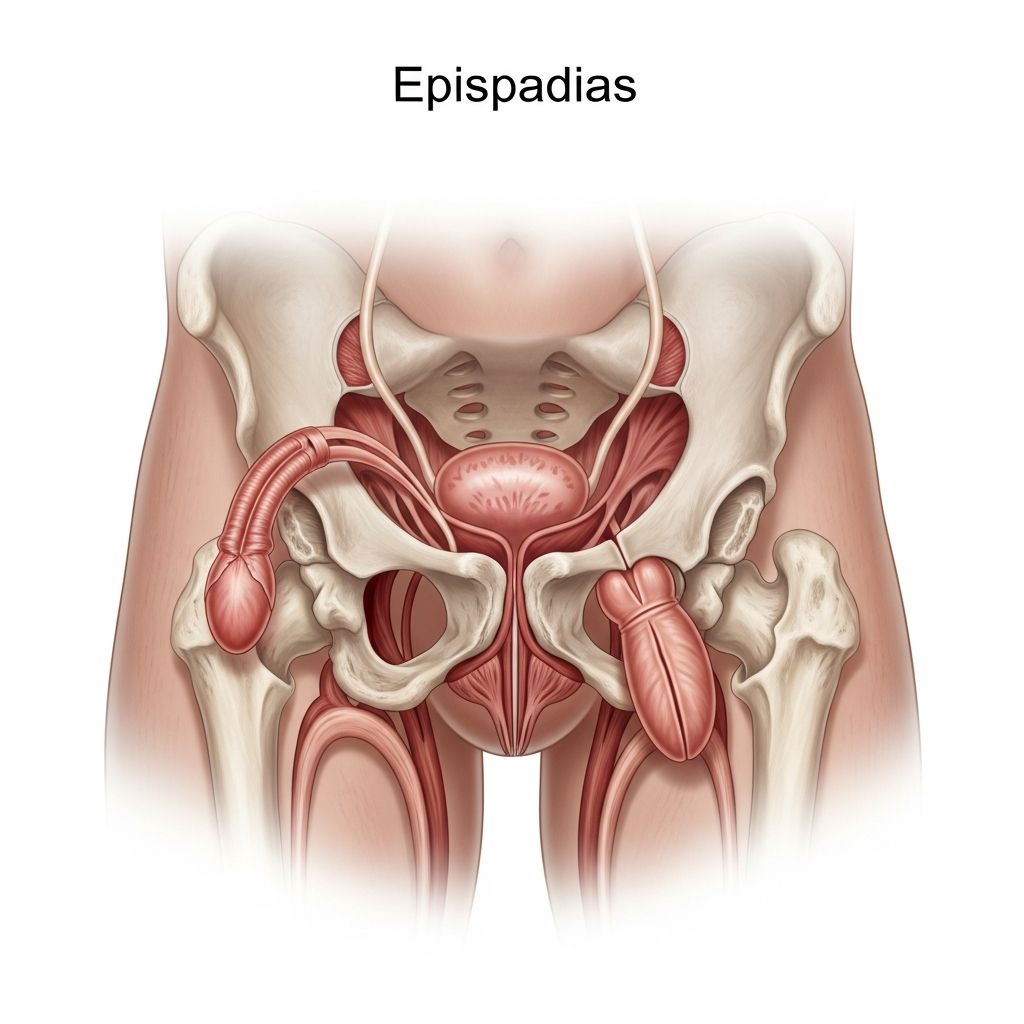
Epispadias is a rare congenital condition that affects the development of the urethra, the tube responsible for carrying urine from the bladder out of the body. In this condition, the urethra does not develop into a complete tube, and urine exits the body from an abnormal location rather than through the normal opening at the tip of the penis in boys or near the normal urethral opening in girls. This birth defect is characterized by an incomplete closure of the urethral tube during fetal development, resulting in the urethral opening being positioned on the top or side of the penis in males, or displaced anteriorly in females.
Epispadias belongs to a spectrum of genitourinary malformations known as the exstrophy-epispadias complex (EEC). While it is considered a relatively rare condition, affecting approximately 1 in 117,000 newborn boys and 1 in 484,000 newborn girls, it requires careful medical attention and intervention. The condition is most commonly diagnosed at birth or shortly after during routine newborn examinations, though in some mild cases, particularly in girls, it may not be identified until later if a child experiences urinary leakage after toilet training.
Understanding the Anatomy and Classification
The classification of epispadias depends significantly on the exact location of the meatus, which is the opening where urine exits the body. This classification is crucial because the position of the meatus directly affects how well the bladder can store and control urine. Healthcare providers classify epispadias based on where the urethral opening is located along the penis.
In males, epispadias is categorized into three main types:
- Glanular epispadias: The opening is located on the glans, or tip area, of the penis. This is the mildest form.
- Penile epispadias: The opening is situated along the shaft of the penis rather than at the tip.
- Penopubic epispadias: The opening is located near the pubic bone. This is the most severe form and most significantly affects bladder control.
A key principle in understanding epispadias severity is that the closer the meatus is to the base of the penis, the greater the likelihood that the condition will affect bladder sphincter function and the person’s ability to control urine flow. The bladder sphincter is the muscular mechanism that opens and closes to release or hold urine, and its proper function is essential for maintaining continence.
Causes and Risk Factors
The exact cause of epispadias remains unknown despite ongoing medical research. However, medical professionals have identified certain factors that may contribute to its development. One leading theory suggests that epispadias may result from improper development of the pubic bone during fetal development, which could disrupt the normal formation of the urethral tube.
Another contributing factor appears to be abnormal development of the cloacal membrane, a structure that normally develops into the gastrointestinal, urinary, and reproductive organs during fetal growth. When the cloacal membrane develops improperly, it can result in epispadias and related genitourinary malformations.
Epispadias is frequently associated with other congenital urological conditions, particularly bladder exstrophy. Bladder exstrophy is a more severe birth defect in which the bladder develops inside out and protrudes through the abdominal wall instead of remaining protected inside the abdomen. Research indicates that nearly all boys with bladder exstrophy will also have epispadias, and most girls with exstrophy also experience this condition.
Related Stories



The condition occurs more frequently in boys than in girls, though the exact reason for this gender difference is not fully understood. Epispadias can develop in isolation without other abnormalities, though it more commonly occurs as part of a broader pattern of genitourinary malformations.
Signs and Symptoms
The presentation of epispadias varies significantly between males and females, and the specific symptoms depend on the severity and classification of the condition.
Symptoms in Males: Baby boys with epispadias typically display a noticeably short and wide penis with an abnormal curve or bend. The most characteristic feature is that the urethra opens on the top or side of the penis instead of at the normal tip location, though in severe cases, the urethra may be open along the entire length of the penis. Additional symptoms may include urinary incontinence, or the inability to control urine flow, particularly in cases where the meatus is positioned closer to the base of the penis.
Symptoms in Females: Girls with epispadias display an abnormally positioned clitoris and labia that do not have a typical appearance. The urethral opening is often located between the clitoris and the labia, though it may be positioned as high as in the abdominal area. Affected girls commonly experience urinary incontinence and may have difficulty controlling urination, especially if the condition is not diagnosed and treated early.
Both males and females with epispadias may experience recurrent urinary tract infections and potential complications related to abnormal urine flow patterns.
Diagnosis and Testing
Healthcare providers typically identify epispadias during the initial newborn physical examination while the baby is still in the hospital. The diagnosis is usually straightforward based on visual inspection of the baby’s genitals, and providers often detect the condition before parents or caregivers even notice any symptoms.
When epispadias is suspected or confirmed, healthcare providers may order several diagnostic tests and imaging studies to assess the extent of the condition and identify any associated abnormalities:
- Blood tests: These evaluate kidney function to ensure the urinary system is working properly.
- Ultrasound of the urinary system and genitals: This non-invasive imaging provides detailed views of the urinary tract structures.
- Pelvic X-ray: This imaging study visualizes the structure of the pelvic bones, particularly to assess for abnormal pubic bone development.
- Intravenous pyelogram (IVP): This specialized X-ray technique uses contrast dye to visualize the kidneys, bladder, and ureters in detail.
- MRI and CT scans: These advanced imaging techniques may be used depending on the specific features of the condition and whether associated abnormalities are suspected.
These diagnostic procedures help healthcare providers classify the severity of epispadias, identify any complications such as reflux nephropathy or hydronephrosis (backward flow of urine into the kidneys), and plan the most appropriate surgical intervention.
Treatment Options
The treatment approach for epispadias depends primarily on the severity of the condition and whether other genitourinary abnormalities are present. Most babies undergo epispadias repair surgery shortly after birth, often with excellent results and good outcomes.
Mild Cases: Very mild cases of epispadias that do not significantly affect bladder function or urinary control may be monitored without immediate surgical intervention, though this is less common.
Surgical Treatment: Babies with moderate to severe epispadias require surgical repair. The goal of surgery is to reposition the urethral opening to its normal location, reconstruct the urethral tube, and restore normal urinary function and continence. Surgical techniques may include:
- Urethral reconstruction and repositioning of the meatus
- Sphincter repair if needed to improve bladder control
- Correction of abnormal penile curvature in boys
- Reconstruction of the clitoris or labia in girls if necessary
Girls typically require less complex epispadias surgery than boys do, and fertility is usually not affected since epispadias does not commonly impact the female reproductive system. The type and complexity of surgery may depend on whether epispadias was diagnosed at birth versus later in childhood, and whether bladder exstrophy or other conditions are present.
If epispadias is diagnosed at birth and surgical repair is performed promptly, urinary control issues most likely will not develop. However, if the problem is not diagnosed or treated until later in childhood, additional procedures may be necessary to address continence issues and correct the appearance of the genitals.
Recovery and Prognosis
The recovery period following epispadias surgery varies depending on the complexity of the repair procedure. Children who undergo minor surgical procedures typically recover quickly, while those requiring more extensive reconstruction may need a longer recovery period. For children who also have bladder exstrophy, epispadias repair may be one of several procedures they require, and the overall recovery process will be more extended.
The prognosis for children with epispadias is generally favorable, especially when the condition is diagnosed early and surgical treatment is performed promptly. With appropriate surgical intervention, most children can achieve or maintain control of urine flow and have normal-appearing genitals. However, some individuals may continue to experience occasional urinary incontinence even after surgery, requiring ongoing management strategies such as intermittent catheterization or other supportive measures.
Potential Complications
While epispadias can typically be successfully managed through surgical intervention, potential complications may arise if the condition is not treated or if complications develop:
- Persistent urinary incontinence: Some individuals may continue to leak urine despite surgical repair.
- Urinary tract infections: The abnormal urinary anatomy can predispose individuals to recurrent infections.
- Kidney and ureter damage: Reflux of urine backward into the kidneys can cause damage over time if not properly managed.
- Infertility: In rare cases, if not properly treated, epispadias could potentially affect reproductive function.
Regular follow-up with urological specialists is essential to monitor for these complications and ensure continued proper function of the urinary system.
Epispadias vs. Hypospadias
Epispadias is sometimes confused with hypospadias, another congenital urethral abnormality, but these are distinct conditions. Both involve abnormal positioning of the urethral opening, but they differ in location and severity. The prefix “epi-” means above, while “hypo-” means below. In hypospadias, the urethra does not fully develop and reach the tip of the penis, with the opening located on the underside or bottom of the penis. Hypospadias is more common than epispadias and primarily affects boys. Epispadias is more severe in its effects on continence and typically requires more complex surgical repair.
Frequently Asked Questions
Q: How common is epispadias?
A: Epispadias is a rare condition, occurring in approximately 1 in 117,000 newborn boys and 1 in 484,000 newborn girls. It is more common in males than females.
Q: Can epispadias be prevented?
A: Since the exact cause of epispadias is unknown and appears to be related to random developmental factors, there is currently no known way to prevent the condition.
Q: Is surgery always necessary for epispadias?
A: Most cases of epispadias require surgical repair, particularly when the condition affects bladder control or has more than mild symptoms. Very mild cases may be monitored, but surgery is typically recommended.
Q: What is the success rate for epispadias surgery?
A: Most epispadias surgeries have good to excellent outcomes, particularly when performed shortly after birth. When caught early, surgical repair typically restores normal urinary function and prevents continence problems.
Q: Will my child have normal sexual function after treatment?
A: With appropriate surgical treatment, most children develop normal sexual function. In girls, fertility is usually not affected by epispadias. In boys, long-term outcomes depend on the severity and type of repair performed.
Q: How often does epispadias occur with other birth defects?
A: Epispadias frequently occurs with bladder exstrophy, and nearly all boys with bladder exstrophy also have epispadias. Most girls with exstrophy also have epispadias. It can also occur in isolation without other abnormalities.
References
- Epispadias – Mondo Disease Overview — National Organization for Rare Disorders. 2025. https://rarediseases.org/mondo-disease/epispadias/
- Epispadias: What is it, Causes, Diagnosis & Treatment — Cleveland Clinic. 2024. https://my.clevelandclinic.org/health/diseases/21551-epispadias
- Epispadias | Health Encyclopedia — Florida Health Finder. 2024. https://quality.healthfinder.fl.gov/health-encyclopedia/HIE/1/001285
- Epispadias | Congenital Urology — Children’s Hospital of Philadelphia. 2024. https://www.chop.edu/conditions-diseases/epispadias
- Epispadias – StatPearls — National Center for Biotechnology Information, National Institutes of Health. 2024. https://www.ncbi.nlm.nih.gov/books/NBK563180/
- Epispadias: Symptoms, Diagnosis & Treatment — Urology Care Foundation. 2024. https://www.urologyhealth.org/urology-a-z/e/epispadias
- Epispadias | Congenital Urology Program — Northwestern Medicine. 2024. https://www.nm.org/conditions-and-care-areas/urology/epispadias
Similar Articles








Read full bio of medha deb