Erythema Annulare Centrifugum Pathology: Expert Guide
Comprehensive pathological analysis of erythema annulare centrifugum, detailing histology, variants, and diagnostic features.
Author: Dr. Harriet Cheng, Dermatopathologist, Reviewed: Dr. Ian Hayden, Dermatologist
Introduction
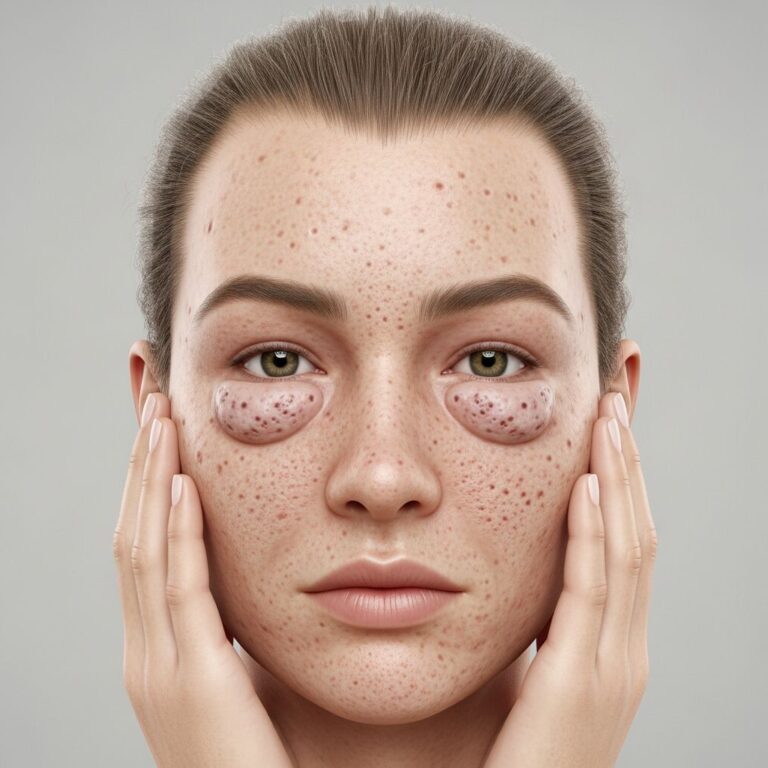
Erythema annulare centrifugum (EAC) represents a distinctive dermatological condition characterized by chronic, reactive annular erythema. This entity manifests as erythematous, circular, arciform, or polycyclic lesions that expand centrifugally, often displaying a characteristic trailing scale along the advancing edge. EAC is classified into superficial and deep variants based on clinical and histopathological features, with the superficial form showing epidermal involvement and the deep form affecting the dermis.
The condition typically initiates as small pink papules that enlarge over weeks, forming plaques with central clearing. Lesions range from millimetres to centimetres in diameter and may coalesce into polycyclic, serpiginous, or gyrate configurations. While frequently idiopathic, EAC serves as a cutaneous marker for underlying systemic diseases, infections, medications, or malignancies, underscoring the importance of thorough investigation.
Pathologically, EAC exemplifies a lymphocytotropic reaction pattern in the skin, featuring a perivascular ‘coat-sleeve’ lymphocytic infiltrate. This infiltrate distinguishes superficial EAC, confined to the papillary dermis, from deep EAC, which extends to the reticular dermis. Understanding these pathological hallmarks is crucial for accurate diagnosis and differentiation from mimics.
Histopathology
Superficial erythema annulare centrifugum
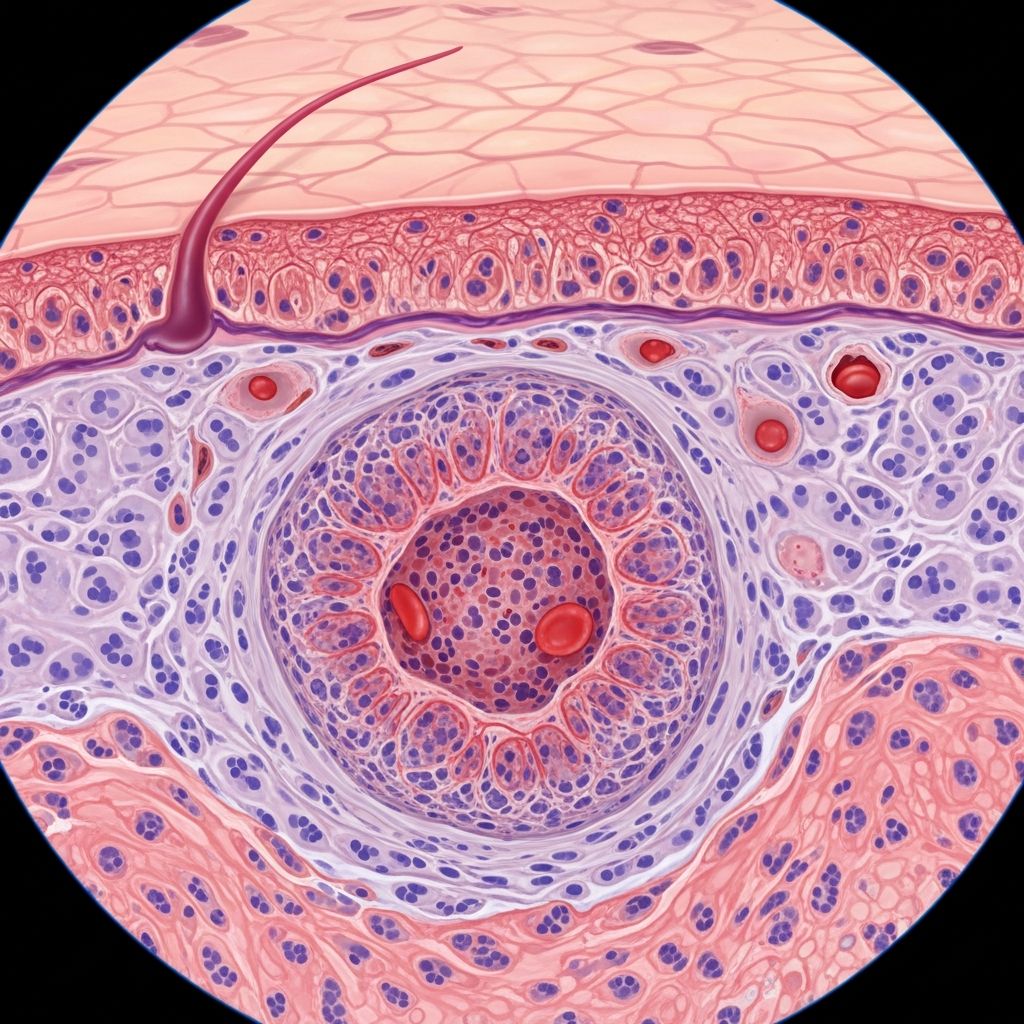
The hallmark of superficial EAC is a dense perivascular and interstitial lymphocytic infiltrate within the papillary dermis, creating the classic ‘coat-sleeve’ appearance around dilated blood and lymphatic vessels. Lymphocytes may extend into the epidermis, inducing mild spongiosis and exocytosis. A subtle trailing scale corresponds to compact orthokeratosis and parakeratosis at the lesional edge.
Magnification reveals angulated lymphocytes hugging vascular walls, with occasional plasma cells and eosinophils. The epidermis shows preserved architecture with focal basal vacuolization. Direct immunofluorescence is typically negative, aiding distinction from autoimmune blistering disorders.
Deep erythema annulare centrifugum
Deep EAC features a denser, ‘sleevelike’ lymphocytic infiltrate encircling vessels in the reticular dermis, sparing the papillary dermis. Lesions appear more indurated clinically, reflecting dermal edema and collagen entrapment by lymphocytes. Vascular dilation and endothelial swelling are prominent, without significant epidermal change.
High-power examination discloses mature lymphocytes without atypia, excluding lymphoma. The infiltrate’s bandlike distribution around mid-to-deep dermal vessels differentiates it from urticarial patterns. Rarely, deep EAC shows mucin deposition, mimicking dermatomyositis.
Special stains and immunohistochemistry
Periodic acid-Schiff (PAS) highlights occasional fungal elements if tinea is suspected, though most EAC cases are negative. Colloidal iron demonstrates increased dermal mucin in select cases. Immunohistochemistry confirms CD3+ T-lymphocytes predominating, with CD4:CD8 ratios favoring CD4 cells. CD20+ B-cells are scant, and CD30 is negative, excluding lymphoproliferative disorders.
Ki-67 proliferation index remains low (<5%), supporting a reactive process. These markers reinforce the diagnosis when morphology alone is equivocal.
Histopathology images
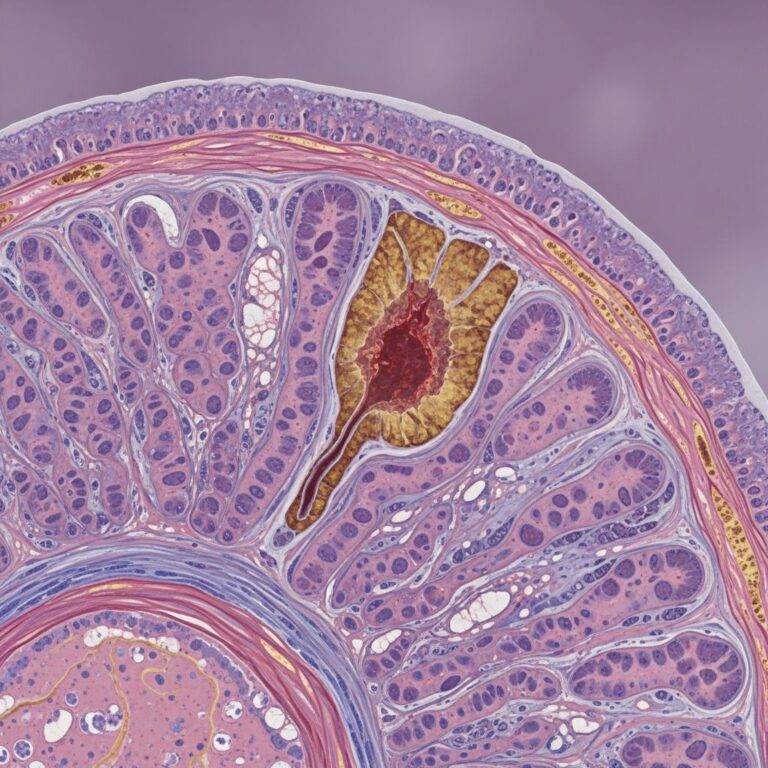
Superficial EAC: Low-power view demonstrates papillary dermal edema with perivascular lymphocytic infiltrate forming coat-sleeves around superficial vessels (H&E, 40x). Higher magnification reveals lymphocyte exocytosis and trailing scale (H&E, 200x).
Related Stories



Deep EAC: Scanning magnification shows bandlike infiltrate in reticular dermis encircling horizontal vessels (H&E, 20x). Detail view confirms sleevelike lymphocytic cuffing without epidermal involvement (H&E, 400x).


Differential diagnosis
| Condition | Key Histological Features | Clinical Distinction |
|---|---|---|
| Tinea corporis | Corneal fungal hyphae (PAS+), epidermal microabscesses, compact orthokeratosis | Annular scaling plaques, KOH+, responds to antifungals |
| Granuloma annulare | Palisading histiocytes, necrobiotic collagen, increased mucin | Hard annular plaques, no trailing scale |
| Subacute cutaneous lupus erythematosus (SCLE) | Lymphoid nodular infiltrate, vacuolar interface, basement membrane thickening | Polycyclic psoriasiform plaques, anti-Ro/La+ |
| Pityriasis rosea | Focal parakeratosis, spongiosis, papillary dermal infiltrate | Herald patch, Christmas-tree distribution, self-limited |
| Lymphoma cutis (mycosis fungoides) | Atypical lymphocytes, epidermotropism, Pautrier microabscesses | Persistent patches/plaques, progression to tumors |
| Erythema gyratum repens | Rapidly migrating bands, paraneoplastic |
The pathological differential centers on excluding infection, granulomatous disease, interface dermatitis, and cutaneous lymphoma. Correlation with clinical features, special stains, and immunohistochemistry resolves most cases.
Frequently asked questions
Q: What is the most characteristic histopathological finding in erythema annulare centrifugum?
A: The ‘coat-sleeve’ perivascular lymphocytic infiltrate is pathognomonic, most prominent in superficial EAC.
Q: How does superficial EAC differ histologically from deep EAC?
A: Superficial type involves papillary dermis with epidermal changes; deep type shows reticular dermal sleeving without epidermal involvement.
Q: Is special staining routinely required for EAC diagnosis?
A: PAS is useful to exclude tinea corporis; otherwise, routine H&E suffices for classic cases.
Q: Can EAC show atypical lymphocytes?
A: No, lymphocytes are mature and polyclonal; atypia suggests cutaneous lymphoma.
Q: What is the role of immunohistochemistry in EAC?
A: Confirms T-cell predominance and low proliferation, excluding malignancy when morphology is equivocal.
Clinical context and investigations
While pathology confirms EAC, clinical correlation identifies underlying triggers. Complete history, physical exam, and targeted investigations (CBC, ANA, TFTs, urinalysis, CXR, age-appropriate cancer screening) are essential. Skin biopsy remains definitive when trailing scale is absent or mimics abound.
In paraneoplastic EAC, lesions may precede malignancy diagnosis by months to years, particularly hematologic and solid tumors. Resolution with tumor treatment supports causality.
Management implications
Pathological classification guides therapy: superficial EAC responds to topical corticosteroids and calcineurin inhibitors; deep EAC may require systemic agents targeting underlying disease. Narrowband UVB phototherapy benefits refractory cases.
Monitoring for systemic associations continues regardless of pathological subtype, as EAC signals potential underlying pathology in 10-20% of cases.
References
- Erythema annulare centrifugum — DermNet NZ. 2023-05-15. https://dermnetnz.org/topics/erythema-annulare-centrifugum
- Erythema Annulare Centrifugum — Patient.info. 2024-02-10. https://patient.info/doctor/dermatology/erythema-annulare-centrifugum
- Erythema annulare centrifugum — PMC (NCBI). 2020-09-20. https://pmc.ncbi.nlm.nih.gov/articles/PMC7505531/
- Erythema Annulare Centrifugum — MD Searchlight. 2023-11-08. https://mdsearchlight.com/skin-problems-and-treatments/erythema-annulare-centrifugum/
- Erythema annulare centrifugum — Wikipedia (references primary sources). 2024-01-12. https://en.wikipedia.org/wiki/Erythema_annulare_centrifugum
Similar Articles








Read full bio of Sneha Tete