Erythema Annulare Centrifugum: Causes, Diagnosis, Treatment
Chronic reactive annular erythema with expanding red rings and trailing scale on skin.
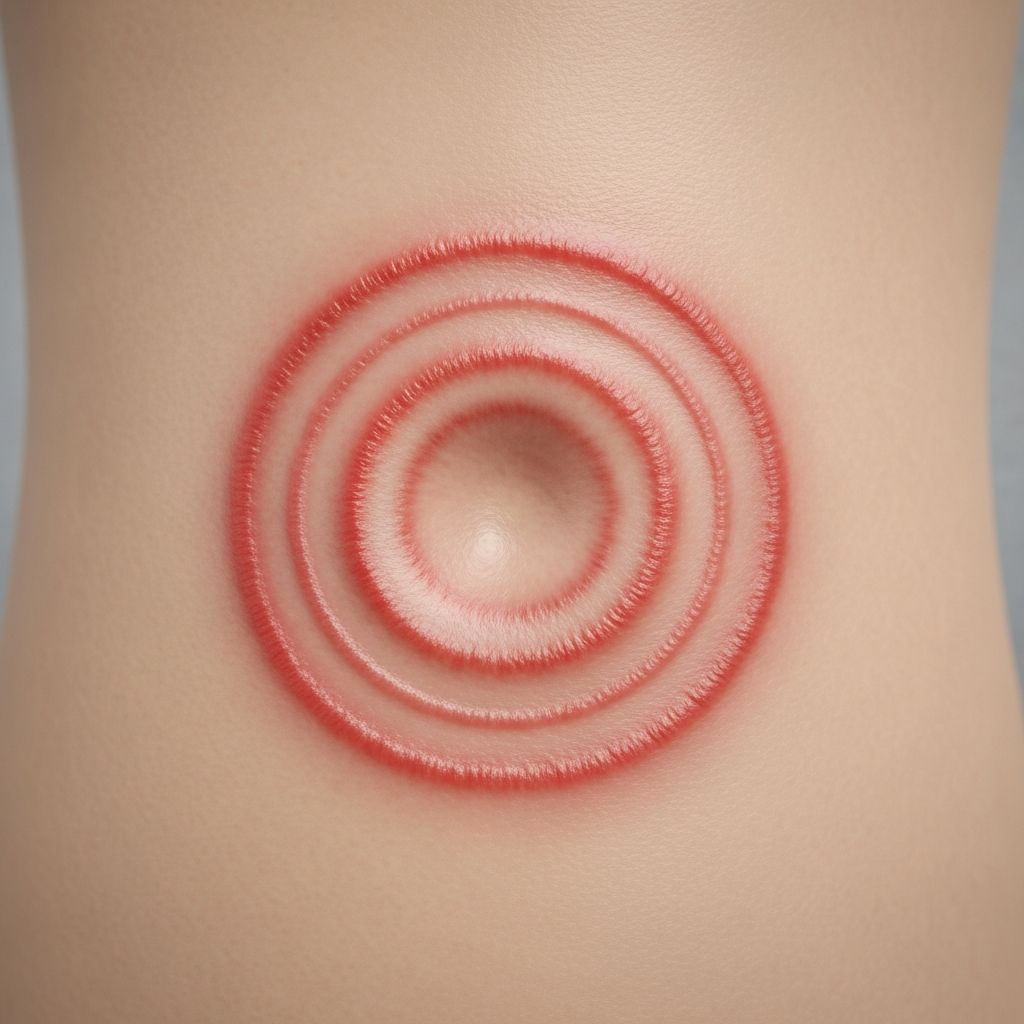
Erythema annulare centrifugum (EAC) is a rare, chronic reactive skin condition characterized by slowly expanding, erythematous annular or arciform lesions with a distinctive trailing scale along the advancing edge.
Introduction
Erythema annulare centrifugum represents a form of cutaneous erythema annulare characterized by erythematous, circular, arciform, or polycyclic lesions that expand centrifugally over time. The hallmark feature is a delicate, trailing scale that adheres to the inner aspect of the advancing border, often described as a ‘figurate erythema.’ This condition is typically asymptomatic but can cause mild pruritus in some cases. EAC is considered a reactive process, most often idiopathic, though associations with various underlying disorders have been documented.
Demographics
EAC affects individuals across all age groups, with a slight predominance in adults, particularly women. Paraneoplastic EAC is more common in females and may precede the diagnosis of an underlying malignancy by several months. Children and young adults can also develop the condition, often in association with infections. The incidence is low, with most cases being sporadic and self-limiting, though recurrent or persistent eruptions occur in a subset of patients.
Causes
While many cases of EAC are idiopathic, numerous triggers have been identified. The condition is frequently associated with underlying systemic disorders, infections, medications, or rarely, malignancies. Key categories include:
- Infections: Bacterial (e.g., Streptococcus, Mycobacterium tuberculosis, Escherichia coli urinary tract infections), fungal (e.g., dermatophytosis), viral (e.g., herpes zoster), and parasitic.
- Medications: Commonly implicated drugs include antimalarials (chloroquine, hydroxychloroquine), cimetidine, spironolactone, gold salts, salicylates, piroxicam, penicillin, amitriptyline, and finasteride.
- Malignancies: Paraneoplastic EAC linked to lymphomas, leukemias, breast cancer, and other solid tumors. Lesions often resolve with treatment of the cancer but recur with relapse.
- Autoimmune/Connective Tissue Diseases: Lupus erythematosus, Sjögren syndrome, rheumatoid arthritis.
- Endocrine: Pregnancy (resolves postpartum), hyperthyroidism.
- Dietary: Blue cheese, tomatoes.
- Other: Stress, hypereosinophilic syndrome, osteoarthritis.
Successful resolution of EAC has followed treatment of underlying causes, such as antibiotics for tuberculosis or antifungals for dermatophytosis.
Clinical Features
Lesions typically begin as small, erythematous papules or plaques that expand peripherally at a rate of several millimeters per day, forming annular or arcuate shapes up to 10 cm in diameter. The advancing edge is raised, palpable, and indurated, with a fine, collarette-like scale trailing behind. Central clearing occurs as the lesion expands, giving a polycyclic or serpiginous appearance. Common sites include thighs, buttocks, upper arms, and trunk, though any body area can be affected. Lesions are usually asymptomatic but may itch mildly. The eruption persists for weeks to months, with new lesions continually appearing.

Diagnosis
Diagnosis is primarily clinical, based on the characteristic morphology and expansion pattern. No specific laboratory tests confirm EAC; investigations aim to identify underlying causes:
- Complete blood count, eosinophil count, liver/kidney function.
- Skin scrapings for fungal elements (KOH prep).
- Cultures for bacteria/fungi.
- Age-appropriate malignancy screening if paraneoplastic suspected.
- Skin biopsy if diagnosis uncertain: Shows superficial perivascular lymphocytic infiltrate (‘basket-weave’ stratum corneum). Deep variant may show dermal interstitial infiltrate.
Histopathology distinguishes superficial (epidermal involvement) from deep (dermal) forms, though clinical overlap exists.
Differential Diagnosis
EAC must be differentiated from other annular erythemas:
| Condition | Key Distinguishing Features |
|---|---|
| Erythema marginatum | Non-scaly, evanescent, rheumatic fever association, no trailing scale. |
| Tinea corporis | Central clearing with active border, positive KOH, responds to antifungals. |
| Granuloma annulare | Non-scaly, dermal nodules, no expansion. |
| Subacute cutaneous lupus erythematosus (SCLE) | Polycyclic with photosensitivity, positive ANA/Ro. |
| Nummular eczema | Vesicles, crusting, no centrifugal expansion. |
| Erythema multiforme | Target lesions, mucosal involvement, acute onset. |
Related Stories



Biopsy resolves most diagnostic uncertainties.
Treatment
Treatment targets underlying causes when identified; idiopathic cases focus on symptom relief. Lesions often resolve spontaneously but may recur.
Local Therapy
- Topical corticosteroids: Potent agents (e.g., clobetasol) applied to advancing border reduce inflammation.
- Topical calcineurin inhibitors: Tacrolimus 0.1% or pimecrolimus 1% ointment for steroid-sparing effect.
- Topical antipruritics: For itch relief.
- Other: Calcipotriene, roflumilast (PDE-4 inhibitor) for refractory cases.
Systemic Therapy
- Treat underlying disorder: E.g., antifungals for dermatophytes, antibiotics for infections, cancer therapy.
- Severe/symptomatic cases: Short-course oral corticosteroids (prednisone 0.5-1 mg/kg), sedating antihistamines (hydroxyzine).
- Empiric antimicrobials: Fluconazole, erythromycin, azithromycin, metronidazole, doxycycline (due to infection associations).
- Advanced therapies: Etanercept (TNF inhibitor), upadacitinib (JAK inhibitor), apremilast (PDE-4 inhibitor, upregulates IL-10).
Recurrence is common post-systemic steroids. Narrowband UVB phototherapy reported effective in select cases.
Outcome
Prognosis is excellent when an underlying cause is treated promptly; idiopathic EAC is self-limiting over months but prone to relapse. Persistent cases may require long-term management. Rarely, paraneoplastic EAC signals occult malignancy requiring vigilant screening. No scarring occurs.
Frequently Asked Questions (FAQs)
What is erythema annulare centrifugum?
A reactive skin rash forming expanding red rings with trailing scale, often idiopathic or linked to infections/drugs.
Is erythema annulare centrifugum contagious?
No, it is not infectious unless secondary to an untreated infection.
How long does it last?
Weeks to months; resolves with cause treatment or spontaneously.
Does it scar?
No, lesions clear without scarring.
When to see a doctor?
If persistent, widespread, or with systemic symptoms—may indicate underlying disease.
References
- Erythema Annulare Centrifugum – StatPearls — Bolognia JL, Schaffer JV, Cerroni L (eds). 2023-05-01. https://www.ncbi.nlm.nih.gov/books/NBK482494/
- Erythema Annulare Centrifugum — MD Searchlight. 2024-01-15. https://mdsearchlight.com/skin-problems-and-treatments/erythema-annulare-centrifugum/
- Erythema Annulare Centrifugum — Patient.info. 2023-11-20. https://patient.info/doctor/dermatology/erythema-annulare-centrifugum
- Erythema annulare centrifugum — DermNet NZ. 2024-08-10. https://dermnetnz.org/topics/erythema-annulare-centrifugum
- Erythema Annulare Centrifugum — Consultant360. 2022-06-12. https://www.consultant360.com/content/erythema-annulare-centrifugum
Similar Articles








Read full bio of medha deb