Erythema Elevatum Diutinum Pathology: 3 Histological Stages
Comprehensive pathology overview of erythema elevatum diutinum, a rare chronic leukocytoclastic vasculitis affecting skin extensors.
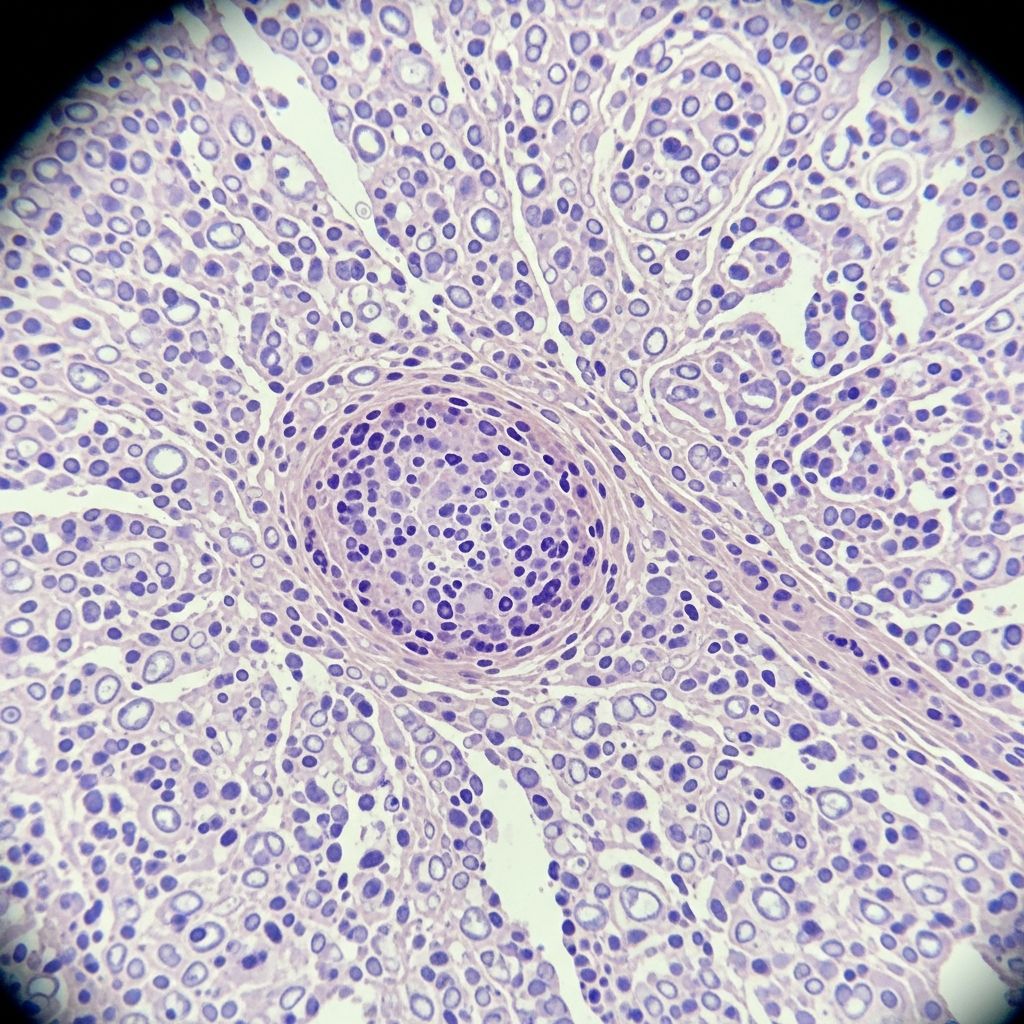
Erythema elevatum diutinum (EED) represents a rare, chronic form of cutaneous small-vessel leukocytoclastic vasculitis characterized by persistent, symmetrical red to brown papules, plaques, and nodules predominantly on extensor surfaces. This condition evolves through distinct histological stages, reflecting ongoing immune complex deposition and vascular injury.
Clinical and Histological Features
EED lesions typically manifest on the backs of hands, elbows, knees, and buttocks, starting as acute inflammatory papules that mature into fibrotic nodules over time. Histologically, early lesions reveal leukocytoclastic vasculitis with neutrophilic infiltration, fibrinoid necrosis of vessel walls, and karyorrhexis, while chronic phases show fibrosis and mixed inflammation.
Pathogenesis
The pathogenesis involves immune complex deposition in post-capillary venules, triggering complement activation and neutrophil recruitment. Associated conditions include infections (streptococcal, HIV), haematological malignancies (myelodysplastic syndrome, multiple myeloma), autoimmune diseases (rheumatoid arthritis, IgA paraproteinaemia), and inflammatory bowel disease.
Histological Evolution
- Early acute phase (hours to days): Dense neutrophilic infiltrate around dermal vessels with endothelial swelling, fibrinoid necrosis, and leukocytoclasia.
- Subacute phase (weeks): Persistent neutrophils mixed with lymphocytes, plasma cells, and early fibrosis.
- Chronic phase (months to years): Fibrosis, capillary proliferation, thickened vessel walls, and haemosiderin deposition yielding brown discoloration.
Direct immunofluorescence demonstrates IgM, C3, and fibrin in vessel walls, confirming immune complex-mediated vasculitis.
Histopathology
Early Lesions
Biopsies from fresh lesions (<72 hours) show leukocytoclastic vasculitis: perivascular and interstitial neutrophils with karyorrhexis (nuclear dust), endothelial cell swelling, fibrin thrombi, and red blood cell extravasation. Punch biopsies from papular lesions best capture acute changes.
Late Lesions
Established plaques exhibit organized fibrosis in the mid-to-deep dermis, vascular proliferation, and a mixed infiltrate of lymphocytes, plasma cells, and macrophages. Haemosiderin-laden macrophages account for the yellow-brown hue. Endarteritis obliterans may narrow lumina.
| Stage | Key Features | Duration |
|---|---|---|
| Acute | Neutrophils, fibrinoid necrosis, karyorrhexis | Days |
| Subacute | Mixed infiltrate, early fibrosis | Weeks |
| Chronic | Fibrosis, haemosiderin, endarteritis | Months-Years |
Immunofluorescence Findings
Positive for IgG, IgM, C3, and fibrinogen along dermal-epidermal junction and perivascular areas, supporting type III hypersensitivity.
Differential Diagnosis
EED mimics include:
- Sweet syndrome: Tender plaques with dense neutrophilic dermatitis sans vasculitis.
- Granuloma faciale: Similar histology but facial location, prominent eosinophils.
- Urticarial vasculitis: Ephemeral lesions with systemic symptoms.
- Mucinoses (pretibial myxoedema): Mucin deposition without vasculitis.
- Multifocal fibrosclerosis: Systemic fibrosis.
- Pyoderma gangrenosum: Ulcerative with neutrophilic infiltrate.
Clinicopathological correlation is essential; screen for paraproteins and haematological malignancy in atypical cases.
Investigations
- Skin biopsy: Essential for diagnosis, including immunofluorescence.
- Blood tests: FBC, paraprotein electrophoresis, ASOT, HIV/hepatitis serology, ANCA, rheumatoid factor.
- Imaging: CXR, ultrasound for underlying disease.
Treatment
Dapsone (first-line): 50-200mg daily, rapid response in 80-90% cases, but relapse common on cessation. Monitor for haemolysis (G6PD screen required).
Alternatives:
- Sulphone derivatives (sulfapyridine).
- Colchicine, hydroxychloroquine.
- Dapsone-resistant: Clofazimine, lenalidomide, rituximab, IVIg.
- Treat underlying disease (e.g., myeloma).
| Agent | Dose | Efficacy | Side Effects |
|---|---|---|---|
| Dapsone | 100-150mg/day | High (rapid) | Haemolysis, agranulocytosis |
| Colchicine | 0.6mg BID | Moderate | GI upset |
| Clofazimine | 100mg/day | Moderate | Hyperpigmentation |
| Rituximab | 375mg/m² weekly | Case reports | Infusion reactions |
Prognosis and Outcome
EED persists for years (average 5-10 years), occasionally up to 25 years, with waxing/waning course. Spontaneous remission occurs in 40-60% after 3-5 years. New lesions cease after 3-4 years, but fibrosis endures. Prognosis ties to underlying conditions; paraneoplastic EED resolves with malignancy treatment.
Related Stories



Frequently Asked Questions (FAQs)
Q: What is the hallmark histopathology of EED?
A: Leukocytoclastic vasculitis in early lesions transitioning to fibrosis and haemosiderin deposition in chronic phases.
Q: Is dapsone always effective for EED?
A: Dapsone induces rapid remission in most, but relapse is common upon discontinuation; alternatives exist for refractory cases.
Q: Should patients be screened for systemic disease?
A: Yes, especially paraproteinaemia, myeloma, and infections, as EED may precede or signal underlying pathology.
Q: How long does EED typically last?
A: 5-10 years on average, with potential spontaneous resolution, though fibrotic changes persist.
Q: What biopsy site yields best diagnostic yield?
A: Early papular lesions (<72h) for acute vasculitis; include immunofluorescence.
References
- Erythema elevatum diutinum — DermNet NZ (A/Prof Amanda Oakley). 2016-01-15. https://dermnetnz.org/topics/erythema-elevatum-diutinum
- Erythema elevatum diutinum: a review of presentation and treatment — S E Momen et al., Journal of the European Academy of Dermatology and Venereology. 2014-12-01. https://doi.org/10.1111/jdv.12566
- Erythema elevatum diutinum: a case report and review of literature — International Journal of Dermatology. 2018. https://doi.org/10.1111/ijd.14169
Similar Articles








Read full bio of medha deb