Erythema Elevatum Diutinum: Diagnosis And Treatment
Rare chronic vasculitis causing persistent red-brown nodules on extremities; dapsone is primary treatment.
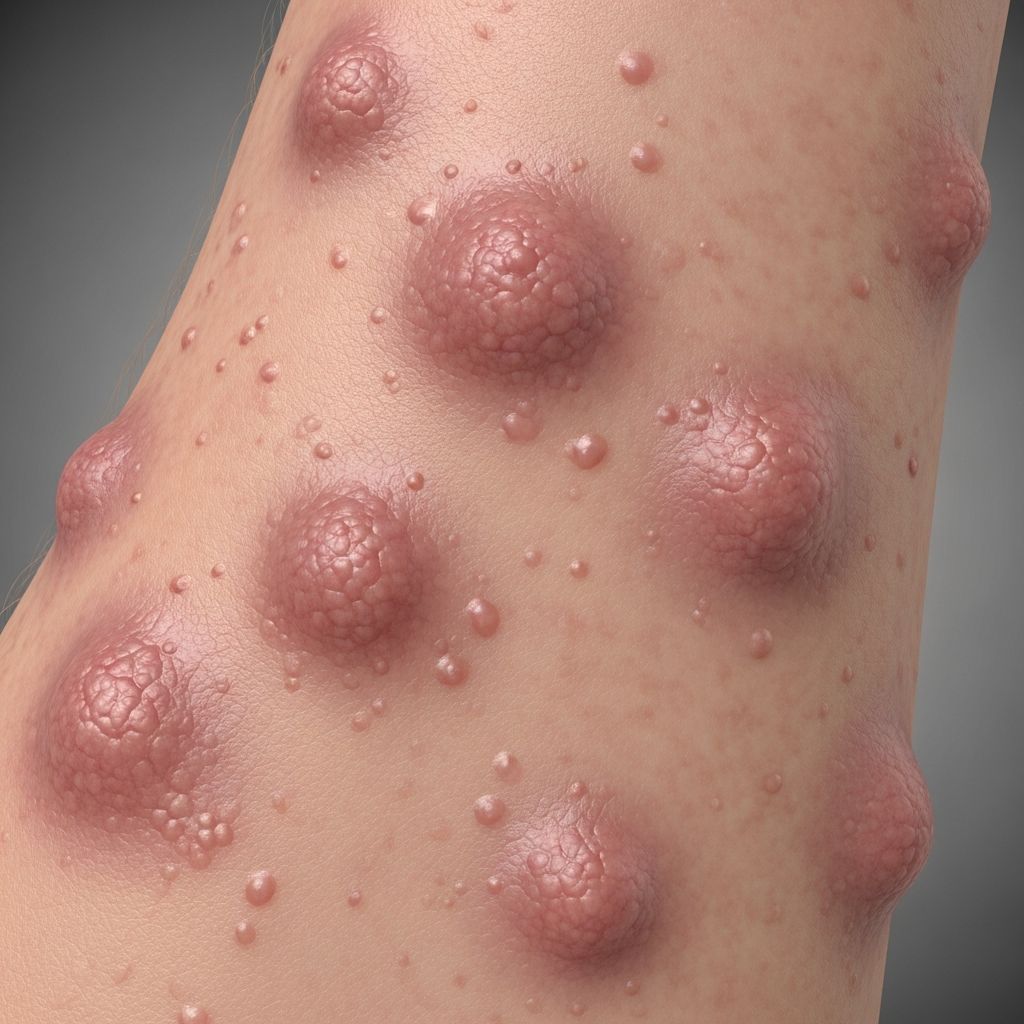
Erythema elevatum diutinum (EED) is a rare, chronic form of localised cutaneous small vessel vasculitis. It is a type of chronic recurrent or late-onset leukocytoclastic vasculitis with a persistent course, characterised by red, purple, brown or yellow papules, plaques or nodules on the extensor surfaces of the extremities.
What is erythema elevatum diutinum?
Erythema elevatum diutinum (EED) is a rare chronic skin condition classified as a form of cutaneous small vessel vasculitis. First described in 1894 by Bury and further characterised by Hutchinson in 1899, EED typically presents with persistent, red-to-brown papules, plaques, or nodules predominantly on the extensor surfaces of the extremities, such as the backs of the hands, elbows, knees, and ankles. The name ‘elevatum diutinum’ reflects its elevated lesions and prolonged duration, often persisting for months to years despite treatment.
The condition evolves in stages: early lesions show features of leukocytoclastic vasculitis, while chronic lesions develop fibrosis and granulation tissue. EED affects adults most commonly between the 4th and 6th decades, with no racial predilection, though it may present earlier in HIV-positive patients. Associated symptoms include arthralgia (joint pain), pruritus, burning, or tingling sensations.
Who gets erythema elevatum diutinum (EED)?
EED primarily affects adults, with peak incidence in the 30–60 age range, though cases occur at any age. It is rare, with limited epidemiological data due to its infrequency. Women and men are equally affected.
In HIV-positive individuals, EED tends to present earlier and with more aggressive, larger nodular lesions. No specific racial or geographic predisposition is noted.
What causes erythema elevatum diutinum?
The exact cause of EED remains unknown, but it is believed to result from immune complex deposition in small dermal vessels, triggering an inflammatory response. This leads to leukocytoclastic vasculitis in early lesions, progressing to fibrosis in chronic stages.
Pathogenic mechanisms may involve antineutrophil cytoplasmic antibodies (ANCAs) and cytokines like interleukin-8, which recruit neutrophils, causing repeated vascular damage and scarring. Streptococcal infections have been implicated as triggers in some cases.
What are the clinical features of erythema elevatum diutinum?
Lesions typically begin as small, red-violet papules or plaques on extensor surfaces, especially hands, elbows, knees, and ankles. They may be itchy, burning, or painful, with underlying joint pain common.
- Early lesions: Transient, urticaria-like or nodular, resembling erythema multiforme or Sweet syndrome.
- Established lesions: Persistent, symmetrical red-brown papules, plaques, or nodules (up to several cm).
- Late lesions: Fibrotic, yellow-brown nodules with hyperkeratosis, fissuring, or ulceration; may mimic rheumatoid nodules.
- HIV-associated: Larger nodules, more widespread.
Rare variants include vesiculobullous EED, cockade (targetoid), and hyperkeratotic forms.
How is erythema elevatum diutinum diagnosed?
Diagnosis relies on clinical presentation and skin biopsy.
- Clinical suspicion: Persistent vasculitic lesions on extensor extremities.
- Skin biopsy: Essential for confirmation.
- Early: Leukocytoclastic vasculitis with neutrophilic infiltrate, nuclear dust, fibrin.
- Late: Fibrosis, capillary proliferation, mixed infiltrate (plasma cells, macrophages).
- Investigations: Screen for associations (e.g., paraproteinemia, infections, autoimmunity).
Related Stories



Histopathology of erythema elevatum diutinum
Biopsies show stage-dependent changes:
| Stage | Key Features |
|---|---|
| Early (vasculitic) | Neutrophilic perivascular infiltrate, leukocytoclasia, fibrinoid necrosis, endothelial swelling, eosinophils. |
| Intermediate | Karyorrhexis, endothelial proliferation, early fibrosis. |
| Late (fibrotic) | Granulation tissue, thick-walled vessels, fibrosis, mixed chronic infiltrate (lymphocytes, plasma cells). |
Immunofluorescence may reveal IgM, C3, or fibrin in vessels.
What is the differential diagnosis for erythema elevatum diutinum?
- Granuloma faciale (face only).
- Sweet syndrome (fever, trunk).
- Mycosis fungoides, rheumatoid nodules, bacillary angiomatosis.
- Multicentric reticulohistiocytosis, pyoderma gangrenosum.
- Other vasculitides (e.g., nodular vasculitis).
What is the treatment for erythema elevatum diutinum?
Treatment targets inflammation and underlying conditions; lesions often recur post-therapy.
Dapsone is first-line (50–200 mg/day), effective in 80% of cases, with rapid onset but relapse on cessation. Screen for G6PD deficiency. Higher doses (100–150 mg) improve response in resistant cases, including HIV.
Alternatives:
- Colchicine (0.5–1 mg BID), sulfapyridine, tetracyclines, niacinamide.
- Immunosuppressants: Methotrexate, rituximab, IVIG.
- Topical/intralesional corticosteroids for limited disease.
- Surgical excision for fibrotic nodules.
- Treat associations (e.g., antiretrovirals for HIV, gluten-free diet for celiac).
Oral corticosteroids are generally ineffective.
What is the outcome for erythema elevatum diutinum?
EED persists for years or decades, with flares and remissions. Early treatment improves response; advanced fibrosis resists therapy. Most cases are benign but chronic.
Frequently Asked Questions
Is erythema elevatum diutinum contagious?
No, EED is not infectious or contagious; it is an immune-mediated vasculitis.
Does dapsone cure EED?
Dapsone controls symptoms effectively but does not cure; relapse occurs on discontinuation.
Can EED be associated with cancer?
Yes, linked to myeloma, lymphoma, myelodysplasia; screen for paraproteins.
Is biopsy always needed for EED?
Yes, to confirm diagnosis and exclude mimics.
How long does EED last?
Months to decades; chronic with recurrences.
References
- Update and Review of the Treatment of Erythema Elevatum Diutinum — Biomed Res Int. 2019-10-15. https://biomedres.us/fulltexts/BJSTR.MS.ID.003662.php
- Erythema elevatum diutinum – DermNet — DermNet NZ. 2023-01-01. https://dermnetnz.org/topics/erythema-elevatum-diutinum
- Erythema elevatum diutinum — Indian J Dermatol Venereol Leprol. 2022-05-20. https://ijdvl.com/erythema-elevatum-diutinum/
- Erythema Elevatum Diutinum – MD Searchlight — MD Searchlight. 2024-08-12. https://mdsearchlight.com/skin-problems-and-treatments/erythema-elevatum-diutinum/
- Erythema elevatum diutinum: a review of presentation and treatment — PubMed. 2014-10-01. https://pubmed.ncbi.nlm.nih.gov/25288365/
- Erythema Elevatum Diutinum – StatPearls — NCBI Bookshelf. 2023-07-17. https://www.ncbi.nlm.nih.gov/books/NBK448069/
Similar Articles








Read full bio of medha deb