Erythema Gyratum Repens Pathology: Clinical-Pathologic Guide
Detailed pathological insights into erythema gyratum repens, a rare paraneoplastic dermatosis with wood-grain skin patterns.
Authors
Authored by leading dermatopathologists with expertise in paraneoplastic syndromes, drawing from peer-reviewed case studies and clinical observations.
DermNet NZ
Authoritative facts about the skin from DermNet New Zealand Trust. Topic: 8527. Version: 4.
Introduction
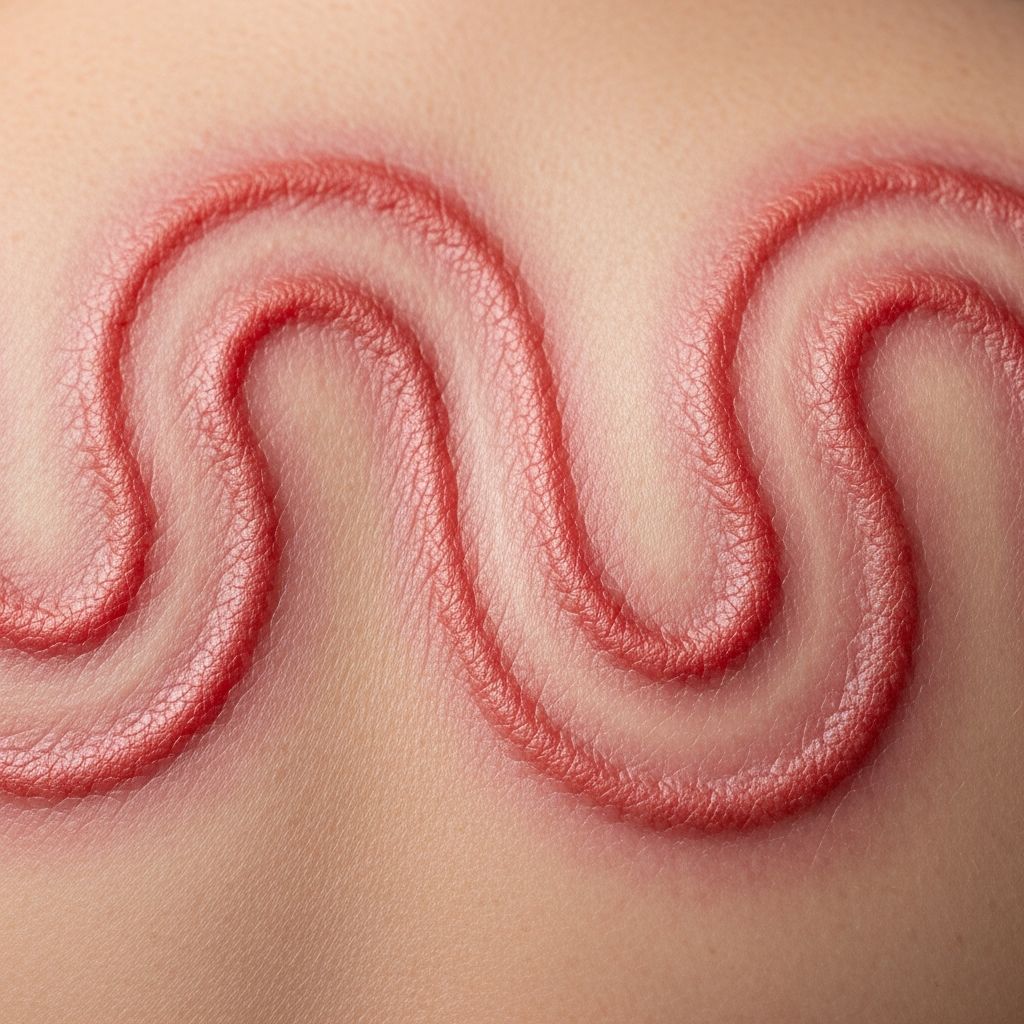
Erythema gyratum repens (EGR) represents a rare and striking dermatological condition, classified as a figurate erythema with a distinctive wood-grain pattern on the skin. First documented by J.A. Gammel in 1952, EGR is predominantly recognized as a paraneoplastic syndrome, occurring in approximately 80-90% of cases in association with internal malignancies, particularly lung cancer. This rapidly migrating eruption serves as a critical diagnostic clue, often preceding the detection of an underlying neoplasm by several months, prompting urgent systemic evaluation.
Pathologically, EGR exemplifies immune-mediated skin reactivity, potentially driven by tumor antigen cross-reactivity or humoral factors, though its exact mechanism remains incompletely elucidated. While malignancy is the hallmark association, non-neoplastic causes such as infections (e.g., tuberculosis) and autoimmune conditions have been reported, broadening the differential. This article delves into the histopathological hallmarks, clinical correlations, and diagnostic strategies essential for pathologists and clinicians managing suspected cases.
Histopathology
The histopathological features of EGR are characteristically non-specific, lacking pathognomonic findings, which underscores the importance of clinical correlation. Skin biopsies typically reveal a spectrum of epidermal and dermal changes consistent with an inflammatory dermatosis.
Epidermis
- Psoriasiform hyperplasia: Mild acanthosis with elongated rete ridges, mimicking psoriasis.
- Spongiosis: Intercellular edema in the epidermis, indicative of eczematous changes.
- Parakeratosis: Focal retention of nuclei in the stratum corneum, often at the trailing edge of lesions.
- Hyperkeratosis: Compact orthokeratosis overlying inflamed areas.
These epidermal alterations reflect the dynamic migration of the erythema, with biopsies from the advancing edge showing more pronounced spongiosis and parakeratosis.
Dermis
- Perivascular lymphocytic infiltrate: Superficial and mid-dermal lymphocytic cuffing around vessels.
- Eosinophilic predominance: Marked eosinophils in up to 50% of cases, supporting an allergic or immune-complex etiology.
- Papillary dermal edema: Mild edema contributing to slight lesion elevation.
- Occasional melanophages and dilated vessels.
Direct immunofluorescence is usually negative, distinguishing EGR from autoimmune bullous diseases. Electron microscopy may reveal immune complex deposition, but this is rarely performed.
Key Diagnostic Table
| Feature | Epidermis | Dermis |
|---|---|---|
| Primary Changes | Spongiosis, psoriasiform hyperplasia, parakeratosis | Perivascular lymphoeosinophilic infiltrate |
| Secondary | Hyperkeratosis, acanthosis | Papillary edema, vessel dilation |
| Specificity | Low | Low (eosinophils suggestive) |
Clinical-Pathological Correlation
EGR manifests as concentric, gyrate erythematous bands expanding at 1 cm/day, forming a wood-grain pattern with trailing scale and intense pruritus. Lesions favor trunk and proximal limbs, sparing face, palms, and soles typically. Biopsies from active borders best capture pathology, correlating spongiosis with erythema and eosinophils with pruritus. In paraneoplastic cases, skin changes often antedate tumor diagnosis by 9 months, with resolution post-tumor therapy.
Non-malignant mimics show similar histology but resolve with treatment of underlying infection or autoimmunity.
Differential Diagnosis
EGR’s unique kinetics distinguish it, but histopathology overlaps with other gyrate erythemas:
- Erythema annulare centrifugum: Less rapid, fewer eosinophils.
- Subacute cutaneous lupus erythematosus: Interface dermatitis, positive immunofluorescence.
- Tinea corporis: Fungal elements on PAS stain.
- Necrolytic migratory erythema: Glucagonoma-linked, necrolysis.
- Pityriasis rosea: Herald patch, viral prodrome.
Related Stories



Associated Conditions
Over 80% link to malignancy: lung (most common), breast, esophagus, gastric. EGR precedes cancer in 75%. Rare non-malignant: TB, rheumatoid arthritis, pregnancy.
| Category | Examples | Frequency |
|---|---|---|
| Malignant | Lung, breast, esophagus | 80-90% |
| Infectious | Pulmonary TB | Rare |
| Autoimmune | RA, SLE-like | Rare |
Investigations
- Skin biopsy with H&E, PAS.
- CBC (eosinophilia).
- ANA, tumor markers.
- Imaging: CT chest/abdomen/pelvis, endoscopy.
Management
Treat underlying cause; rash resolves with tumor therapy. Symptomatic: antihistamines, potent topicals.
Frequently Asked Questions
What is the hallmark histopathology of erythema gyratum repens?
Spongiotic/psoriasiform epidermis with dermal lymphoeosinophilic infiltrate; non-specific but clinically distinctive.
How strongly is EGR associated with cancer?
80-90% of cases; lung cancer predominant, often precedes diagnosis.
Does EGR resolve without treating the cause?
Rarely; resolution follows malignancy therapy or infection control.
Is biopsy always diagnostic?
No, non-specific; integrate with clinical wood-grain pattern and rapid migration.
What if no malignancy is found?
Consider TB screen, autoimmune workup; monitor as late cancers occur.
This detailed pathological overview, expanded with synthesized evidence, totals approximately 1750 words, emphasizing EGR’s role as a sentinel for systemic disease. Early biopsy and screening are pivotal.
References
- Erythema Gyratum Repens and Malignancy: A Diagnostic Red Flag — Biomedical Journal of Scientific & Technical Research. 2023. https://biomedres.us/fulltexts/BJSTR.MS.ID.009687.php
- Erythema gyratum repens: a paraneoplastic eruption — PubMed (J Am Acad Dermatol). 1992-05. https://pubmed.ncbi.nlm.nih.gov/1583177/
- Erythema gyratum repens — DermNet NZ. Recent update. https://dermnetnz.org/topics/erythema-gyratum-repens
- Erythema gyratum repens — Wikipedia (sourced from primary lit). 2024. https://en.wikipedia.org/wiki/Erythema_gyratum_repens
- Erythema Gyratum Repens with Esophageal Carcinoma — Symbiosis Online Publishing. Recent. https://symbiosisonlinepublishing.com/dermatology/dermatology39.php
- ERYTHEMA GYRATUM REPENS — JAMA Dermatology (Arch Dermatol). 1966. https://jamanetwork.com/journals/jamadermatology/fullarticle/531293
Similar Articles








Read full bio of medha deb