Erythema Gyratum Repens: Key Insights On Diagnosis & Management
Rare figurate erythema strongly linked to internal malignancy, featuring wood-grain rash patterns.
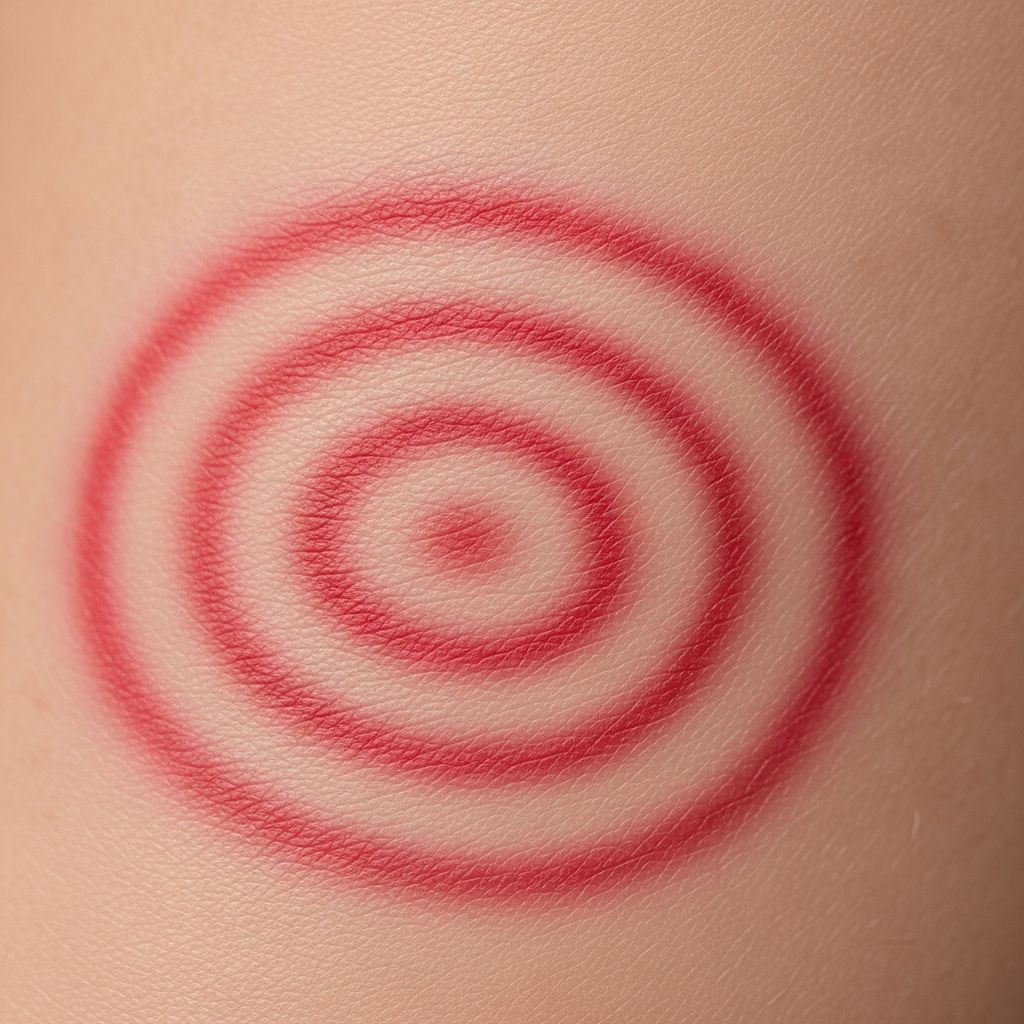
Erythema gyratum repens (EGR) is a rare and distinctive figurate erythema characterised by its gyrate, wood-grain-like pattern of concentric erythematous rings with trailing scales. This migratory rash expands rapidly, often signalling an underlying internal malignancy in over 80% of cases, most commonly lung cancer. First described in 1952, EGR typically affects older adults and demands urgent investigation for occult neoplasm due to its strong paraneoplastic association.
What is erythema gyratum repens?
Erythema gyratum repens represents one of the most striking paraneoplastic dermatoses, exhibiting a unique wood-grain appearance formed by parallel waves of erythematous serpiginous bands. The term ‘repens’ derives from Latin, meaning ‘creeping,’ aptly describing the rash’s dynamic migration at rates up to 1 cm per day. This condition typically emerges in individuals over 60 years, with males affected approximately twice as frequently as females.
Histopathologically, EGR shows nonspecific features including parakeratosis, acanthosis, spongiosis, and a superficial perivascular lymphocytic infiltrate. Circulating epidermal nuclear autoantibodies have been detected in some cases, supporting an immune-mediated pathogenesis, though the exact mechanism linking the rash to malignancy remains elusive.
While the rash’s spectacular morphology is pathognomonic, EGR’s paramount clinical significance lies in its role as a harbinger of systemic disease. The eruption often precedes cancer diagnosis by several months (average 9 months), providing a critical window for early tumour detection and improved prognosis.
Who gets erythema gyratum repens?
EGR predominantly manifests in older adults, with mean onset age around 65 years. The male-to-female ratio approximates 2:1. No racial or geographic predispositions are documented.
- Primary risk factor: Internal malignancy (80–90% of cases)
- Most common neoplasm: Lung cancer (30–50%)
- Other associated cancers: Breast (10%), oesophagus (5–10%), stomach, uterus, pancreas, lymphoma, throat, prostate
- Benign associations (10–20%): Tuberculosis, cryptogenic organising pneumonia, rheumatoid arthritis, pregnancy
- Idiopathic cases: Rare (<5%)
In non-malignant cases, EGR-like eruptions have been reported with dermatoses such as pityriasis rubra pilaris (PRP), psoriasis, and dermatophyte infections, often termed ‘EGR-like’ to distinguish from true paraneoplastic EGR.
What causes erythema gyratum repens?
The precise aetiology remains unknown, but several pathogenetic hypotheses predominate:
- Immune-mediated: Molecular mimicry where tumour antigens cross-react with skin components, producing epidermal nuclear IgG autoantibodies detected in 50% of cases
- Cytokine dysregulation: Tumour secretion of inflammatory mediators (IL-1, TNF-α) triggers keratinocyte hyperproliferation and epidermal migration
- Circulating factors: Tumour-derived proteins deposit in skin, inducing the characteristic figurate pattern
Rarely, EGR occurs without malignancy, suggesting that intense immune dysregulation alone can produce the morphology. Drug-induced cases (e.g., retinoids in PRP therapy) further support immune pathogenesis.
What are the clinical features of erythema gyratum repens?
EGR announces itself with its pathognomonic morphology:
| Feature | Description |
|---|---|
| Morphology | Concentric, parallel, wavy erythematous rings (‘wood-grain’ or ‘marble cake’ pattern) |
| Dynamics | Rapid peripheral expansion (1 cm/day); central clearing with collarette scale |
| Symptoms | Intense pruritus (universal); burning (50%) |
| Distribution | Trunk > proximal limbs; spares face, palms/soles (usually) |
| Associated signs | Palmoplantar keratoderma (10%); hyperkeratosis; xerosis |
Related Stories



The rash evolves dramatically over days to weeks, with new rings continuously forming within established lesions, creating perpetual motion. Nail changes and mucous membrane involvement are absent.
How is erythema gyratum repens diagnosed?
Diagnosis rests primarily on clinical morphology, supported by:
- Skin biopsy: Nonspecific – parakeratosis, acanthosis, spongiosis, perivascular lymphocytes
- Direct immunofluorescence: Negative or nonspecific
- Serology: Epidermal nuclear autoantibodies (limited sensitivity/specificity)
- Urgent malignancy workup: Essential regardless of biopsy findings
Malignancy screening protocol
- Full history/physical examination
- CXR, CT chest/abdomen/pelvis
- Tumour markers (age/sex appropriate)
- Upper/lower GI endoscopy
- Age-appropriate cancer screening
- Repeat imaging if initial negative
Negative initial evaluation mandates surveillance, as malignancy may emerge months later.
What is the differential diagnosis for erythema gyratum repens?
| Condition | Distinguishing Features |
|---|---|
| Necrolytic migratory erythema | Glucagonoma; crusted erosions; periorificial |
| Erythema migrans | Lyme disease; single lesion; central clearing |
| Tinea corporis | Annular; responds to antifungals; KOH positive |
| Subacute cutaneous LE | Photosensitive; psoriasiform; ANA positive |
| Erythrokeratoderma variabilis | Onset infancy; genetic; non-pruritic |
| Pityriasis rosea | Christmas-tree; self-limited; viral prodrome |
| PRP/psoriasis variants | Hyperkeratotic plaques; may mimic during resolution |
What is the treatment for erythema gyratum repens?
Treatment targets the underlying malignancy: Surgical resection, chemotherapy, or radiotherapy typically induces rash resolution within weeks.
Symptomatic measures:
- Emollients + potent topical steroids
- Oral antihistamines (hydroxyzine, fexofenadine)
- Gabapentinoids for refractory pruritus
- Phototherapy (narrowband UVB)
Systemic immunosuppressants (steroids, azathioprine, methotrexate) show inconsistent, transient benefit and are not first-line.
What is the outcome for erythema gyratum repens?
Prognosis correlates with underlying malignancy:
- Rash resolves rapidly with successful cancer treatment
- Recurs with cancer relapse/progression
- Benign cases follow spontaneous/indolent course
- 5-year mortality approaches 50% due to associated cancers
Clinical images of erythema gyratum repens
[Image descriptions: Multiple clinical photographs would depict trunk showing characteristic parallel, wavy erythematous bands with wood-grain pattern and trailing collarette scale. Leading edges advance peripherally while centres clear.]
Frequently asked questions about erythema gyratum repens
Is erythema gyratum repens always cancer?
No, 10–20% represent benign associations or idiopathic cases, but urgent malignancy exclusion remains mandatory.
How quickly does the rash spread?
Leading edge migrates 1 cm/day, with new rings continuously forming within established lesions.
Does the rash resolve spontaneously?
Rarely; persistent evolution continues until underlying cause addressed.
What is the most common cancer?
Lung cancer accounts for 30–50% of malignancy-associated cases.
Can topical steroids cure EGR?
No; they provide limited symptomatic relief but don’t affect disease course.
References
- Erythema gyratum repens — DermNet NZ (New Zealand Dermatological Society). 2023. https://dermnetnz.org/topics/erythema-gyratum-repens
- Erythema Gyratum Repens: A Rare Paraneoplastic Rash — PubMed Central (PMC). 2011-11-23. https://pmc.ncbi.nlm.nih.gov/articles/PMC3236141/
- Erythema gyratum repens – Wikipedia — Wikimedia Foundation. 2024. https://en.wikipedia.org/wiki/Erythema_gyratum_repens
- Erythema Gyratum Repens and Malignancy: A Diagnostic Red Flag — Biomedical Journal of Scientific & Technical Research. 2023. https://biomedres.us/pdfs/BJSTR.MS.ID.009687.pdf
Similar Articles








Read full bio of medha deb