Erythroderma Images
Clinical images and detailed insights into erythroderma, a severe inflammatory skin condition affecting over 90% of the body surface.
Author: Reviewed by Dr. Amanda Oakley, Dermatologist, Hamilton, New Zealand. Updated February 2024.
What is erythroderma?
Erythroderma, also known as exfoliative dermatitis, is a severe and potentially life-threatening inflammatory skin condition characterized by intense erythema (redness) affecting more than 90% of the body surface area, often accompanied by scaling, exfoliation, and systemic symptoms. This condition represents the most extreme manifestation of various underlying dermatological disorders, where the skin’s barrier function is profoundly disrupted, leading to widespread inflammation, heat loss, and fluid imbalance. Unlike milder forms of dermatitis, erythroderma involves nearly the entire cutaneous surface, resulting in dramatic visual changes and significant morbidity.
The term ‘erythroderma’ derives from Greek roots ‘erythros’ (red) and ‘derma’ (skin), aptly describing the hallmark diffuse redness. It can arise acutely or subacutely from pre-existing skin diseases or de novo in previously healthy individuals. Histopathologically, it features epidermal hyperproliferation, parakeratosis, and inflammatory infiltrates involving keratinocytes, lymphocytes, adhesion molecules, and cytokines, dramatically increasing epidermal cell turnover. Clinically, it often begins with a morbilliform (measles-like) eruption or exacerbation of plaques, progressing to generalized erythema within days to weeks.
Who gets erythroderma?
Erythroderma predominantly affects adults, with a higher incidence in males and those over 50 years, though erythrodermic atopic dermatitis more commonly impacts children and young adults. There is no racial predilection, but the condition’s epidemiology varies by underlying cause: inflammatory dermatoses like psoriasis and eczema prevail in younger patients (<40 years), while malignancies such as cutaneous T-cell lymphoma (CTCL) are more frequent in the elderly.
- Pre-existing skin conditions: Psoriasis (most common, up to 25-40% of cases), atopic dermatitis, contact dermatitis, seborrheic dermatitis, pityriasis rubra pilaris.
- Drug-induced: Antibiotics (e.g., beta-lactams), anticonvulsants, allopurinol, sulfonamides—often as severe hypersensitivity reactions.
- Malignancies: CTCL (Sézary syndrome), leukemias, lymphomas.
- Infections and others: HIV, staphylococcal scalded skin syndrome, rare ichthyoses.
Risk factors include abrupt withdrawal of systemic steroids in psoriasis patients, which can precipitate erythrodermic flares, and overuse of topical therapies.
Causes of erythroderma
The etiology of erythroderma is heterogeneous, with over 50% of cases linked to exacerbations of primary dermatoses. Inflammatory conditions like psoriasis vulgaris account for 23-40% of instances, where plaque lesions coalesce into confluent erythema. Atopic dermatitis contributes significantly in younger cohorts, often triggered by allergens or infections. Drug eruptions represent 10-20% of cases, manifesting as hypersensitivity with rapid onset post-exposure.
| Cause Category | Examples | Approximate Prevalence |
|---|---|---|
| Inflammatory Dermatoses | Psoriasis, Atopic/Seborrheic Dermatitis | 50-70% |
| Drug Reactions | Antibiotics, Anticonvulsants | 10-20% |
| Malignancy | CTCL/Sézary Syndrome | 10-15% |
| Other (Infections, Idiopathic) | HIV, Unknown | <10% |
Less common triggers include autoimmune blistering diseases (pemphigus), infections (toxic shock syndrome), and systemic illnesses. Idiopathic cases pose diagnostic challenges, requiring exclusion of occult malignancy.
Clinical features of erythroderma
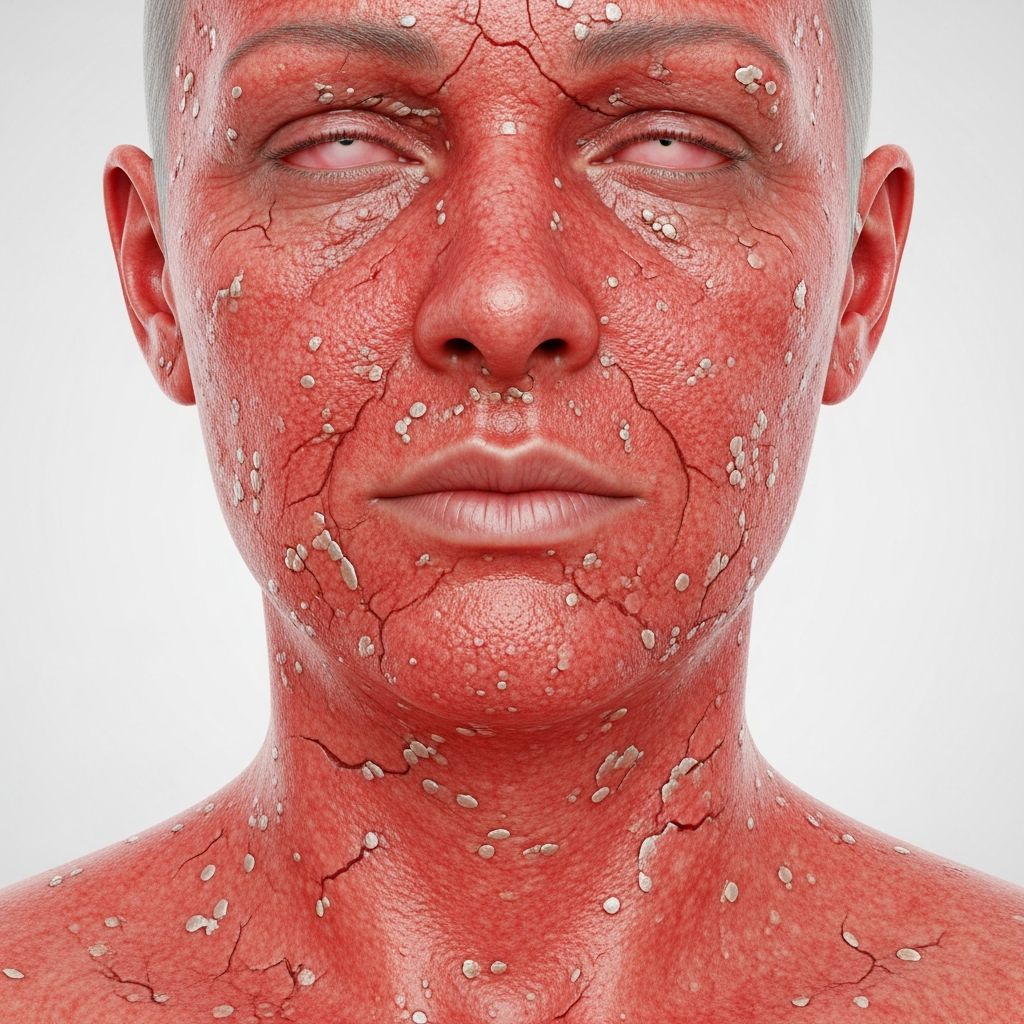
Erythroderma presents with uniform erythema enveloping >90% body surface, sparing flexures in some cases (e.g., psoriasis). Scaling emerges 2-6 days post-erythema, varying from fine to thick sheets, with pruritus leading to excoriations or lichenification. Oedema manifests as facial puffiness, eyelid ectropion, or pedal swelling due to vascular leakage and protein loss.
- Skin findings: Diffuse red hue, exfoliation, nail dystrophy (shedding), hair loss.
- Systemic: Chills, fever, tachycardia from hyperperfusion; dehydration, electrolyte imbalance from insensible losses.
Image 1: Erythroderma due to psoriasis—confluent erythematous plaques with silver scale covering trunk and limbs, facial sparing.
Image 2: Drug-induced erythroderma—intense erythema with early fine desquamation on back and arms.
Image 3: Sézary syndrome variant—wrinkled ‘elephant skin’ with erythroderma and palmoplantar keratoderma.
Diagnosis of erythroderma
Diagnosis is primarily clinical, based on >90% erythema with scaling. Clues to etiology include history (drugs, prior psoriasis), morphology (islands of scale sparing in drug reactions), and exam (lymphadenopathy in CTCL). Essential investigations:
- Skin biopsy: Reveals underlying pathology (e.g., Munro microabscesses in psoriasis).
- Labs: CBC (eosinophilia in drugs/atopy), LFTs, renal function, serum proteins.
- Imaging/Cultures: Rule out infection/malignancy.
- Patch testing: For suspected contact dermatitis.
Histology is non-specific but supports cause identification.
Complications of erythroderma
Erythroderma disrupts thermoregulation, fluid balance, and immunity, yielding high complication rates (mortality 10-40% in elderly/malignant cases).
- High-output cardiac failure: Tachycardia, edema from increased perfusion.
- Dehydration/Hypothermia: Massive insensible losses.
- Infections: Secondary bacterial (Staph/Strep), sepsis.
- ARDS/Pulmonary edema: Rare but grave.
- Nutritional: Hypoalbuminemia, anemia.
Hospitalization is mandatory for monitoring.
Management of erythroderma
Treatment is supportive plus cause-directed.
- Supportive: Emollients, wet wraps, IV fluids, temp control, nutrition.
- Anti-inflammatory: Cyclosporine (psoriasis), methotrexate, biologics (anti-IL17/23); avoid abrupt steroids.
- Specific: Discontinue offender drug, chemotherapy for malignancy.
Prognosis hinges on cause: >80% survival for inflammatory vs. poor for CTCL.
Frequently Asked Questions
Q: Is erythroderma contagious?
A: No, erythroderma is not infectious; it stems from inflammatory, allergic, or neoplastic processes.
Q: How long does erythroderma last?
A: Variable—weeks for drug-induced to chronic in malignancies; early intervention improves outcomes.
Q: Can erythroderma be fatal?
A: Yes, due to complications like sepsis or cardiac failure, especially in frail patients.
Q: What does erythroderma look like?
A: Widespread red, inflamed skin with peeling, resembling a severe burn.
Q: Is erythroderma psoriasis?
A: It can be an extreme form of psoriasis, but many other causes exist.
References
- Erythroderma – Dermatologic Disorders — Merck Manuals Professional Edition. 2023. https://www.merckmanuals.com/professional/dermatologic-disorders/dermatitis/erythroderma
- Erythroderma — DermNet NZ. 2024-02. https://dermnetnz.org/topics/erythroderma
- Erythroderma – PMC – NIH — National Library of Medicine. 2020-04-01. https://pmc.ncbi.nlm.nih.gov/articles/PMC7139437/
- Erythrodermic Psoriasis: Symptoms, Causes & Treatment — Cleveland Clinic. 2023. https://my.clevelandclinic.org/health/diseases/22998-erythrodermic-psoriasis
- Erythroderma — Cedars-Sinai Health Library. 2023. https://www.cedars-sinai.org/health-library/diseases-and-conditions/e/erythroderma.html
Similar Articles



Read full bio of Sneha Tete