Erythropoiesis: Red Blood Cell Production Process
Understand how your body produces red blood cells through the complex process of erythropoiesis.
What is Erythropoiesis?
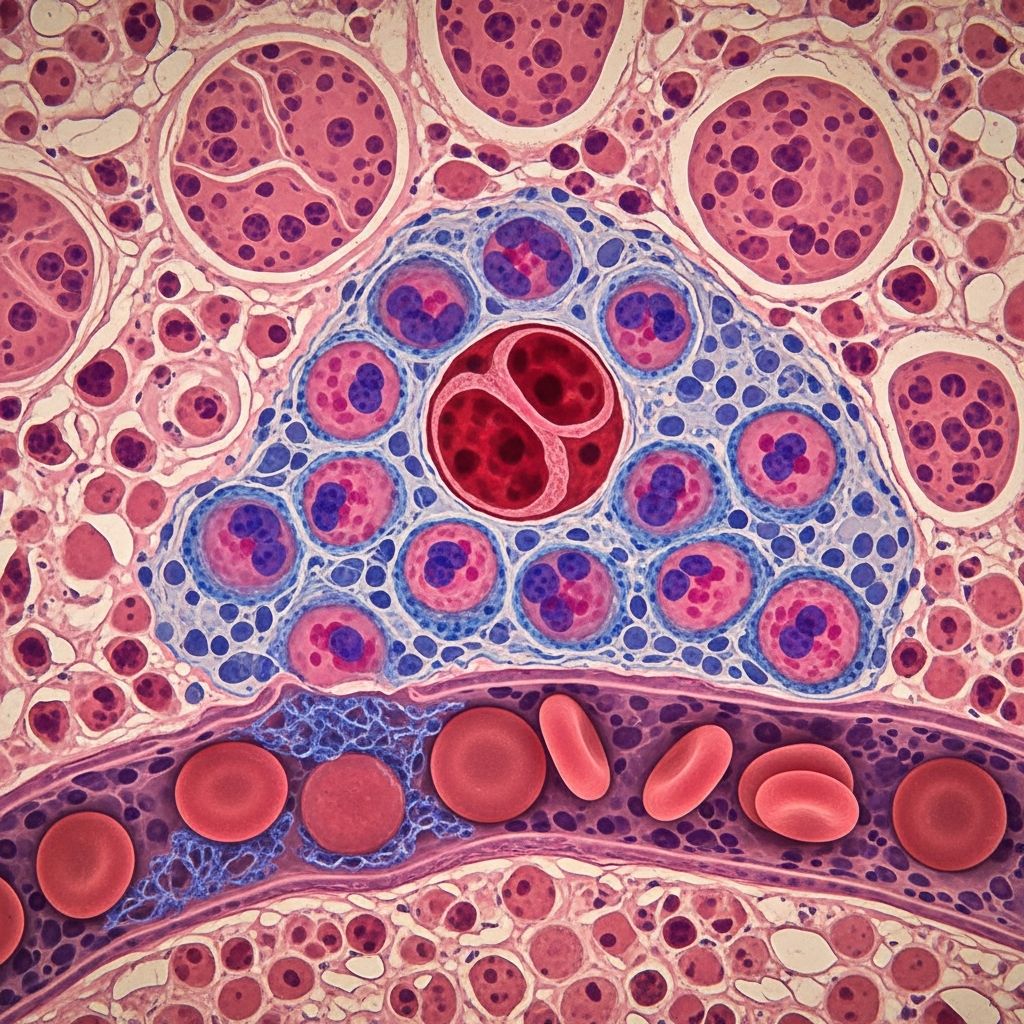
Erythropoiesis is the physiological process by which your body produces red blood cells, also known as erythrocytes. This complex and tightly-regulated process originates in the bone marrow from multipotent hematopoietic stem cells and culminates in the production of mature, enucleated red blood cells that circulate throughout your bloodstream. Understanding erythropoiesis is fundamental to comprehending how your body maintains adequate oxygen delivery to tissues and organs.
At baseline, erythropoiesis occurs at a steady but low basal rate, with approximately 1% of circulating erythrocytes cleared and replaced by new cells daily. Red blood cells remain in circulation for approximately 120 days, during which time they are continuously surveyed by resident macrophages within the liver and spleen. This constant renewal process ensures that your body maintains a healthy population of oxygen-carrying cells to support vital functions.
The Stages of Red Blood Cell Development
Erythropoiesis occurs through several distinct stages of cell differentiation and maturation. Each stage involves specific cellular transformations that progressively develop the cell from a stem cell into a functional red blood cell capable of transporting oxygen throughout your body.
Hematopoietic Stem Cell Origin
The process begins with hematopoietic stem cells located in the bone marrow. These multipotent cells have the capacity to self-renew and differentiate into various blood cell types. When conditions signal the need for more red blood cells, these stem cells commit to the erythroid lineage and begin their transformation.
Erythroid Progenitor Cells
As hematopoietic stem cells differentiate, they progress through increasingly committed progenitor stages. Early erythroid progenitors respond to signals indicating oxygen demand, and their proliferation accelerates when hemoglobin levels fall or hypoxia is detected. This stage is crucial for the body’s ability to rapidly increase red blood cell production in response to physiological demands.
Erythroblast Maturation
Erythroblasts represent the morphologically recognizable stages of red blood cell development. During this phase, cells synthesize increasing amounts of hemoglobin while their nuclei gradually condense. The progression from early erythroblasts to late erythroblasts involves significant accumulation of hemoglobin and progressive reduction in cell size.
Reticulocyte Stage
Following extrusion of the nucleus, cells enter the reticulocyte stage. Reticulocytes remain in the bone marrow for a brief period before being released into circulation. In the bloodstream, reticulocytes continue maturing for approximately 1-2 days before becoming fully mature erythrocytes. During this transitional phase, ribosomes are gradually lost, and the cell becomes progressively more specialized for oxygen transport.
Regulation of Erythropoiesis
Erythropoiesis is regulated by multiple interconnected mechanisms that ensure red blood cell production matches physiological demands. The primary regulatory hormone is erythropoietin, with additional modulation through iron availability, oxygen sensing, and inflammatory signaling.
Erythropoietin (EPO): The Master Regulator
Related Stories



Erythropoietin is a glycoprotein hormone produced primarily by the kidneys, with minor contributions from the liver. In patients without advanced kidney disease, erythropoietin levels begin to rise proportionately when hemoglobin falls below 12 to 13 g/dL, providing a compensatory increase in red blood cell production to restore adequate oxygen-carrying capacity. This elegant feedback system ensures that EPO production is precisely calibrated to the body’s oxygen requirements.
Oxygen Sensing and Hypoxia
The body’s oxygen-sensing mechanisms are central to erythropoiesis regulation. Hypoxia—either from decreased atmospheric oxygen, anemia, or compromised oxygen delivery—triggers increased EPO production. Erythrocyte 2,3-diphosphoglycerate levels rise with hypoxia or anemia, enabling more efficient release of oxygen from hemoglobin to peripheral tissues. Persistent exposure to decreased oxygen pressure at elevated altitudes or even intermittent exposure to relative hypoxia, as in patients with untreated sleep apnea, elicits increased EPO production with resultant elevated hemoglobin and hematocrit levels.
Iron Metabolism and Hepcidin Regulation
Iron is critical for hemoglobin synthesis and plays a fundamental role in the regulation of erythropoiesis. The liver-derived peptide hepcidin serves as the master regulator of systemic iron homeostasis. Normally, hepcidin levels decrease in conditions such as anemia, absolute iron deficiency, and hypoxia, where more iron is needed for erythropoiesis. However, conditions of systemic inflammation, such as chronic kidney disease, result in elevated hepcidin levels, diminished iron mobilization, and relative iron deficiency, leading to less iron available for erythropoiesis and resistance to erythropoietin action.
Genetic Factors in Erythropoiesis
Recent research has identified specific genetic factors essential for efficient erythropoiesis. For example, Sox6 has been demonstrated to be necessary for efficient erythropoiesis in adult mice under both basal and stress conditions. These genetic factors work in concert with hormonal and metabolic signals to orchestrate the complex developmental process.
Clinical Disorders of Erythropoiesis
Disruptions in erythropoiesis can lead to various clinical conditions characterized by either decreased or increased red blood cell production. Understanding the underlying pathophysiology enables more targeted therapeutic approaches.
Anemia and Decreased Erythropoiesis
Anemia results when erythropoiesis fails to maintain adequate red blood cell numbers. Historically, therapies have been non-specific, limited to symptomatic control via packed red blood cell transfusion, which results in iron overload and the eventual need for iron chelation or splenectomy to reduce defective red cell destruction.
Anemia of Chronic Kidney Disease
Anemia of chronic kidney disease is multifactorial and can be caused by decreased erythropoietin production by the peritubular interstitial cells of the kidney, higher circulating levels of uremia-induced inhibitors of erythropoietin, shorter red blood cell lifespan, and relative iron deficiency. Notably, measuring serum levels of erythropoietin is of no diagnostic utility in patients with anemia of chronic kidney disease, as there is no clear threshold defining a low value, especially in uremia, which can induce resistance to erythropoietin.
Polycythemia and Increased Erythropoiesis
In conditions such as polycythemia vera, overproduction of red cells has historically been dealt with by non-specific myelosuppression or phlebotomy. Phlebotomy and hydroxyurea remain the cornerstone of treatment with the aim to prevent cardiovascular complications via reduction of hematocrit and associated blood viscosity.
Therapeutic Innovations in Erythropoiesis Management
With a deeper understanding of the molecular mechanisms underlying disease pathophysiology, new therapeutic targets have been identified, offering more specific and effective approaches to managing disorders of erythropoiesis.
Erythropoiesis-Stimulating Agents (ESAs)
In 1990, the erythropoiesis-stimulating agent recombinant human erythropoietin showed promising results, raising hemoglobin levels by more than 5 g/dL and maintaining them after 2 months of therapy in 10 patients on hemodialysis whose mean baseline hemoglobin level was 6.3 g/dL. A year later, a double-blind, randomized placebo-controlled trial in 118 patients on hemodialysis with hemoglobin levels less than 9 g/dL found improvements in quality of life and exercise capacity.
Commonly used ESAs include recombinant human erythropoietin (epoetin alfa) and darbepoetin alfa, which has a longer half-life. Additionally, a recently approved form of pegylated recombinant human erythropoietin offers improved pharmacokinetic properties. Recent advances have also introduced novel therapies developed to address limitations of traditional ESAs in clinical practice.
Targeting Iron Overload
Patients with sickle cell disease and beta-thalassemia frequently are treated with chronic transfusions resulting in significant iron overload and organ toxicity. Effective iron chelators exist, however they require long-term use and efficacy is hindered by poor compliance. Understanding hepcidin regulation has opened new avenues for managing iron metabolism in these patients, offering potential for more targeted interventions.
Gene Therapy for Red Cell Disorders
Gene therapy represents one of the most promising novel therapeutic modalities for definitive cure of inherited erythropoiesis disorders. The predominant trend from clinical trials includes transfusion independence in beta-thalassemia and amelioration of disease phenotype in severe sickle cell disease. Patients have achieved transfusion-independence with stable hemoglobin levels, with enhanced lentiviral vector transduction efficiency demonstrating much higher transgene expression resulting in increases in hemoglobin of 4–6 g/dL within 2–5 months following transplantation.
Other Emerging Therapies
Novel therapeutic modalities currently in development include induction of fetal hemoglobin, interference with aberrant signaling pathways, and targeted approaches to hepcidin regulation. These innovations represent significant advances beyond traditional symptomatic management and offer promise for more effective long-term disease control.
Benefits and Risks of Erythropoiesis-Stimulating Therapy
| Aspect | Benefits | Risks |
|---|---|---|
| Hemoglobin Improvement | Increased hemoglobin levels reduce need for transfusions | Excessive hemoglobin elevation may increase cardiovascular risk |
| Quality of Life | Improved exercise capacity and overall functional status | Potential for adverse thromboembolic events |
| Iron Burden | Reduced transfusion requirements decrease secondary iron overload | ESA resistance in inflammatory states requires higher doses |
| Clinical Outcomes | Reduced need for transfusion-related complications | Long-term safety profile requires continued monitoring |
Frequently Asked Questions
Q: How long does it take for a red blood cell to develop through erythropoiesis?
A: The complete process of red blood cell development from hematopoietic stem cell to mature erythrocyte typically takes approximately 7-10 days in the bone marrow, with an additional 1-2 days of maturation after the cell enters circulation as a reticulocyte.
Q: What is the difference between erythropoiesis and hematopoiesis?
A: Hematopoiesis is the broader process of blood cell production that includes red blood cells, white blood cells, and platelets. Erythropoiesis is specifically the process of red blood cell production and represents one component of hematopoiesis.
Q: How does the body increase erythropoiesis during altitude exposure?
A: When exposed to high altitude with lower oxygen availability, your body detects hypoxia and increases erythropoietin production, which stimulates accelerated red blood cell development. This increased erythropoiesis leads to higher hemoglobin and hematocrit levels over several weeks to months.
Q: Can erythropoietin levels be measured to diagnose anemia?
A: Measuring serum erythropoietin levels is generally not useful for diagnosing anemia, particularly in chronic kidney disease, as there is no clear threshold defining a low value, and uremia can induce resistance to erythropoietin.
Q: What role does iron play in erythropoiesis?
A: Iron is critical for hemoglobin synthesis and plays a key role in the regulation of erythropoiesis. The body carefully regulates iron availability through hepcidin, which decreases during anemia or hypoxia to allow more iron mobilization for red blood cell production.
Q: How do gene therapy approaches improve erythropoiesis in blood disorders?
A: Gene therapy delivers functional genes directly to patient hematopoietic stem cells, allowing them to produce corrected hemoglobin or other necessary proteins. This approach can lead to transfusion-independence and sustained improvement in disease symptoms without ongoing medication requirements.
References
- Erythropoiesis: insights into pathophysiology and treatments in 2017 — National Center for Biotechnology Information (NCBI), PubMed Central. 2018. https://pmc.ncbi.nlm.nih.gov/articles/PMC6016880/
- Anemia of Chronic Kidney Disease: Will New Agents Deliver on Their Promise — Cleveland Clinic, Consult QD. 2024. https://consultqd.clevelandclinic.org/anemia-of-chronic-kidney-disease-will-new-agents-deliver-on-their-promise
- Treating anemia: It’s not just the EPO — Cleveland Clinic Journal of Medicine. 2024. https://www.ccjm.org/content/89/4/174
- Erythropoietin: Production, Purpose, Test & Levels — Cleveland Clinic Health Information. 2024. https://my.clevelandclinic.org/health/articles/14573-erythropoietin
- Hematopoiesis: Definition, Types & Process — Cleveland Clinic Health Information. 2024. https://my.clevelandclinic.org/health/articles/24287-hematopoiesis
- Sox6 Is Necessary for Efficient Erythropoiesis in Adult Mice under Basal and Stress Conditions — PLOS ONE. 2009. https://journals.plos.org/plosone/article?id=10.1371/journal.pone.0012088
- How safe are erythropoiesis-stimulating agents? — Cleveland Clinic Journal of Medicine. 2008. https://www.ccjm.org/content/75/5/359
Similar Articles








Read full bio of medha deb