Etanercept: Benepali, Enbrel, and Erelzi Guide
Complete guide to etanercept biosimilars and originator: efficacy, safety, and treatment options.
What is Etanercept?
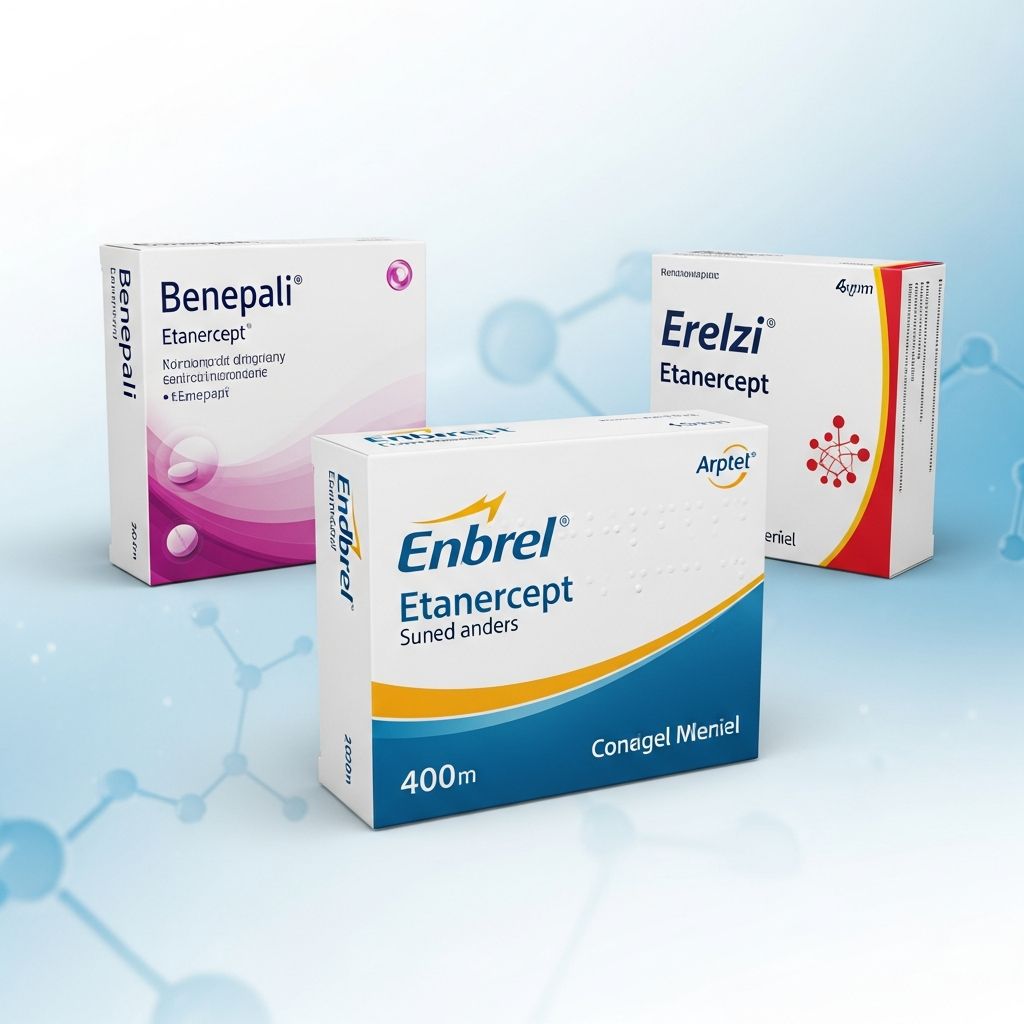
Etanercept is a biologic medication belonging to a class of drugs known as tumor necrosis factor (TNF) inhibitors, which are used to treat inflammatory conditions by suppressing the immune system’s overactive response. The originator medication, Enbrel, was developed by Pfizer and has been used clinically for many years. In recent years, biosimilar versions have become available, including Benepali (developed by Biogen) and Erelzi (developed by Novartis), offering more affordable treatment alternatives.
What Conditions Does Etanercept Treat?
Etanercept is approved for treating various autoimmune and inflammatory disorders in both adults and children. The primary conditions include:
- Rheumatoid Arthritis (RA): Moderate to severe active rheumatoid arthritis, particularly in patients previously treated with methotrexate
- Psoriatic Arthritis: Active and progressive severe forms of the disease
- Ankylosing Spondylitis: Chronic inflammatory condition affecting the spine
- Non-radiographic Axial Spondyloarthritis: Inflammatory spinal condition without visible joint damage
- Plaque Psoriasis: Severe plaque-type skin manifestations
- Juvenile Idiopathic Arthritis (JIA): Including polyarticular, extended oligoarticular, psoriatic arthritis, and enthesitis-related arthritis in children
How Does Etanercept Work?
Etanercept functions as a TNF receptor fusion protein that binds to and neutralizes tumor necrosis factor-alpha (TNF-α), a key inflammatory cytokine involved in autoimmune diseases. By blocking TNF signaling, etanercept reduces inflammation, slows disease progression, and improves symptoms in patients with inflammatory arthritis and other conditions. The medication is typically administered via subcutaneous injection, with dosing frequency varying based on the specific condition being treated.
Biosimilars vs. Originator: Understanding the Difference
Biosimilar medications are biologically derived drugs that are highly similar to an already approved originator biologic drug. Unlike generic medications, which are chemically identical copies of small-molecule drugs, biosimilars cannot be identical due to the complexity of biological manufacturing processes. However, they must demonstrate comparable efficacy and safety profiles to their reference product.
The two approved etanercept biosimilars—Benepali and Erelzi—have undergone rigorous regulatory evaluation by the European Medicines Agency (EMA) and have been deemed biosimilar to Enbrel. This means they have similar manufacturing processes, comparable clinical efficacy, and equivalent safety profiles, though minor differences in formulation may exist.
Efficacy of Etanercept Biosimilars
Clinical Trial Evidence
Multiple clinical studies have demonstrated the effectiveness of etanercept biosimilars compared to the originator. In phase III trials evaluating Benepali, a randomized, double-blind study involving 596 patients with moderate-to-severe rheumatoid arthritis showed equal efficacy to Enbrel, with similar ACR20 response rates at week 24 (78.1% with Benepali versus comparable rates with Enbrel). The efficacy and tolerability of Erelzi were similarly investigated in phase III studies in adult patients with plaque-type psoriasis, demonstrating equivalent efficacy and safety compared to the originator.
Real-World Effectiveness
Extensive observational studies involving several thousand adult participants support the clinical trial findings. Research by Lindström et al. observed 1,015 patients with spondyloarthritis who switched from Enbrel to Benepali, finding no increase in disease activity at 6 months post-switch. Similarly, Holroyd et al. followed 92 adult patients with various rheumatic diseases for at least 6 months after switching from Enbrel to Benepali without observing disease deterioration. In juvenile idiopathic arthritis, comparative analyses confirm that Enbrel and biosimilars Benepali and Erelzi do not significantly differ in efficacy, with both achieving significant reductions in disease activity.
Related Stories



A large-scale study published in Rheumatology supported by the British Society for Rheumatology found that biologic-naïve rheumatoid arthritis patients had similar outcomes in survival and disease activity whether they received the originator or biosimilar treatment.
Safety Profile and Side Effects
Common Adverse Events
During clinical trials, the safety profiles of Benepali, Erelzi, and Enbrel were comparable. The incidence of treatment-emergent adverse events ranged from 55% to 60% across treatment groups, with most adverse effects being mild to moderate in severity. The most frequently reported adverse effects include:
- Upper respiratory tract infections
- Injection site reactions (local redness, swelling, or bruising)
- Mild liver function abnormalities
- Headache and fatigue
Injection Site Reactions
One notable finding in observational studies was a higher incidence of injection site reactions in patients initiating biosimilar therapy compared to those starting Enbrel. Approximately 20% of patients beginning treatment with Benepali or Erelzi experienced local injection site reactions, compared to 6.8% of patients starting Enbrel after January 2017. However, this increased rate had no significant impact on treatment adherence or discontinuation rates, indicating that patients tolerated this side effect acceptably.
Serious Adverse Events
The proportion of serious adverse events was similar between biosimilars and the originator. Safety outcomes obtained with biosimilars in rheumatoid arthritis patients can be reasonably extrapolated to other approved therapeutic indications. When comparing serious adverse events in observational studies of juvenile idiopathic arthritis, no significant differences were found between products.
Switching Between Etanercept Products
Many patients currently receiving Enbrel may be candidates for switching to an approved biosimilar. Clinical evidence supports the safety and efficacy of switching from the originator to biosimilars during an ongoing course of therapy. Long-term observational data demonstrate that disease activity does not deteriorate following such switches, making biosimilars appropriate alternatives for both treatment initiation and mid-therapy transitions.
Healthcare providers may recommend switching to a biosimilar for various reasons, including cost considerations and equivalent therapeutic outcomes. The decision to switch should be made in consultation with your rheumatologist or healthcare provider, considering your individual disease status and treatment response.
Drug Interactions and Contraindications
Etanercept should not be used in patients with active tuberculosis or other serious infections. The medication requires careful monitoring in patients with:
- History of tuberculosis or tuberculosis exposure
- Chronic hepatitis B infection
- Severe infections or sepsis
- Known hypersensitivity to etanercept or any vaccine components
- Certain malignancies or high risk for malignancy
Combination therapy with methotrexate enhances etanercept effectiveness in treating rheumatoid arthritis, with combination therapy showing superior efficacy compared to methotrexate monotherapy. However, specific drug interaction profiles should be discussed with healthcare providers before initiating or modifying treatment regimens.
Dosing and Administration
Etanercept is administered via subcutaneous injection. Dosing varies based on the specific condition being treated and patient factors. Standard dosing for rheumatoid arthritis typically involves either:
- 50 mg once weekly, or
- 25 mg twice weekly (3-4 days apart)
For other conditions such as psoriatic arthritis and ankylosing spondylitis, similar dosing regimens apply. Pediatric patients with juvenile idiopathic arthritis receive weight-based dosing. Patients are typically trained in self-injection techniques to administer the medication at home, though some may receive injections at clinical facilities.
Cost Considerations and Availability
The primary advantage of etanercept biosimilars over the originator is their significantly lower cost, making treatment more accessible and reducing financial burden on healthcare systems and patients. The availability of approved biosimilars—Benepali and Erelzi—has expanded treatment options while maintaining equivalent therapeutic benefit. As biosimilar versions become more widely available and adopted, cost savings accumulate for both individual patients and healthcare organizations, potentially improving treatment access for larger patient populations.
Monitoring During Treatment
Patients receiving etanercept therapy require regular clinical monitoring to assess treatment response and detect potential adverse effects. Monitoring typically includes:
- Regular assessments of disease activity and symptom control
- Periodic blood tests to monitor liver function and blood cell counts
- Screening for infection signs and symptoms
- Evaluation for malignancy development
- Assessment of injection site reactions and local tolerability
Healthcare providers adjust dosing or recommend alternative therapies based on individual response and tolerance patterns.
Frequently Asked Questions
Q: Are Benepali and Erelzi as effective as Enbrel?
A: Yes, clinical evidence confirms that Benepali and Erelzi biosimilars are equivalent to Enbrel in terms of efficacy and safety. Multiple phase III studies and extensive real-world observational data support comparable effectiveness across all approved indications.
Q: Can I switch from Enbrel to a biosimilar?
A: Yes, switching from Enbrel to an approved biosimilar like Benepali or Erelzi is safe and supported by clinical evidence. Discuss switching with your healthcare provider to ensure it aligns with your treatment goals and disease management plan.
Q: Why do biosimilars cost less than Enbrel?
A: Biosimilars are developed after the originator’s patent expires, allowing manufacturers to streamline development and manufacturing processes. This reduces development costs while maintaining safety and efficacy standards, resulting in lower medication prices.
Q: What should I do if I experience injection site reactions?
A: Mild injection site reactions (redness, swelling, bruising) are common and typically resolve without intervention. Apply ice before or after injection to minimize discomfort. Contact your healthcare provider if reactions are severe, persist, or show signs of infection.
Q: Can etanercept be combined with other medications?
A: Etanercept can be combined with methotrexate for enhanced efficacy in rheumatoid arthritis treatment. However, avoid combining with other biologic TNF inhibitors. Discuss all current medications with your healthcare provider before starting etanercept therapy.
Q: How long does it take for etanercept to work?
A: Some patients experience symptom improvement within 2-4 weeks, though maximum benefit typically develops over 12-16 weeks of consistent treatment. Individual response varies, and healthcare providers may adjust therapy based on your response.
Q: Are there age restrictions for etanercept use?
A: Etanercept is approved for use in both adults and children with juvenile idiopathic arthritis. Pediatric dosing is weight-based and adjusted accordingly. Children as young as 2 years old may receive etanercept therapy under appropriate medical supervision.
Q: What infections pose the greatest risk during etanercept therapy?
A: Tuberculosis represents the most serious infectious risk. Screening for tuberculosis is essential before initiating therapy. Other serious infections include bacterial sepsis and fungal infections. Report any fever, persistent cough, or signs of infection immediately to your healthcare provider.
References
- Efficacy and Safety of Etanercept Biosimilars Compared with the Originator in Juvenile Idiopathic Arthritis — National Center for Biotechnology Information (NCBI). 2021. https://pmc.ncbi.nlm.nih.gov/articles/PMC8593791/
- Vurdering av byttbarhet – Enbrel, Benepali og Erelzi (Evaluation of Interchangeability) — Norwegian Medicine Agency. https://www.dmp.no/globalassets/documents/offentlig-finansiering-og-pris/medisinbytte/horinger/vurdering-av-byttbarhet_etanercept.pdf
- Biogen/Novartis etanercept biosimilars comparable with Pfizer’s Enbrel — Pearce IP Law. 2023-03-21. https://www.pearceip.law/2023/03/21/biogen-novartis-etanercept-biosimilars-comparable-with-pfizers-enbrel/
- Effectiveness, safety and economic analysis of Benepali in rheumatoid arthritis — Reumatología Clínica. 2021. https://www.reumatologiaclinica.org/es-effectiveness-safety-economic-analysis-benepali-articulo-S2173574321000563
- Etanercept – Enbrel e altri (Etanercept – Enbrel and others) — Pharmamedix. https://www.pharmamedix.com/principio.php?pa=Etanercept
Similar Articles








Read full bio of medha deb