Eustachian Tubes: Anatomy, Function, and Health
Understanding your Eustachian tubes: anatomy, function, and what affects their health.
Understanding Your Eustachian Tubes
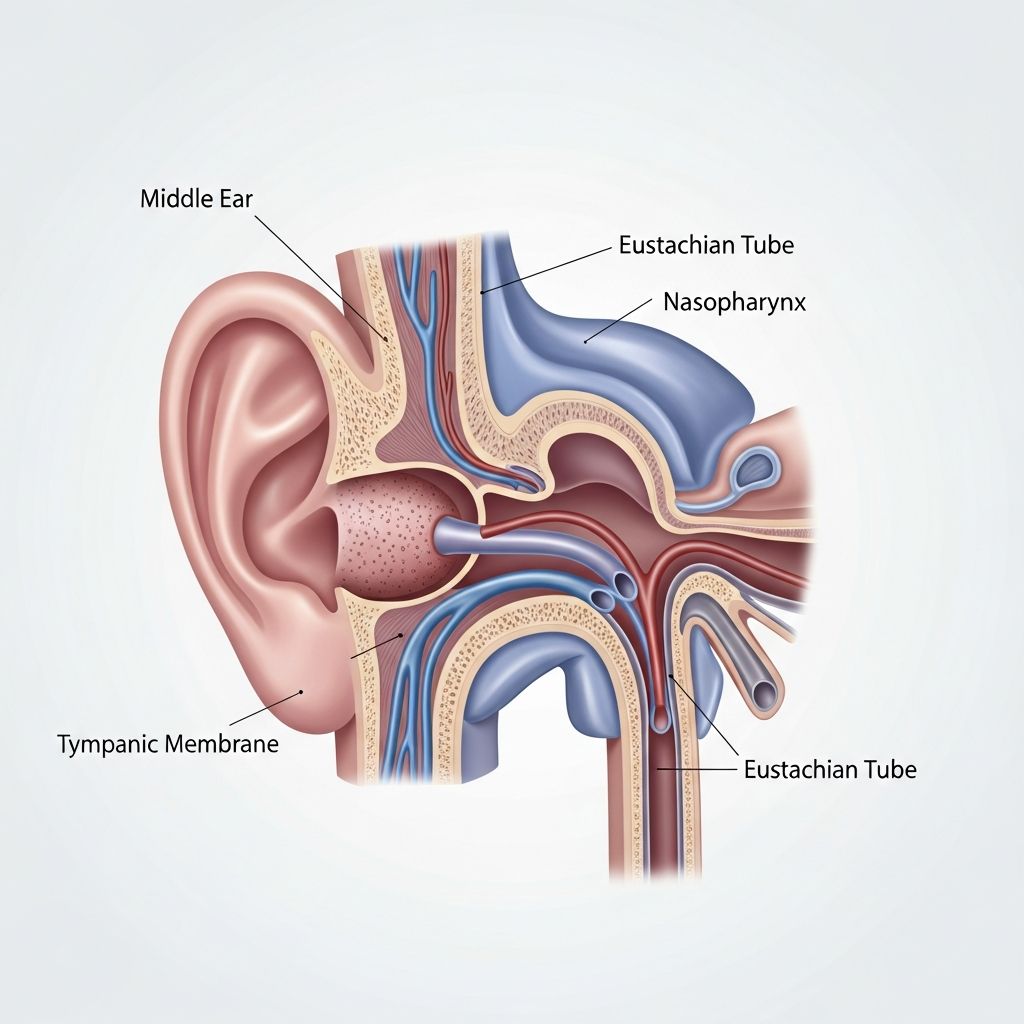
The Eustachian tube is a narrow, tube-shaped structure that plays a critical role in maintaining ear health and hearing function. Located deep within your ear, this remarkable anatomical feature connects your middle ear to the nasopharynx (the upper part of your throat behind your nose). Understanding how your Eustachian tubes work is essential for recognizing why you might experience ear-related discomfort and when to seek medical attention.
What Are Eustachian Tubes?
The Eustachian tube, also known as the auditory tube or pharyngotympanic tube, is a narrow osseo-fibrocartilaginous canal approximately 35 millimeters (about 1.4 inches) long in adults. This small but mighty structure serves as a vital link between two important areas: your middle ear and your nasopharynx. The tube is lined with mucous membrane and contains specialized cells that help maintain ear health through multiple mechanisms.
In its normal resting state, the Eustachian tube remains closed, protecting your middle ear from bacteria, viruses, and other pathogens that exist in the nasopharynx. However, when you swallow, yawn, or perform the Valsalva maneuver (forcibly exhaling with your mouth and nose closed), the tube opens to allow air passage and pressure equalization.
Anatomy of the Eustachian Tube
Structural Composition
The Eustachian tube has a complex anatomical structure composed of two distinct portions, each with different characteristics and functions. Understanding these components helps explain how the tube operates and why certain conditions affect it differently.
Osseous (Bony) Portion: The anteroinferior section of the Eustachian tube is composed of bone and accounts for approximately one-third of the tube’s length. This rigid bony portion is fixed and cannot change shape or diameter. It connects directly to the middle ear cavity and serves as an anchor point for the more flexible cartilaginous portion.
Cartilaginous Portion: The posterosuperior section comprises approximately two-thirds of the Eustachian tube and is supported by cartilage and fibrous tissue. This flexible section is supported by a curved triangular plate of fibrocartilage located in a groove between the greater wing of the sphenoid bone and the petrous portion of the temporal bone. This design allows the cartilaginous portion to expand and contract during muscle contractions, enabling the tube to open and close as needed.
Supporting Musculature
Four primary muscles work in coordination to control the opening and closing of your Eustachian tube: These muscles are essential for the tube’s function and are innervated by different cranial nerves.
| Muscle Name | Innervation | Primary Function |
|---|---|---|
| Tensor Veli Palatini | Mandibular nerve (CN V) | Contracts anterolateral wall; primary contributor to tube opening |
| Levator Veli Palatini | Vagus nerve (CN X) | Elevates soft palate and rotates cartilaginous lamina |
| Salpingopharyngeus | Vagus nerve (CN X) | Assists in tube opening and stabilization |
| Tensor Tympani | Mandibular nerve (CN V) | Dampens sound vibrations and supports tube function |
The tensor veli palatini muscle makes the largest contribution to actively opening the Eustachian tube. When this muscle contracts, it pulls on the cartilage to dilate the tube and allow air passage. Simultaneously, the levator veli palatini muscle elevates the soft palate and rotates the cartilaginous lamina medially, further facilitating tube opening. These coordinated muscle contractions work together during swallowing and yawning to accomplish pressure equalization.
Related Stories



How Your Eustachian Tubes Function
Pressure Equalization: The Primary Function
The most important function of the Eustachian tube is to equalize air pressure between the atmosphere and your middle ear. When atmospheric pressure changes—such as when you ascend or descend in an airplane, climb a mountain, or dive underwater—your middle ear must adjust its internal pressure to match. Without this equalization mechanism, the pressure difference would push your eardrum inward or outward, causing discomfort and potentially damaging your hearing.
During swallowing and yawning, muscle contractions cause the Eustachian tube to open briefly, allowing a small amount of air to pass through from the nasopharynx into the middle ear. This air passage eliminates any pressure differential and results in the characteristic “popping” sensation many people experience when flying or driving through mountains. This equalization is crucial for proper eardrum function, enabling the eardrum to vibrate appropriately and transmit sound waves effectively to the inner ear.
Drainage and Mucociliary Clearance
Beyond pressure regulation, the Eustachian tube serves as a drainage pathway for fluids and secretions produced in the middle ear. The interior of the Eustachian tube is lined with ciliated epithelium—tissue covered with tiny hair-like structures called cilia. These cilia, working in conjunction with mucus-secreting cells, create a mucociliary clearance system that continuously moves fluid and debris from the middle ear toward the nasopharynx.
This drainage function is essential for maintaining a clean, infection-free middle ear. The anteroinferior (bony) portion of the tube primarily functions in mucociliary clearance, while the posterosuperior (cartilaginous) portion primarily functions in gas exchange. As the Eustachian tube matures and becomes more oblique in angle during childhood development, gravity increasingly assists in this drainage process, making the system more efficient.
Protection of Middle Ear Structures
The Eustachian tube performs several protective functions for your middle ear and inner ear structures. While the tube connects the sterile middle ear to the unsterile nasopharynx, it maintains several protective mechanisms:
- Local Immune Defense: The mucosal lining of the Eustachian tube contains immune-responsive tissue that helps defend against infections.
- Mechanical Protection: The normal closed state of the tube protects against retrograde passage of secretions and pathogenic microorganisms into the middle ear.
- Sound Protection: The tube design protects against the retrograde propagation of vocal sounds from the nasopharynx into the middle ear.
- Surfactant Action: Special surfactants in the tube reduce surface tension, minimizing the effort required to dilate the tube during opening.
Development of the Eustachian Tube
The Eustachian tube develops during fetal life from two embryological sources. The tube develops as a connection between the lateral extension of the first pharyngeal pouch endoderm and the first branchial cleft ectoderm. The expansion of this pouch forms the tubotympanic recess, which eventually develops into the entire middle ear cavity. The surrounding fibrocartilaginous tissue and muscles associated with the Eustachian tube form from the mesoderm during embryonic development.
In infants and young children, the Eustachian tube is more horizontal and shorter than in adults, making it more susceptible to middle ear infections. Additionally, the cartilage in pediatric Eustachian tubes contains less elastin, reducing the efficiency of the tube’s recoil capacity and its ability to remain closed when not actively opening. As children grow, the tube becomes more angled and the cartilage becomes denser with elastin, improving function and reducing infection risk.
The Mechanism of Tube Opening and Closing
Understanding how the Eustachian tube opens and closes provides insight into both normal ear function and conditions that affect ear health. While the tube remains closed at rest, its interaction with specific muscles enables precise control of when and how much it opens.
Active Opening During Swallowing and Yawning
When you swallow or yawn, your brain sends signals to the muscles controlling the Eustachian tube. The tensor veli palatini muscle contracts, pulling on the cartilaginous portion and dilating the tube’s opening. Simultaneously, the levator veli palatini muscle elevates the soft palate and rotates the cartilaginous lamina medially. These synchronized contractions create a temporary opening that allows air to flow through.
The tensor veli palatini contributes approximately 60-70% of the active opening force, making it the primary muscle responsible for tube dilation. The levator veli palatini provides crucial secondary support. This coordinated action is why people instinctively swallow or chew gum when they experience ear pressure changes during flights or altitude changes.
Passive Opening and Valsalva Maneuver
Beyond the natural opening that occurs with swallowing and yawning, the Eustachian tube can also open in response to direct pressure changes. The Valsalva maneuver—forcefully exhaling while keeping your mouth and nose closed—increases nasopharyngeal pressure and can force the Eustachian tube open. This technique is commonly used by divers and pilots to equalize ear pressure when other methods prove insufficient.
Closure and Protection
When muscles relax and active opening is not occurring, the Eustachian tube closes through natural recoil. The elastin-rich cartilage returns to its original position, and a pad of fat and loose connective tissue on the medial aspect of the membranous portion helps keep the tube sealed. This closure protects the middle ear from pressure fluctuations and prevents the introduction of nasopharyngeal bacteria and viruses.
Common Issues Affecting Eustachian Tube Function
Eustachian Tube Dysfunction
When the Eustachian tube fails to open and close properly, a condition called Eustachian tube dysfunction (ETD) develops. This can result from inflammation, congestion, or muscular dysfunction. Common causes include allergies, colds, sinus infections, adenoid enlargement, and sudden altitude or pressure changes. Symptoms may include ear fullness, hearing loss, tinnitus (ringing in the ears), and ear pain.
Middle Ear Infections
Improper drainage through the Eustachian tube can lead to fluid accumulation in the middle ear, creating an environment where bacteria or viruses can multiply. This condition, called otitis media, is particularly common in children whose Eustachian tubes are not yet fully developed.
Frequently Asked Questions
Q: Why do my ears pop when I fly or drive uphill?
A: Your Eustachian tube opens and closes to equalize the pressure difference between your middle ear and the atmosphere. As altitude or pressure changes rapidly, your Eustachian tube works to balance this difference, and you hear a “popping” sound when it succeeds.
Q: Why are children more prone to ear infections?
A: Children’s Eustachian tubes are shorter, more horizontal, and contain less elastin, making them less efficient at draining fluid and protecting against infection. As children grow, the tubes become more angled and mature, improving function.
Q: What can I do to help my Eustachian tubes function better?
A: Swallowing frequently, chewing gum, yawning, and staying hydrated can help keep your Eustachian tubes functioning properly. If you experience persistent symptoms, consult a healthcare provider.
Q: How long does it take for Eustachian tube dysfunction to resolve?
A: This depends on the underlying cause. Mild cases related to colds or allergies often resolve within a few weeks, while more persistent cases may require medical intervention.
Q: Can hearing loss be caused by Eustachian tube problems?
A: Yes, fluid accumulation or improper pressure equalization can cause conductive hearing loss. However, this is typically temporary and improves once the underlying Eustachian tube dysfunction is treated.
References
- Physiology, Eustachian Tube Function — StatPearls, National Center for Biotechnology Information. 2024. https://www.ncbi.nlm.nih.gov/books/NBK532284/
- Eustachian (Auditory) Tube: Anatomy and Function — Kenhub. 2024. https://www.kenhub.com/en/library/anatomy/eustachian-tube
- Anatomy, Head and Neck, Ear Eustachian Tube — StatPearls, National Center for Biotechnology Information. 2024. https://www.ncbi.nlm.nih.gov/books/NBK482338/
- The Eustachian (Auditory) Tube – Osseous — TeachMeAnatomy. 2024. https://teachmeanatomy.info/head/organs/ear/eustachian-tube/
- Eustachian Tube Dysfunction — Stanford Medicine Department of Otolaryngology. 2024. https://med.stanford.edu/ohns/OHNS-healthcare/earinstitute/conditions-we-treat/eustachian-tube-dysfunction.html
Similar Articles








Read full bio of medha deb