Examination Of The Nails: A Clinician’s Comprehensive Guide
Master the systematic examination of nails to diagnose skin diseases, systemic conditions, and nail abnormalities effectively.
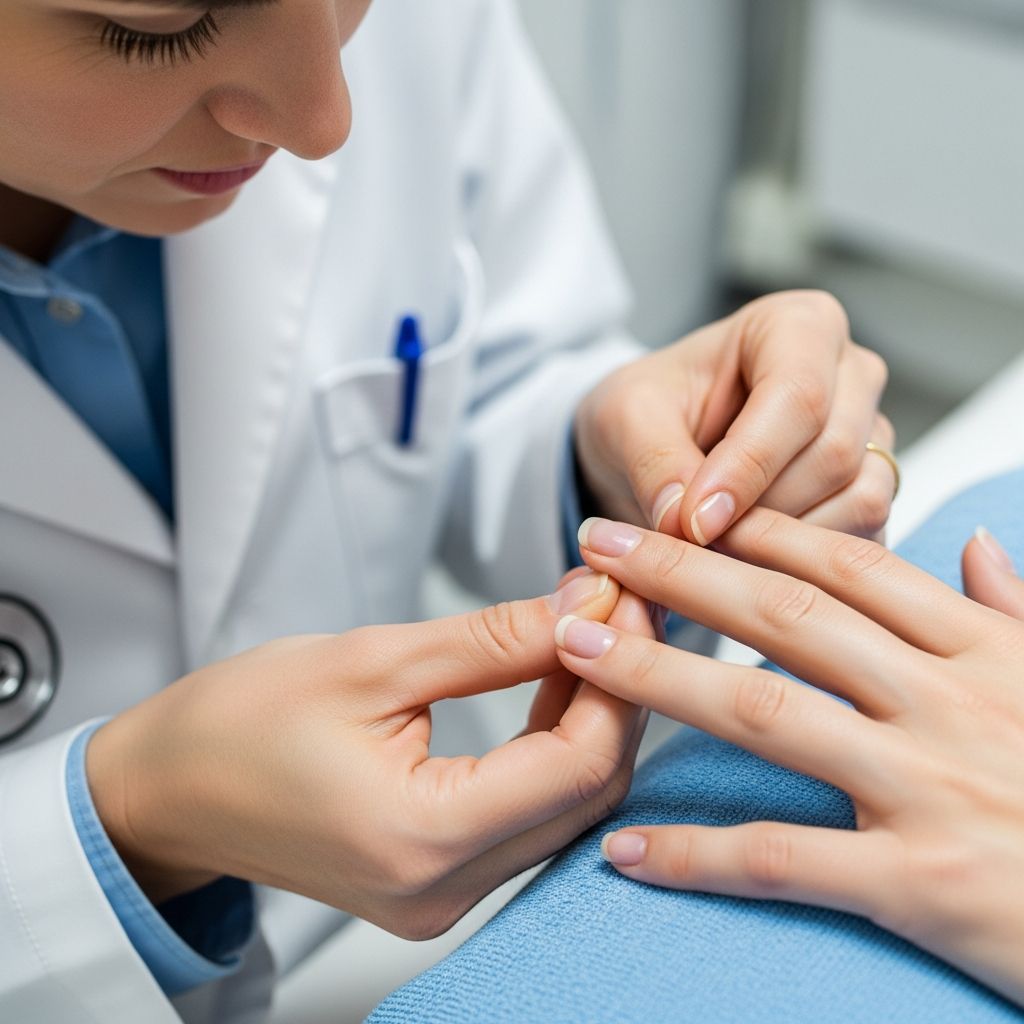
Developing proficiency in nail examination is crucial for dermatologists, as nails provide vital clues to both localised nail disorders and systemic diseases. This guide outlines how to systematically assess nail plate surface, discolouration, shape, and surrounding structures, with a glossary of terms and associations to common conditions like psoriasis, eczema, and subungual melanoma.
Learning Objectives
By the end of this module, clinicians should be able to:
- Develop skills in examining the nails and describing abnormalities of the nail plate surface.
- Identify and describe nail plate discolouration.
- Recognise changes in nail shape and surrounding skin.
- Associate nail findings with underlying skin diseases and systemic conditions.
Nail Anatomy and Function
Nails are specialised extensions of the stratum corneum, composed primarily of keratin. They serve protective functions, aid in scratching, and facilitate fine motor tasks like picking up small objects. The nail unit includes the nail plate, matrix, bed, proximal and lateral nail folds, and hyponychium. Careful inspection requires good lighting and sometimes magnification to evaluate these components.
Always examine all nails—fingernails and toenails—as changes may be unilateral, bilateral, or affect specific digits. Ask about associated skin diseases, trauma history, systemic symptoms, and family history. Fungal infections (onychomycosis) often accompany tinea pedis or manuum, while psoriasis or lichen planus may present with nail changes before skin lesions.
Approach to Nail Examination
Begin with a general overview:
- Inspect the nail plate: View from above, below, and the free edge. Note colour, thickness, surface texture, and integrity.
- Examine surrounding skin: Proximal nail fold (PNF), lateral nail folds, hyponychium, and periungual area for inflammation, scaling, or tumours.
- Assess handedness: Dominant hand nails may show more wear or trauma.
- Check all digits: Compare affected and unaffected nails.
If a nail problem is presented, perform a full skin examination, focusing on sites prone to associated conditions: feet/hands/groin for fungi, scalp/elbows/knees/flexures for psoriasis, oral mucosa/wrists/ankles/scalp for lichen planus.
Glossary of Nail Terms
Accurate terminology is essential for diagnosis and communication. Key terms include:
- Onycholysis: Separation of nail plate from bed, often due to psoriasis, trauma, or infection.
- Paronychia: Inflammation of nail folds, acute (bacterial) or chronic (fungal/irritant).
- Leukonychia: White discolouration of nail plate (superficial, total, punctate).
- Melanonychia: Brown-black pigmentation, longitudinal band raises melanoma concern.
- Pits: Depressions from proximal matrix damage, e.g., psoriasis.
Abnormalities of Nail Plate Surface
Nail plate surface irregularities often stem from matrix or bed inflammation. Common findings:
- Pitting: Random (psoriasis) or regular (alopecia areata). Pits form when parakeratotic cells are shed from proximal matrix.
- Ridging: Longitudinal (lichen planus, eczema) or transverse (Beau’s lines from systemic insult).
- Beau’s lines: Deep transverse grooves indicating temporary growth arrest (fever, chemotherapy, severe illness).
- Onychomadesis: Complete nail shedding after severe matrix insult.
Related Stories



Psoriasis: Classic triad of pitting, onycholysis, and subungual hyperkeratosis (oil drop sign). Up to 50% of psoriasis patients have nail involvement, sometimes preceding skin disease.
Eczema: Irregular pitting, ridging, and chronic paronychia with nail thickening.
Lichen planus: Thinning, longitudinal ridging/grooving, dorsal pterygium (scar-like fusion of PNF to plate).
| Condition | Nail Surface Features | Associated Skin Findings |
|---|---|---|
| Psoriasis | Pitting, onycholysis, hyperkeratosis | Scalp, elbows, knees plaques |
| Eczema | Irregular pitting, ridging | Hand/foot dermatitis, paronychia |
| Lichen planus | Thinning, ridging, pterygium | Violaceous papules, oral lesions |
Nail Plate Discolouration
Differentiate plate vs. bed pigmentation. Use dermoscopy if available: apply gel, view from above and free edge.
- Leukonychia: White—punctate (trauma), transverse (Muehrcke’s lines: hypoalbuminaemia), total (systemic illness).
- Yellow nail syndrome: Thick, slow-growing yellow nails with lymphoedema, respiratory issues.
- Melanonychia: Longitudinal bands from matrix melanocytes. Benign (naevi: irregular colour, blurred borders) vs. melanoma (width >3mm, irregular, Hutchinson sign).
- Haemorrhage: Subungual blood—well-defined proximal edge, distal streaks. Proximal spots suspicious for tumours.
Exclude subungual melanoma: pigmented band expanding proximally, pseudo-Hutchinson sign (pigment through PNF). Biopsy indicated for suspicious features.
Changes in Nail Shape and Size
Shape alterations reflect chronic matrix/bed pathology:
- Clubbing: Loss of nail-fold angle, spongy matrix (lung/heart disease, IBD).
- Koilonychia: Spoon-shaped (iron deficiency, Plummer-Vinson).
- Onychogryphosis: Thickened, curved ‘ram’s horn’ (neglect, psoriasis).
- Half-and-half nails: Proximal white/distal brown (renal failure).
Systemic clues: splinter haemorrhages (endocarditis), azure lunulae (Wilson disease).
Periungual and Nail Fold Abnormalities
Paronychia: Red, swollen folds—acute (Staph/Strep), chronic (Candida, irritants). Leads to nail dystrophy.
Dorsal pterygium: Scarring splits PNF, hallmark of lichen planus.
Myxoid cysts: Gelatinous domes over DIP joint, distort distal matrix.
Tumours: Periungual fibromas (tuberous sclerosis), warts, SCC, glomus tumours (painful red subungual nodule).
Nails in Systemic Disease
Nails mirror internal health:
- Cardiac: Clubbing, splinter haemorrhages.
- Pulmonary: Clubbing, yellow nail syndrome.
- Gastrointestinal: Clubbing (IBD, cirrhosis).
- Endocrine: Koilonychia (thyroid/iron), onycholysis (hyperthyroid).
- Nutritional: Beau’s lines (malnutrition).
Special Techniques
- Dermoscopy: Assess pigment patterns, blood spots.
- KOH prep/clipping: For onychomycosis.
- Biopsy: Matrix, bed, or fold for tumours/dystrophy.
Frequently Asked Questions (FAQs)
Q: What is the most important nail finding to exclude in melanonychia?
A: Subungual melanoma, presenting as an expanding longitudinal pigmented band >3mm wide with irregular borders or Hutchinson sign. Biopsy recommended.
Q: How does psoriasis affect nails?
A: Features include haphazard pitting, onycholysis, subungual hyperkeratosis (‘oil drop’), and nail thickening. Check skin for confirmation.
Q: What causes Beau’s lines?
A: Temporary matrix insult from severe illness, trauma, chemotherapy, or infection. Lines grow out over months.
Q: When is nail biopsy indicated?
A: Suspicious melanonychia, persistent paronychia, dystrophic nails unresponsive to treatment, or periungual tumours.
Q: Are nail changes always dermatological?
A: No; they signal systemic disease (clubbing, koilonychia) or associated skin conditions (psoriasis, lichen planus).
References
- Principles of dermatological practice. Examination of the skin — DermNet NZ. 2008 (updated). https://dermnetnz.org/cme/principles/examination-of-the-skin
- Dermoscopy of the nail — DermNet NZ. 2008 (updated). https://dermnetnz.org/cme/dermoscopy-course/dermoscopy-of-the-nail
- Dermatological guide – Skin cancer detection, patient education — PMC (NCBI). 2024. https://pmc.ncbi.nlm.nih.gov/articles/PMC11188824/
- Dermatologic Examination — Lecturio Medical. 2021. https://www.lecturio.com/concepts/dermatologic-examination/
- Principles of dermatological practice. Examination of the nails — DermNet NZ. 2008 (updated). https://dermnetnz.org/cme/principles/examination-of-the-nails
- HOW AND WHY SHOULD DOCTOR EXAMINE THE NAILS? — YouTube (Medical Education). Accessed 2026. https://www.youtube.com/watch?v=bUa1rfq5oCo
Similar Articles








Read full bio of medha deb