Eye Muscles: How They Work, Types, and Anatomy
Complete guide to eye muscles: Learn how six muscles control your eye movement and vision.
Eye Muscles: How They Work, Types, Anatomy & Function
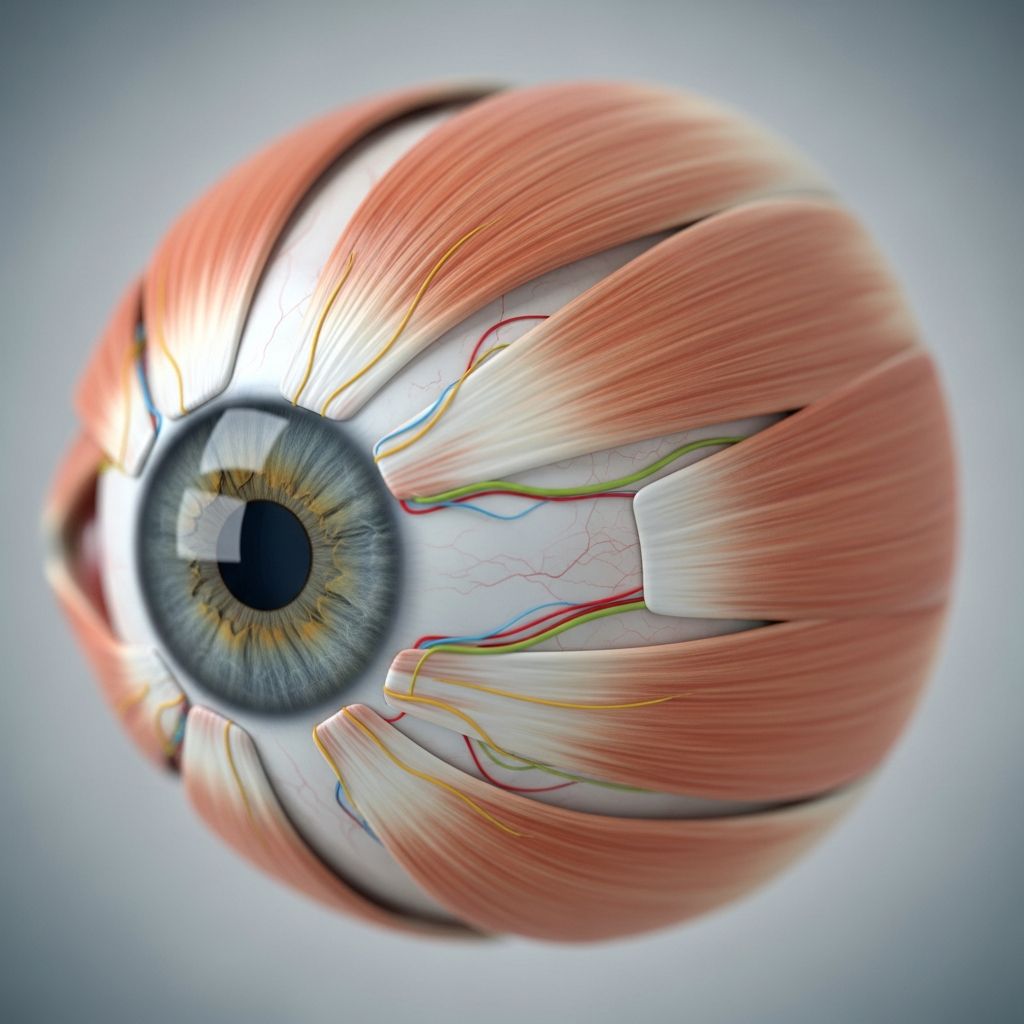
Your eyes are remarkably complex organs that rely on a sophisticated system of muscles to function properly. Both of your eyes have six muscles that control movement, allowing you to direct your eyes side-to-side, up and down, or at diagonal angles. These muscles are how you can track moving objects, read text, and maintain focus throughout your daily activities. The muscles that control eye movement all attach to the outside of your eyeball, which is why experts sometimes refer to them as “external” or “extrinsic” muscles.
Understanding the Two Types of Eye Muscles
Eye muscles are classified into two main categories: rectus muscles and oblique muscles. Understanding the distinction between these types helps clarify how your eyes achieve different ranges of motion and coordination.
Rectus Muscles
Each eye has four rectus muscles, which are the primary movers responsible for most eye movements. These muscles work by contracting and relaxing to pull the eyeball in specific directions. The four rectus muscles are:
- Medial Rectus: Located on the inner side of the eye, this muscle moves your eye inward toward your nose, a movement called adduction.
- Lateral Rectus: Positioned on the outer side of the eye, this muscle moves your eye outward away from your nose, a movement called abduction.
- Superior Rectus: Found on top of the eye, this muscle elevates your eye upward, allowing you to look up. The superior rectus also has secondary actions including intorsion (inward rotation).
- Inferior Rectus: Located beneath the eye, this muscle depresses your eye downward, allowing you to look down. Like the superior rectus, it also contributes to eye rotation movements.
Oblique Muscles
Each eye also has two oblique muscles that handle more specialized movements and rotational control. These muscles run at an angle, which gives them unique capabilities for eye positioning.
- Superior Oblique: This muscle runs from the back of the eye through a pulley-like structure called the trochlea and emerges at the top inner part of the eye. When it contracts, it primarily causes depression (looking down) and intorsion (inward rotation). The superior oblique is innervated by the trochlear nerve, the only cranial nerve that crosses to the opposite side of the brain.
- Inferior Oblique: This muscle originates from the floor of the eye socket near the nose and runs toward the outer back portion of the eye. It causes elevation (looking up) and extorsion (outward rotation of the eye).
How Eye Muscles Work Together
The six external muscles of your eyes work in pairs. When one muscle moves, its partner in the same eye helps control and balance that movement. This paired coordination is essential for smooth, coordinated eye movement. That’s why your eyes can only turn so far in each direction – they’re limited by the balance between opposing muscles.
Paired Muscle Coordination
When you look to the right, your right lateral rectus contracts while your right medial rectus relaxes. Simultaneously, your left lateral rectus relaxes while your left medial rectus contracts. This coordinated action allows both eyes to move together smoothly toward the right.
Related Stories



Yoking: Coordinated Eye Movement
There’s also another type of paired movement that happens involving both of your eyes. Experts call this “yoking” because your eyes turn together like a pair of horses or oxen yoked together. That’s how your eyes turn in unison, allowing you to focus on objects while maintaining binocular vision and depth perception. This coordinated movement is essential for activities like reading, driving, and playing sports.
Eye Movement Along Three Axes
External eye muscles are responsible for moving the eye along three distinct axes, providing comprehensive visual coverage of your environment.
| Movement Type | Direction | Primary Muscles Involved | Function |
|---|---|---|---|
| Horizontal | Toward or away from the nose | Medial and Lateral Rectus | Allows left-right eye movement for tracking and scanning |
| Vertical | Elevation or depression | Superior and Inferior Rectus, Superior and Inferior Oblique | Enables up-down eye movement for reading and visual exploration |
| Torsional | Top of eye toward or away from nose | Superior and Inferior Oblique | Provides subtle rotational movement for fine visual alignment |
The Role of Cranial Nerves
The muscles that control your eye movement depend on signals that travel through three cranial nerves. These nerves transmit commands from your brain to coordinate precise eye movements:
- Oculomotor Nerve (CN III): Controls the medial rectus, superior rectus, inferior rectus, and inferior oblique muscles. This is the most extensive of the eye-controlling nerves.
- Trochlear Nerve (CN IV): Controls the superior oblique muscle. This nerve is unique because it’s the only cranial nerve that crosses to the opposite side of the brain before reaching the eye.
- Abducens Nerve (CN VI): Controls the lateral rectus muscle, which is responsible for moving your eye outward.
Anatomical Attachment Points
All eye muscles originate from the common tendinous ring (annulus of Zinn), a fibrous band located deep within the eye socket at the back of the orbit. From this anchor point, the rectus muscles and superior oblique muscle extend anteriorly toward the eyeball. The superior oblique muscle follows a unique path through the trochlea, a pulley-like structure at the top inner corner of the eye socket, before inserting into the eyeball.
The insertion points on the eyeball are strategically positioned along the equator and beyond, which determines the specific actions each muscle can perform. Muscles that insert anterior to the eye’s equator produce different movements than those inserting posterior to the equator, and some muscles cross multiple axes to enable combined movements like elevation with inward rotation.
The Ciliary Body and Accommodation
While the extraocular muscles control eye movement, another important eye muscle system manages focusing. The ciliary body contains muscles that make your lens change its shape while you’re focusing on what you’re seeing. When you’re looking at something closer, your lens becomes rounded. When you’re looking at something farther away, your lens flattens out.
This happens because of the zonular fibers that stretch from the ciliary body to support your lens. The ciliary body’s jobs include making aqueous fluid and controlling the muscle that lets your lens change shape to focus on what you’re seeing. The ciliary muscle is what controls the shape of the lens through a process known as accommodation.
Complex Movement Capabilities
The anatomy and coordination of eye muscles enable remarkably complex movements. Because rectus muscles cross multiple axes of the eyeball, they can produce primary and secondary actions. For example, the superior rectus muscle not only elevates the eye but also contributes to intorsion and adduction when working in combination with other muscles.
The oblique muscles, with their angled approach to the eyeball, add nuance to eye positioning. The superior oblique depresses the eye and causes intorsion, while the inferior oblique elevates the eye and causes extorsion. This sophisticated arrangement allows your eyes to maintain proper alignment and focus even when looking at objects in challenging positions or during complex head movements.
Maintaining Proper Eye Alignment
Proper eye alignment is crucial for binocular vision and depth perception. Your brain processes signals from both eyes and compares them to create a three-dimensional image of your surroundings. When the eye muscles function correctly, both eyes aim at the same target simultaneously, allowing the visual cortex to fuse the images from each eye into a single, coherent picture.
The yoking mechanism ensures that when one eye moves, the other follows automatically. This prevents the strain that would result from each eye moving independently and allows you to maintain focus on moving objects without cognitive effort.
Frequently Asked Questions
Q: How many muscles control each eye?
A: Each eye has six muscles that control movement: four rectus muscles (medial, lateral, superior, and inferior) and two oblique muscles (superior and inferior).
Q: What is the trochlea and why is it important?
A: The trochlea is a pulley-like structure at the top inner corner of the eye socket. The superior oblique muscle passes through it, which changes the direction of the muscle’s pull and enables unique eye movements like depression and inward rotation.
Q: Can eye muscle problems affect vision?
A: Yes, problems with eye muscles can cause misalignment of the eyes, double vision, or difficulty tracking moving objects. Conditions like strabismus and nystagmus involve eye muscle dysfunction.
Q: How do the eyes move together?
A: Your eyes move together through a process called yoking, where both eyes turn in unison like paired oxen. This is controlled by coordinated signals from the three eye-controlling cranial nerves working in harmony.
Q: What is the difference between rectus and oblique muscles?
A: Rectus muscles move the eye primarily in horizontal and vertical directions, while oblique muscles run at angles and enable more complex movements including depression, elevation, and rotational movements.
Q: How does accommodation work?
A: Accommodation is controlled by the ciliary muscle within the ciliary body. When this muscle contracts, it allows the lens to become more spherical, increasing focusing power for near objects. When it relaxes, the lens flattens for distance vision.
References
- Muscles of the Eye – Extraocular Muscles and Movements — Sam Webster, YouTube. 2018-05-01. https://www.youtube.com/watch?v=lDGCT9e-MWg
- Anatomy of the Eye — Cleveland Eye Clinic. 2024-02-23. https://clevelandeyeclinic.com/2024/02/23/anatomy-of-the-eye/
- Ciliary Body: Anatomy, Function and Associated Eye Diseases — Oscar Wylee. https://www.oscarwylee.com.au/glasses/eye/ciliary-body
- Eye Muscles: How They Work, Types, Anatomy & Function — Cleveland Clinic. https://my.clevelandclinic.org/health/body/eye-muscles
- Ciliary Body of the Eye: Anatomy and Function — Cleveland Clinic. https://my.clevelandclinic.org/health/body/24839-ciliary-body
Similar Articles








Read full bio of Sneha Tete