Facial Muscles: What They Are, Types, Anatomy & Function
Understanding facial muscles: anatomy, types, and their essential roles in expression and chewing.
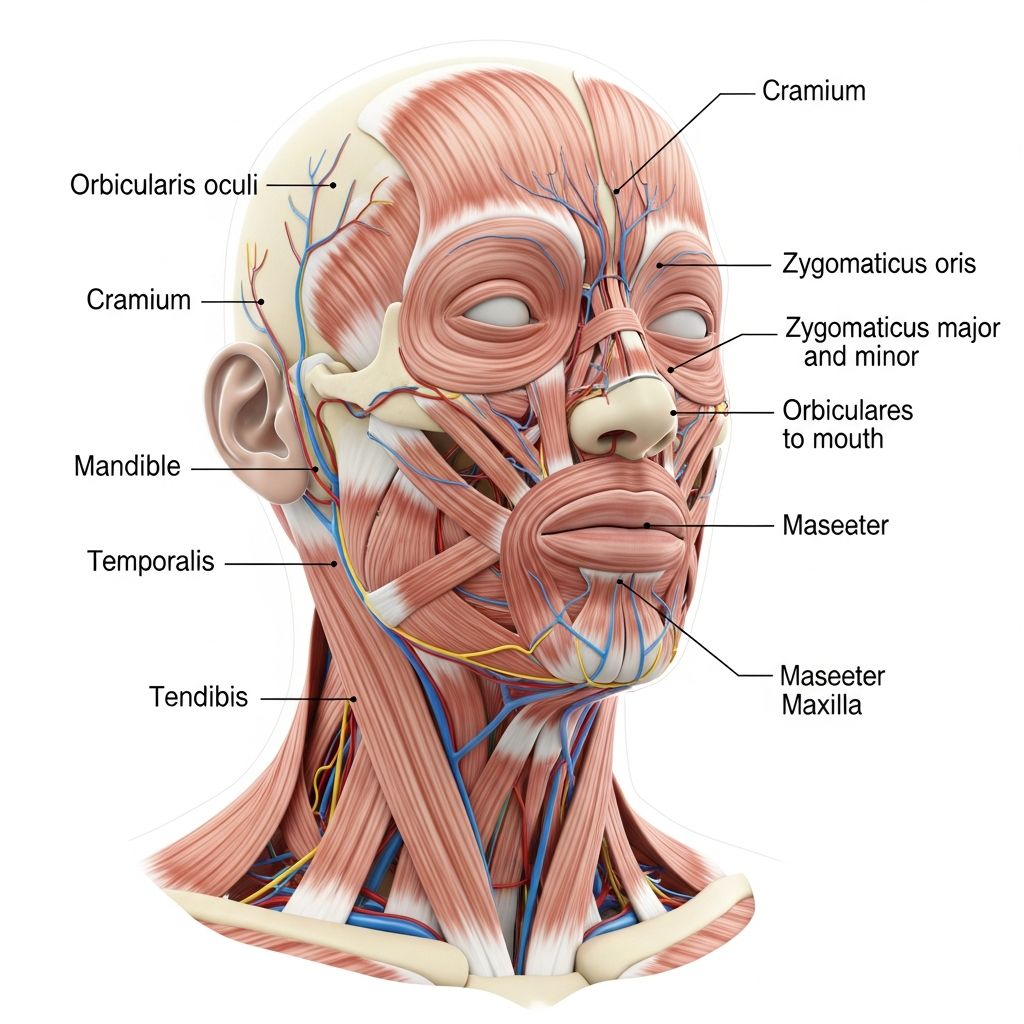
Your face contains a complex system of muscles that work together to create the expressions and movements you use every day. These facial muscles, also called craniofacial muscles, are essential structures that enable you to smile, frown, chew, and communicate with others. Located throughout your face including your ears, mouth, forehead, nose, and eyes, these muscles run underneath your skin from your scalp down to your neck. Without these remarkable muscles, you wouldn’t be able to eat, speak, or express emotions.
What Are Facial Muscles?
Facial muscles are skeletal muscles that attach to various points on your skull and work together to control movements in different parts of your face. Your face contains approximately 20 flat skeletal muscles that originate from bone or fascia and insert into your skin. These muscles are different from other skeletal muscles in your body because they attach to skin rather than bone at one end, allowing them to move the skin of your face directly. This unique characteristic gives you the ability to create the wide range of facial expressions that communicate your emotions and intentions to others.
These muscles are typically paired, meaning you have one on the left side of your face and one on the right side, allowing for balanced and coordinated facial movements. The facial muscles are part of your skeletal system, also known as the musculoskeletal system, and contain elastic fibers that allow them to contract and relax.
Primary Functions of Facial Muscles
Your facial muscles serve two major essential functions that are critical to daily life and communication:
- Chewing (Mastication): The muscles of mastication work together to move your jaw and allow you to bite and chew food. These powerful muscles generate the force needed to break down food into manageable pieces for digestion.
- Facial Expressions: Facial muscles enable you to create expressions such as smiling, pouting, and raising your eyebrows in surprise. These expressions are vital for nonverbal communication and emotional expression.
Beyond these primary functions, facial muscles also assist with additional important tasks including speaking, breathing, and swallowing. The coordination of these muscles allows you to perform complex actions like talking while maintaining proper facial expressions.
Types and Location of Facial Muscles
Facial muscles are organized into several distinct groups based on their location and function. Understanding the different types helps explain how your face can create such diverse movements and expressions.
Muscles of Mastication (Chewing Muscles)
The muscles involved in chewing are specialized to generate the force needed for eating. These muscles work in coordination with your jaw to crush and grind food. The primary muscles of mastication include the masseter, temporalis, medial pterygoid, and lateral pterygoid muscles. These powerful muscles are controlled by your trigeminal nerve and work together to open and close your mouth with significant force.
Related Stories



Muscles of Facial Expression
The muscles that control facial expression can be further divided into groups based on their location on your face. These muscles are generally thinner and more delicate than the muscles of mastication, designed for precise control rather than power.
Auricular Muscles
Your auricular muscles are located around your ears. They allow some people to move their ears through voluntary or involuntary contraction. These muscles include the anterior auricular, superior auricular, and posterior auricular muscles. While many people cannot consciously move their ears, these muscles remain functional and can respond to emotional states or reflexive stimuli.
Buccolabial Muscles
Your buccolabial muscles are located in and around your mouth area. These muscles control movements of your lips, cheeks, and the area around your mouth. Important buccolabial muscles include the orbicularis oris (which closes your lips), buccinator (which compresses your cheeks), zygomaticus major and minor (which pull your mouth into a smile), and the levator labii superioris (which raises your upper lip). These muscles are essential for eating, speaking, and creating expressions like smiling and pouting.
Epicranial Muscles
Your epicranial muscles are located around your forehead, skull, and neck area. These muscles include the frontalis, which raises your eyebrows and creates forehead wrinkles, and the occipitalis, which pulls your scalp backward. The epicranius muscle group (combining frontalis and occipitalis with the galea aponeurotica) allows for scalp movement and forehead expression. These muscles are important for expressions of surprise and attention.
Nasal Muscles
Your nasal muscles are positioned around your nose. These include the nasalis, which flares your nostrils, and the procerus, which wrinkles the bridge of your nose. These muscles, though small, contribute to breathing control and expressions of disgust or concentration.
Orbital Muscles
Your orbital muscles surround your eyes. The orbicularis oculi is the primary orbital muscle and is responsible for closing your eyelids and creating crow’s feet wrinkles at the corners of your eyes. These muscles are essential for protecting your eyes and for expressions involving the eyes, such as winking or squinting.
Anatomical Structure and Composition
Facial muscles are part of the skeletal muscle system and share certain structural characteristics with other muscles in your body, while also possessing unique features suited to their specific functions. All the muscles in the skeletal system contain elastic fibers that allow them to contract and relax. When viewed under a microscope, skeletal muscle fibers appear striped or striated because some fibers appear dark red and others appear light, giving them a distinctive lined appearance. This striped pattern is characteristic of voluntary muscles that you can consciously control.
These muscles are organized in bundles held together by sheaths of tough connective tissue called fascia, which provides support and helps coordinate muscle movement. The fascia surrounding facial muscles also contributes to the overall structure and elasticity of your face, helping to maintain skin tension and facial contours.
How Facial Muscles Function
To function properly, your facial muscles require signals from your brain transmitted through your facial nerve, also known as the seventh cranial nerve or CN VII. This cranial nerve contains motor fibers that control the movement of facial muscles, sensory fibers that transmit information about touch and taste, and parasympathetic fibers that control tear production and salivation. When your brain decides you want to smile, it sends a signal through your facial nerve to the facial muscles responsible for creating that smile. The motor branches of the facial nerve spread out like tree roots throughout your face and into your neck, ensuring that all facial muscles receive the necessary signals for coordinated movement.
The coordination between your brain and facial muscles allows you to perform complex actions automatically without conscious thought. However, you can also voluntarily control many facial expressions, allowing you to consciously smile, frown, or raise your eyebrows when you choose to do so.
Common Facial Muscle Problems
Damage to your facial nerve and problems with your facial muscles can result from various conditions and situations. When your facial nerve malfunctions, especially the motor functions that control movement, healthcare providers often refer to this as facial nerve palsy, with “palsy” meaning paralysis. Common causes of facial muscle and nerve problems include:
- Bell’s palsy, which causes sudden weakness of facial muscles on one side of the face
- Stroke or transient ischemic attack affecting facial nerve function
- Facial nerve injuries from trauma or surgery
- Hemifacial spasm, where motor branches of the facial nerve become overactive, leading to frequent facial muscle twitches
- Infections or inflammation affecting the facial nerve
- Tumors or growths pressing on the facial nerve
If you experience facial muscle weakness, inability to close your eye, drooping of facial features, or difficulty with eating or speaking, these may indicate facial nerve damage and you should consult with a healthcare provider.
The Blood Supply to Facial Muscles
Your facial artery plays a crucial role in supplying blood to your facial muscles and surrounding structures. This artery starts in the side of your neck and runs diagonally across your cheek, ending just below your eye. The facial artery has specialized twists that allow it to stretch while you’re chewing or moving your mouth in other ways, ensuring that blood flow remains adequate even during facial movements. The artery branches into multiple smaller vessels that supply blood to your muscles, mouth, nose, and other facial areas. Understanding the blood supply to facial muscles is important for surgical procedures and in treating conditions affecting facial blood flow.
Frequently Asked Questions
Q: How many facial muscles do I have?
A: You have approximately 20 flat skeletal muscles in your face that are considered the primary facial muscles. However, this number can vary slightly between individuals, and when including smaller accessory muscles and muscles in the neck and scalp region that assist with facial movement, the total number is higher.
Q: Which nerve controls facial muscles?
A: The facial nerve, also known as cranial nerve VII or CN VII, controls your facial muscles. This nerve sends motor signals from your brain to the facial muscles, allowing you to create expressions and perform other facial movements.
Q: Can I strengthen my facial muscles?
A: Yes, facial muscles can be exercised and maintained through facial exercises, proper hydration, good nutrition, and maintaining healthy skin care habits. Some people practice facial yoga or specific exercises designed to tone facial muscles.
Q: What happens if my facial nerve is damaged?
A: If your facial nerve is damaged, you may experience weakness or paralysis of the facial muscles on one or both sides of your face. This can affect your ability to smile, blink, eat, or speak clearly. A healthcare provider can perform tests to determine the extent of damage and recommend appropriate treatment options.
Q: Why do facial muscles look striped under a microscope?
A: Facial muscles are skeletal muscles composed of fibers that appear both dark and light under a microscope. This alternating pattern creates a striped or striated appearance. The dark fibers contain more myoglobin (an oxygen-carrying protein), while the light fibers have less myoglobin, creating the distinctive striped pattern characteristic of voluntary skeletal muscles.
Q: Are facial muscles used in speaking?
A: Yes, facial muscles play an important role in speech. The muscles around your mouth, lips, and cheeks help control the movement of your lips and tongue needed to form different sounds. Additionally, facial expressions often accompany speech to enhance communication and convey emotion or emphasis.
Conclusion
Your facial muscles are remarkable structures that enable you to interact with the world around you. From the powerful muscles of mastication that help you chew and eat, to the delicate muscles of expression that allow you to smile, frown, and communicate your emotions, these muscles are essential to daily life. They work under the direction of your facial nerve to create the vast array of movements and expressions that define human communication and emotion. The next time you smile at a friend or enjoy your favorite meal, remember the complex system of facial muscles working together to make these simple yet profound actions possible.
References
- Facial Muscles: What They Are, Types, Anatomy & Function — Cleveland Clinic. 2024-01-15. https://my.clevelandclinic.org/health/body/21672-facial-muscles
- Facial Nerve (CN VII): What It Is, Function & Anatomy — Cleveland Clinic. 2024-01-15. https://my.clevelandclinic.org/health/body/22218-facial-nerve
- Anatomy and histology of the frontalis muscle — National Center for Biotechnology Information (PubMed). 2014. https://pubmed.ncbi.nlm.nih.gov/25417794/
- Facial Artery: Anatomy & Function — Cleveland Clinic. 2024-01-15. https://my.clevelandclinic.org/health/body/24988-facial-artery
- Fascia Tissue Function — Cleveland Clinic. 2024-01-15. https://my.clevelandclinic.org/health/body/23251-fascia
Similar Articles








Read full bio of medha deb