Facial Psoriasis: Quick Guide To Diagnosis And Treatment
Comprehensive guide to understanding, diagnosing, and managing psoriasis on the face effectively.
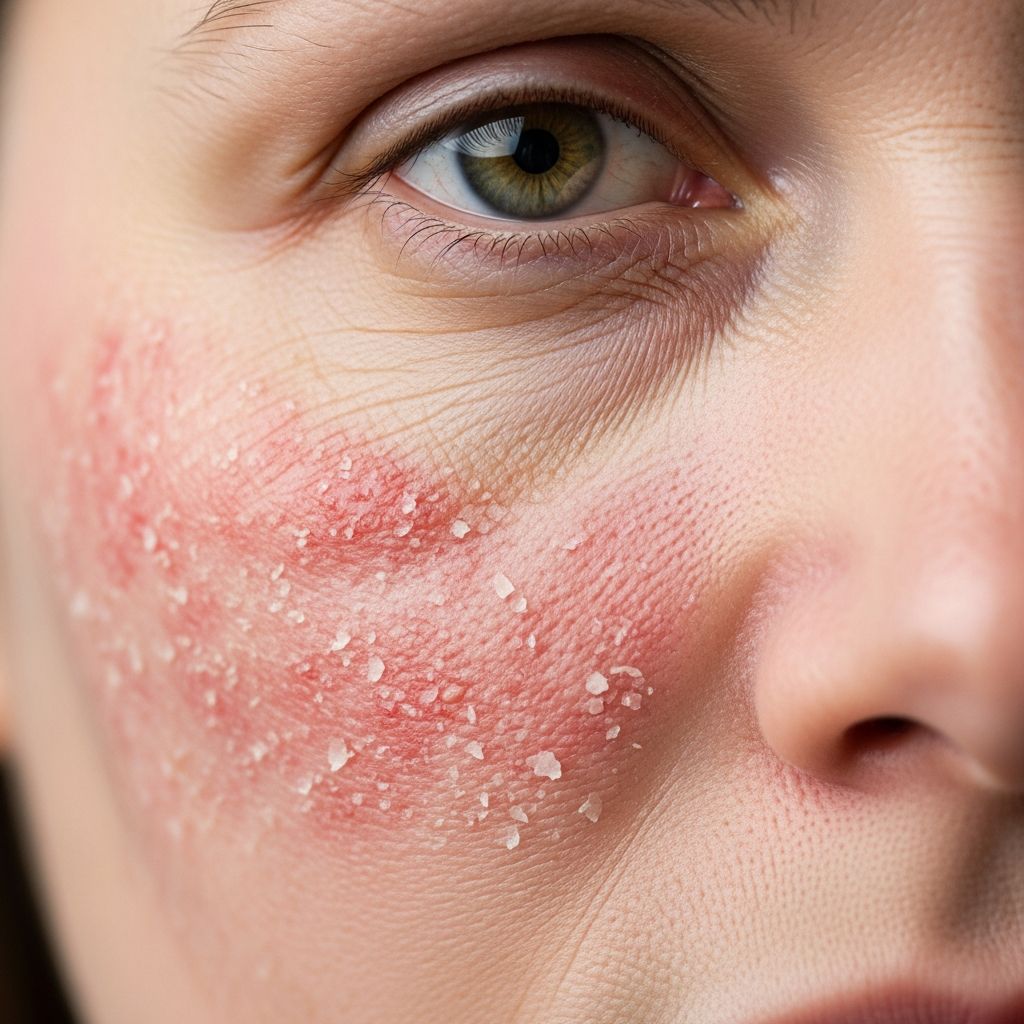
Facial psoriasis affects 50–80% of people with chronic plaque psoriasis at some time, but only 5–20% have it continuously. It often arises in patients with scalp, flexure or widespread psoriasis. Facial psoriasis is difficult to treat and often requires specialist input.
What is facial psoriasis?
Facial psoriasis refers to psoriasis affecting the skin of the face. Psoriasis is a chronic, immune-mediated inflammatory skin disease characterised by well-demarcated erythematous plaques with scale, usually involving extensible areas (elbows, knees, lower back). Facial psoriasis is uncommon as a presentation of psoriasis as monotherapy.
The most commonly affected sites are the glabella (between the eyebrows and extending to the nose), forehead (especially hairline), nasolabial folds, behind the ears and lips. Plaques are often thin and have little scale because of the seborrhoeic nature of facial skin.
Who gets facial psoriasis?
Facial psoriasis occurs equally in males and females, at any age. It is more common in patients with scalp psoriasis. Facial psoriasis is more common in patients with:
- Extensive psoriasis
- Flexural psoriasis
- Scalp psoriasis
Childhood facial psoriasis is rare and is usually associated with severe psoriasis or HIV infection. Facial psoriasis may be precipitated by irritants, allergy or contact dermatitis.
What causes facial psoriasis?
The cause of psoriasis is multifactorial. Genetic factors play a significant role, with multiple genes implicated in susceptibility. Environmental triggers include:
- Trauma or Koebner phenomenon: Minor trauma to the skin can trigger psoriasis plaques.
- Infection: Streptococcal infections are linked to guttate psoriasis, which can affect the face.
- Stress: Psychological stress exacerbates psoriasis flares.
- Medications: Beta-blockers, lithium, antimalarials can trigger or worsen psoriasis.
- Smoking and alcohol: Both are risk factors for psoriasis onset and severity.
- Vitamin D deficiency: Low levels correlate with worse symptoms.
In facial areas, harsh skincare products, cosmetics, and sun exposure act as irritants.
What are the clinical features of facial psoriasis?
Clinical features vary by skin type but typically include:
- Redness: Salmon-pink plaques on lighter skin; violaceous-brown on darker skin tones.
- Scaling: Fine, white or silvery scales, less prominent than on the body.
- Itch: Mild to moderate pruritus; scratching worsens plaques.
- Well-defined borders: Sharp margins distinguishing from eczema.
Specific sites:
- Glabella and forehead: Symmetric plaques extending from scalp.
- Nasolabial folds: Deep red, moist plaques mimicking seborrhoeic dermatitis.
- Perioral area: Scaling around lips, sparing the vermilion border.
- Eyelids and ears: Thin plaques; ear involvement common with scalp disease.
On darker skin, hyperpigmentation or hypopigmentation may persist post-treatment.
Diagnosis
This is made clinically by an experienced observer. Facial psoriasis is often misdiagnosed as eczema, seborrhoeic dermatitis, or rosacea.
Dermoscopy may show:
- Au lait-white structureless areas
- Red dots/globules
- Linear tortuous vessels
A skin biopsy is rarely needed but shows typical psoriasis features: regular epidermal hyperplasia (psoriasiform hyperplasia), parakeratosis, Munro microabscesses, dilated capillaries in dermal papillae.
Differential diagnosis
| Condition | Key Distinguishing Features |
|---|---|
| Seborrhoeic dermatitis | Greasy yellow scale; retroauricular fissuring; less well-defined. |
| Eczema | Ill-defined; oozing; personal/family atopy history. |
| Rosacea | Telangiectasia; papules/pustules; flushing; no scale. |
| Tinea faciei | Annular; central clearing; KOH positive. |
| Contact dermatitis | Asymmetric; history of exposure. |
Related Stories



What is the treatment for facial psoriasis?
There is no cure, but control is achievable for most with topical therapy. Treatment escalates based on severity.
General skin care
- Emollients: Fragrance-free, non-comedogenic; apply frequently.
- Avoid irritants: Soap-free cleansers; no alcohol-based products.
- Sunscreen: Broad-spectrum SPF 30+ daily.
- Gentle cleansing: Twice daily with lukewarm water.
Topical therapy
First-line for mild-moderate disease.
- Corticosteroids: Mild potency (hydrocortisone 1%) safe long-term; potent ones (mometasone) short courses only (intermittent use). Side effects: atrophy, telangiectasia, steroid rosacea.
- Calcineurin inhibitors: Tacrolimus 0.03–0.1%, pimecrolimus 1%; steroid-sparing; twice daily. Caution: burning sensation initially.
- Vitamin D analogues: Calcipotriol, calcitriol; reduce scaling; combine with steroid.
- Other topicals: Roflumilast foam/cream (PDE4 inhibitor); tapinarof; coal tar; salicylic acid for scale removal.
Phototherapy
Narrowband UVB (NB-UVB) effective for facial psoriasis; 2–3x/week. Avoid PUVA on face due to cataract risk.
Systemic treatment
For severe/refractory cases:
- Oral retinoids: Acitretin; effective but teratogenic.
- Immunosuppressants: Methotrexate, ciclosporin short-term.
- Biologics: TNF inhibitors (etanercept), IL-17/IL-23 inhibitors (secukinumab, guselkumab); excellent for facial disease.
What is the outlook for facial psoriasis?
Most achieve good control with topical therapy. Relapses common with triggers. Regular dermatologist follow-up essential. Cosmetic camouflage aids quality of life.
Frequently Asked Questions
Q: Is facial psoriasis contagious?
A: No, psoriasis is not infectious or contagious.
Q: Can makeup worsen facial psoriasis?
A: Yes, comedogenic products can occlude follicles and irritate plaques. Use non-comedogenic, hypoallergenic makeup.
Q: How long do facial psoriasis treatments take to work?
A: Topicals: 2–4 weeks; phototherapy: 4–6 weeks; biologics: 4–12 weeks.
Q: Is sun exposure helpful for facial psoriasis?
A: Moderate exposure may help, but always use sunscreen to prevent burns.
Q: Can diet affect facial psoriasis?
A: Anti-inflammatory diets (Mediterranean) may reduce flares; avoid personal triggers.
References
- Psoriasis on Face: Early Stages, Symptoms, Diagnosis, and More — Revival Research. 2023. https://revivalresearch.org/blogs/psoriasis-on-face/
- Psoriasis on the Face: Symptoms, What It Looks Like & Treatment — Cleveland Clinic. 2024-06-12. https://my.clevelandclinic.org/health/diseases/25047-psoriasis-on-the-face
- Psoriasis on the Face (Facial Psoriasis) — WebMD. 2024. https://www.webmd.com/skin-problems-and-treatments/psoriasis/facial-psoriasis
- Facial psoriasis — DermNet NZ. 2023-11-15. https://dermnetnz.org/topics/facial-psoriasis
- Psoriasis: Diagnosis and treatment — American Academy of Dermatology. 2025. https://www.aad.org/public/diseases/psoriasis/treatment/treatment
- Psoriasis – Diagnosis and treatment — Mayo Clinic. 2024-08-20. https://www.mayoclinic.org/diseases-conditions/psoriasis/diagnosis-treatment/drc-20355845
Similar Articles








Read full bio of Sneha Tete