Favre-Racouchot Syndrome Pathology: Clinical Guide
Exploring the histopathology, clinical features, and solar damage behind Favre-Racouchot syndrome, also known as nodular elastosis with cysts and comedones.
Favre-Racouchot syndrome, also known as nodular elastosis with cysts and comedones, senile comedones, or solar comedones, is a dermatological condition characterized by the development of large open comedones, cysts, and nodules on actinically damaged skin, primarily due to chronic ultraviolet (UV) exposure.
Introduction
Favre-Racouchot syndrome (FRS) was first described in 1932 by French dermatologist Maurice Favre and later detailed by Favre and Racouchot in 1951. It manifests as asymptomatic elastotic nodules, large black open comedones, and cysts superimposed on sun-damaged, atrophic skin, most commonly affecting the periorbital, malar, nasal, and temporal regions of the face.
The condition arises from prolonged sun exposure leading to solar elastosis, a degenerative change in the dermal elastic tissue. It predominantly affects older adults, particularly those with fair skin types and a history of significant UV exposure without protection. Smoking and occupational radiation may exacerbate the process.
Clinical Features
Clinically, FRS presents with a background of photodamaged skin exhibiting atrophy, yellowish discoloration, deep wrinkles, furrows, and telangiectasias. Key lesions include:
- Large, open black comedones (barrel-shaped, 1-2 mm), often symmetrical in periorbital and malar areas.
- Closed comedones with yellowish keratin plugs.
- Soft, waxy, noninflammatory nodules and cysts (elastotic nodules).
- Diffuse yellowish hue due to solar elastosis.
Lesions are typically asymptomatic but can become inflamed if secondarily infected. Common sites are the temples, cheeks, nose, forehead, lateral neck, retroauricular areas, and earlobes. The skin appears thickened yet atrophic with a waxy texture.
Dermoscopy
Dermoscopy reveals distinctive features aiding diagnosis:
- Well-defined dilated pilosebaceous openings with embedded blackheads.
- Large black barrel-shaped rings around hair follicles (open comedones).
- Structureless yellowish-brown circular areas (closed comedones).
- Yellowish background hue from solar elastosis.
- Linear arborizing vessels (telangiectasias).
- Enlarged pores and pigmentary changes indicating chronic actinic damage.
These findings correlate with enlarged pores and keratin-filled infundibula on clinical exam.
Histopathology
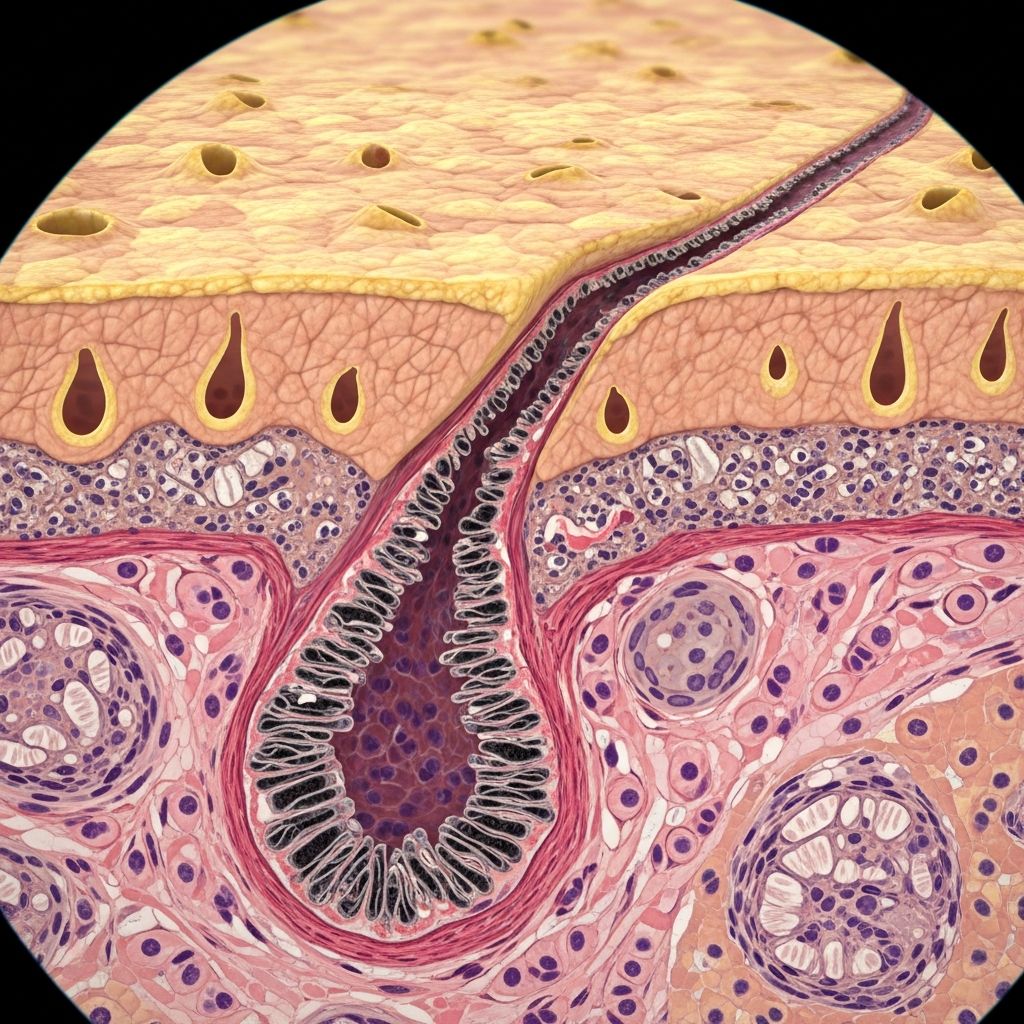
Histological examination is confirmatory and shows:
- Atrophic epidermis.
- Basophilic degeneration in the upper dermis.
- Severe solar elastosis: thickened, tortuous, clumped elastic fibers with blue-gray discoloration.
- Dilated pilosebaceous infundibula filled with lamellar keratin (comedones).
- Cyst-like spaces lined by flattened squamous epithelium.
- Atrophic or absent sebaceous glands.
- Absence of significant dermal inflammation.
Early stages may feature elastic fiber hyperplasia; advanced stages show dense hypertrophic elastotic material. Follicular plugging results from keratin retention.
| Feature | Description |
|---|---|
| Epidermis | Atrophic |
| Upper Dermis | Basophilic degeneration, solar elastosis |
| Pilosebaceous Units | Dilated openings with keratin, atrophic glands |
| Cysts/Comedones | Lined by flattened epithelium, no inflammation |
Pathogenesis
The primary etiology is chronic UV exposure (UVA and UVB), causing dermal elastic tissue destruction (solar elastosis). This leads to collagen and elastic degeneration in the upper dermis, sebum retention, and follicular hyperkeratosis. UVB induces immediate damage, while UVA penetrates deeper, promoting elastotic changes over decades.
Additional risk factors include smoking, which impairs skin repair, and radiation exposure. Genetic predisposition in fair-skinned individuals (Fitzpatrick types I-II) increases susceptibility. The process is slow, with lesions appearing after prolonged photodamage.
Related Stories



Differential Diagnosis
FRS must be distinguished from similar conditions:
| Condition | Key Distinguishing Features |
|---|---|
| Acne Vulgaris | Inflammatory papules/pustules in younger patients; no solar elastosis. |
| Solar Elastotic Bands (Forearm) | Cord-like yellow papules on forearms; no comedones. |
| Colloid Milium | Translucent papules; histologically distinct (colloid material). |
| Actinic Keratoses | Scaly, precancerous; lacks cysts/comedones. |
| Drug-Induced Comedones | History of medications (e.g., EGFR inhibitors); not photodistributed. |
Diagnosis is primarily clinical, supported by dermoscopy and biopsy if needed.
Treatment
FRS is benign and cosmetic; treatment targets lesions and photodamage:
- Extraction: Manual/comedone extractor for large open comedones.
- Topicals: Retinoids (tretinoin, adapalene) to promote turnover; ammonium lactate for elastosis.
- Lasers/Procedures: CO2 laser ablation, Erbium:YAG, or Q-switched Nd:YAG for cysts/comedones; effective for resurfacing.
- Chemical Peels: TCA or salicylic acid for superficial lesions.
- Prevention: Broad-spectrum sunscreen, sun avoidance, smoking cessation.
Recurrence is common without photoprotection. Inflammation may require topical antibiotics.
Frequently Asked Questions (FAQs)
Q: Who is at risk for Favre-Racouchot syndrome?
A: Elderly individuals with fair skin, chronic sun exposure, and smoking history; more common in men.
Q: Is Favre-Racouchot syndrome cancerous?
A: No, it is benign and non-malignant, though on actinically damaged skin at risk for skin cancers.
Q: Can FRS be prevented?
A: Yes, daily sunscreen (SPF 30+), protective clothing, and avoiding peak sun hours prevent progression.
Q: Does smoking worsen FRS?
A: Yes, smoking accelerates skin aging and elastosis, increasing risk.
Q: How effective is laser treatment?
A: Lasers like CO2 provide significant improvement in 70-90% of cases, with minimal downtime.
Prognosis
FRS is chronic but harmless; cosmesis improves with intervention. Ongoing photoprotection halts progression. Monitor for skin malignancies on affected areas.
References
- Favre–Racouchot syndrome — Journal of Skin and Sexually Transmitted Diseases. 2021. https://jsstd.org/favreracouchot-syndrome/
- Favre–Racouchot disease: A clinico-dermoscopic profile — Our Dermatology Online. 2021. https://www.odermatol.com/odermatology/20214/24.Favre-RatherS.pdf
- Can you identify this condition? – PMC – NIH — National Library of Medicine. 2010. https://pmc.ncbi.nlm.nih.gov/articles/PMC2837691/
- Favre–Racouchot syndrome — Wikipedia (informed by primary sources). N/A. https://en.wikipedia.org/wiki/Favre–Racouchot_syndrome
- Favre-Racouchot syndrome – VisualDx — VisualDx. 2023. https://www.visualdx.com/visualdx/diagnosis/favre-racouchot+syndrome?diagnosisId=51559&moduleId=101
- Elastosis – DermNet — DermNet NZ. 2023. https://dermnetnz.org/topics/elastosis
- Favre-Racouchot Syndrome (Nodular Elastosis…) — Dermatology Advisor. 2023. https://www.dermatologyadvisor.com/home/decision-support-in-medicine/dermatology/favre-racouchot-syndrome-nodular-elastosis-elastoidosis-with-cysts-and-comedones-senile-or-solar-comedones-smokers-comedones/
Similar Articles








Read full bio of Sneha Tete