FDA Greenlights Nemluvio and Vtama for Atopic Dermatitis
Discover the latest FDA-approved treatments revolutionizing atopic dermatitis care with biologic injections and steroid-free topicals.
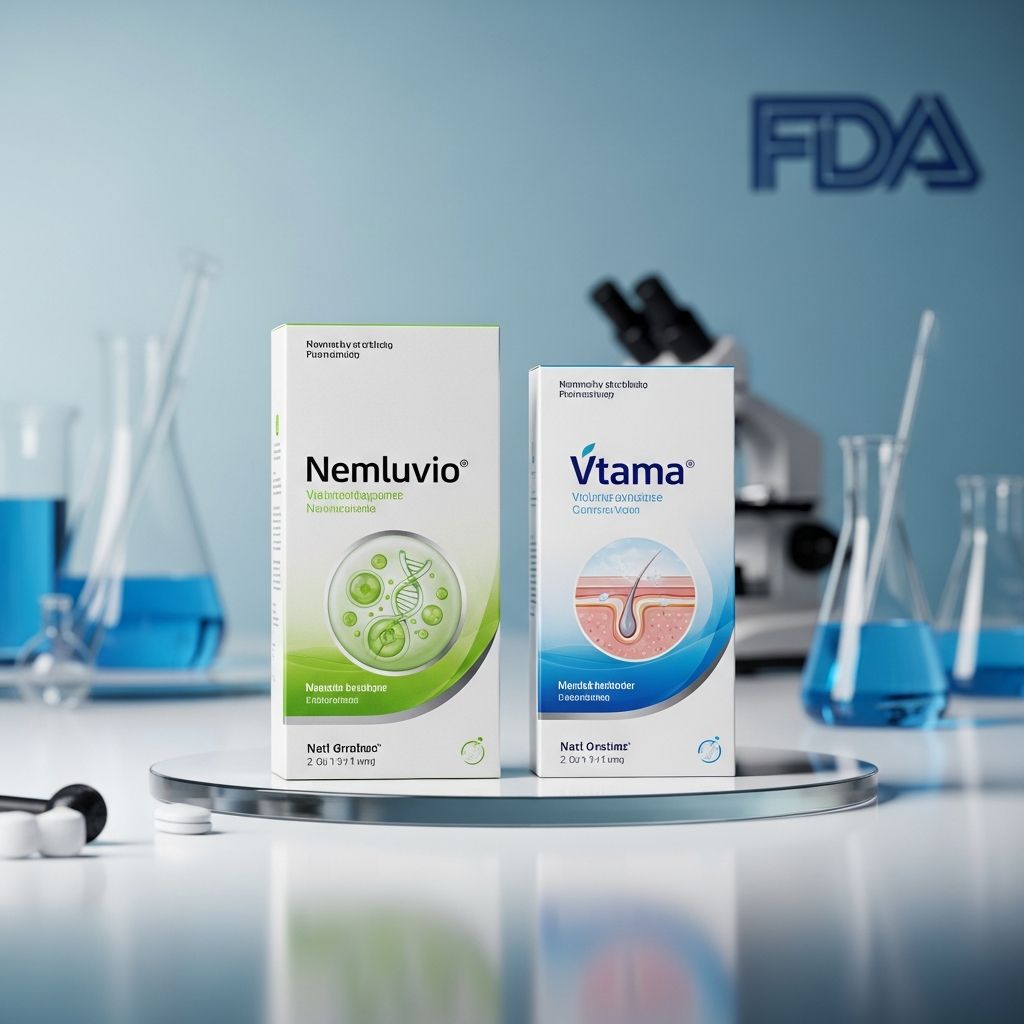
Atopic dermatitis, commonly known as eczema, affects millions worldwide with relentless itching, redness, and skin barrier disruptions. Recent advancements have brought two promising treatments to the forefront: Nemluvio, an injectable biologic, and Vtama, a topical cream. These FDA approvals mark significant progress in managing moderate-to-severe cases, providing targeted relief without relying solely on traditional steroids.
Understanding Atopic Dermatitis and the Need for Innovation
Atopic dermatitis is a chronic inflammatory skin condition characterized by intense pruritus (itch), dry skin, and recurrent flares. It arises from a complex interplay of genetic predisposition, immune dysregulation, and environmental triggers. In severe forms, it impairs sleep, daily activities, and quality of life. Conventional treatments like emollients and corticosteroids offer temporary relief but often fall short for persistent symptoms, leading to side effects such as skin thinning or rebound flares.
The demand for safer, more effective options has driven research into biologics and non-steroidal topicals. Biologics like Nemluvio target specific cytokines driving inflammation, while creams like Vtama modulate immune pathways locally on the skin. These therapies represent a shift toward precision medicine in dermatology.
Nemluvio: A Breakthrough Biologic Targeting Itch
Nemluvio (nemolizumab) is a monoclonal antibody that specifically blocks the interleukin-31 (IL-31) receptor alpha, a key player in itch signaling. Approved by the FDA for moderate-to-severe atopic dermatitis in adults, it is administered as a subcutaneous injection every four weeks after an initial loading dose.
Clinical trials, including the phase 3 ARCADIA program, demonstrated rapid and sustained itch reduction. Patients reported up to 60% improvement in itch scores within weeks, alongside clearer skin. This is particularly beneficial for those unresponsive to prior therapies like dupilumab. Nemluvio’s mechanism addresses the neuropathic component of itch, offering relief where topicals alone fail.
- Rapid onset: Significant itch relief by week 4.
- Sustained efficacy: Maintained through 52 weeks in extensions.
- Safety profile: Common side effects include injection-site reactions and conjunctivitis, generally mild.
For patients with skin of color, subpopulation analyses show consistent benefits across ethnic groups, addressing historical underrepresentation in trials.
Vtama: Steroid-Free Topical Innovation
Vtama (tapinarof) cream 1% is a novel aryl hydrocarbon receptor (AhR) agonist approved for plaque psoriasis but now expanded for atopic dermatitis in patients aged 2 and older. Its once-daily application activates anti-inflammatory pathways, promotes skin barrier repair, and reduces inflammation without steroids.
Pivotal ADORING trials (ADORING 1, 2, 3) enrolled diverse populations, showing 30-40% of patients achieving clear or almost clear skin (IGA 0/1). Notably, treatment-free intervals averaged 80 days post-clearance, minimizing long-term use. Efficacy held across Asian, Black, White, and other groups.
| Trial | Key Endpoint | Vtama Success Rate | Vehicle Rate |
|---|---|---|---|
| ADORING 1 | IGA 0/1 + 2-point improvement | 36% | 13% |
| ADORING 2 | IGA 0/1 + 2-point improvement | 40% | 14% |
| ADORING 3 | Disease clearance | 52% | 20% |
Vtama’s steroid-sparing nature suits pediatric and long-term use, with mild application-site reactions as primary adverse events.
Related Stories



Comparing Nemluvio and Vtama: When to Choose Each
These treatments complement existing options. Nemluvio suits widespread, severe disease requiring systemic control, while Vtama excels for localized mild-to-moderate flares.
| Feature | Nemluvio | Vtama |
|---|---|---|
| Mechanism | IL-31Rα inhibitor (biologic) | AhR agonist (topical) |
| Administration | Subcutaneous injection q4w | Topical cream QD |
| Best For | Moderate-severe, refractory itch | Mild-moderate, maintenance |
| Age Approval | Adults | ≥2 years |
| Onset | Weeks | Days to weeks |
Combination approaches, such as Vtama for maintenance post-Nemluvio induction, may optimize outcomes.
Broader Landscape of 2026 Atopic Dermatitis Therapies
Beyond these, 2026 sees further expansions. Adquey (difamilast 1%) ointment, a PDE4 inhibitor, gained FDA approval on February 12, 2026, for mild-to-moderate atopic dermatitis. It offers another non-steroidal topical with rapid itch relief. Roflumilast cream, approved in 2025 for ages 2-5, achieved 40% EASI-75 responses in pediatrics.
Biologics like lebrikizumab also expand options, showing hyperpigmentation improvements in skin of color. These reflect a trend toward diverse, inclusive trials and personalized care.
Practical Guidance for Patients and Providers
Consult a dermatologist to assess severity via EASI or IGA scores. Start with topicals like Vtama for mild cases; escalate to biologics like Nemluvio for uncontrolled symptoms. Lifestyle measures—moisturizing, trigger avoidance—remain foundational.
- Monitor for infections, a common complication.
- Tailor to comorbidities like asthma.
- Insurance coverage varies; patient assistance programs aid access.
Future Directions in Eczema Management
Ongoing research explores oral JAK inhibitors, microbiome modulators, and AI-driven flare prediction. Digital tools track symptoms for proactive care. No cure exists, but these advances promise prolonged remission.
Frequently Asked Questions (FAQs)
Is there a cure for atopic dermatitis?
No, but treatments like Nemluvio and Vtama control symptoms effectively, leading to clear skin periods.
Are these treatments safe for children?
Vtama is approved for ages 2+; Nemluvio for adults. Pediatric trials support safety.
How quickly do they work?
Nemluvio reduces itch in 4 weeks; Vtama shows skin improvements in 8-16 weeks.
Can they be used together?
Yes, under medical supervision for comprehensive control.
What if I have skin of color?
Trials confirm efficacy across ethnicities.
References
- Atopic Dermatitis Treatment in 2026 New Options & Insights — Trillium Clinic. 2026. https://trilliumclinic.com/new-insights-on-atopic-dermatitis-treatment/
- Recent FDA Approvals Expand Dermatology Options for Patients with Skin of Color — American Journal of Managed Care (AJMC). 2026. https://www.ajmc.com/view/recent-fda-approvals-expand-dermatology-options-for-patients-with-skin-of-color
- Novel Drug Approvals for 2026 — U.S. Food and Drug Administration (FDA). 2026-02-12. https://www.fda.gov/drugs/novel-drug-approvals-fda/novel-drug-approvals-2026
- Update on Drugs & Devices: January-February 2026 — Skin Therapy Letter. 2026. https://www.skintherapyletter.com/drug-updates/jan-feb-2026/
- FDA approves Adquey for mild-to-moderate atopic dermatitis — Epocrates. 2026. https://www.epocrates.com/online/article/fda-approves-adquey-for-mild-to-moderate-atopic-dermatitis
Similar Articles








Read full bio of medha deb