Fibrofolliculoma / Trichodiscoma Pathology
Detailed histopathological analysis of fibrofolliculoma and trichodiscoma, key markers of Birt-Hogg-Dubé syndrome.
Fibrofolliculoma and trichodiscoma represent a spectrum of benign adnexal hamartomas characterized by perifollicular epithelial and mesenchymal proliferations. These lesions commonly manifest as small papules on the face, neck, and upper trunk, either sporadically or as multiple eruptions indicative of Birt-Hogg-Dubé (BHD) syndrome—a genetic disorder with renal and pulmonary complications.
Introduction
Fibrofolliculoma and trichodiscomas are increasingly recognized as part of the same histopathological continuum, with many experts viewing them as variants of a single entity originating from hair follicle mantle cells. Fibrofolliculoma features prominent epithelial strands radiating from the infundibular portion of a hair follicle, enveloped by fibrous stroma, while trichodiscoma emphasizes a predominantly mesenchymal component with papillary dermal fibrosis and minimal epithelial elements. These tumours are hamartomatous, recapitulating normal follicular architecture, particularly the perifollicular sheath or adventitia.
Clinically, isolated lesions present as asymptomatic, dome-shaped papules measuring 2-4 mm, skin-coloured to hypopigmented, primarily on the face. Multiple lesions, often numbering in the dozens to hundreds, raise suspicion for BHD syndrome, an autosomal dominant condition caused by mutations in the folliculin (FLCN) gene on chromosome 17p11.2. This syndrome confers increased risks of renal cell carcinoma (particularly chromophobe and oncocytic subtypes), pulmonary cysts, and spontaneous pneumothorax. Recognition is crucial, as affected patients require systemic screening.
Historical nomenclature reflects ongoing debate: perifollicular fibroma, neurofollicular hamartoma, and mantleoma have been proposed as related or synonymous terms. Recent studies highlight morphological diversity, including spindle cell, lipomatous, myxoid, and sclerotic variants, attributed to hair bulge stem cell differentiation.
Clinical Features
Fibrofolliculoma/trichodiscoma typically appears in adulthood (third to fifth decades), with a slight female predominance in sporadic cases. Lesions are symmetric, periorificial (around nose, mouth, ears), and non-tender. In BHD syndrome, onset is earlier (20-30s), with profuse facial papules resembling acne, trichostasis spinulosa, or angiofibromas.
- Sporadic cases: Solitary or few papules on face, neck, upper trunk.
- BHD-associated: Multiple (often >50), central face predominant; acrochordon-like lesions on neck/axillae.
- Rare presentations: Cystic/nodular forms, scalp/earlobe involvement, or extracutaneous sites (e.g., mucosa).
Associated BHD features include renal tumours (15-30% lifetime risk), lung cysts (70-85%), and family history of pneumothorax. Dermatological differentials encompass basal cell naevus syndrome, multiple trichoepitheliomas, and tuberous sclerosis.
Pathology
Fibrofolliculoma
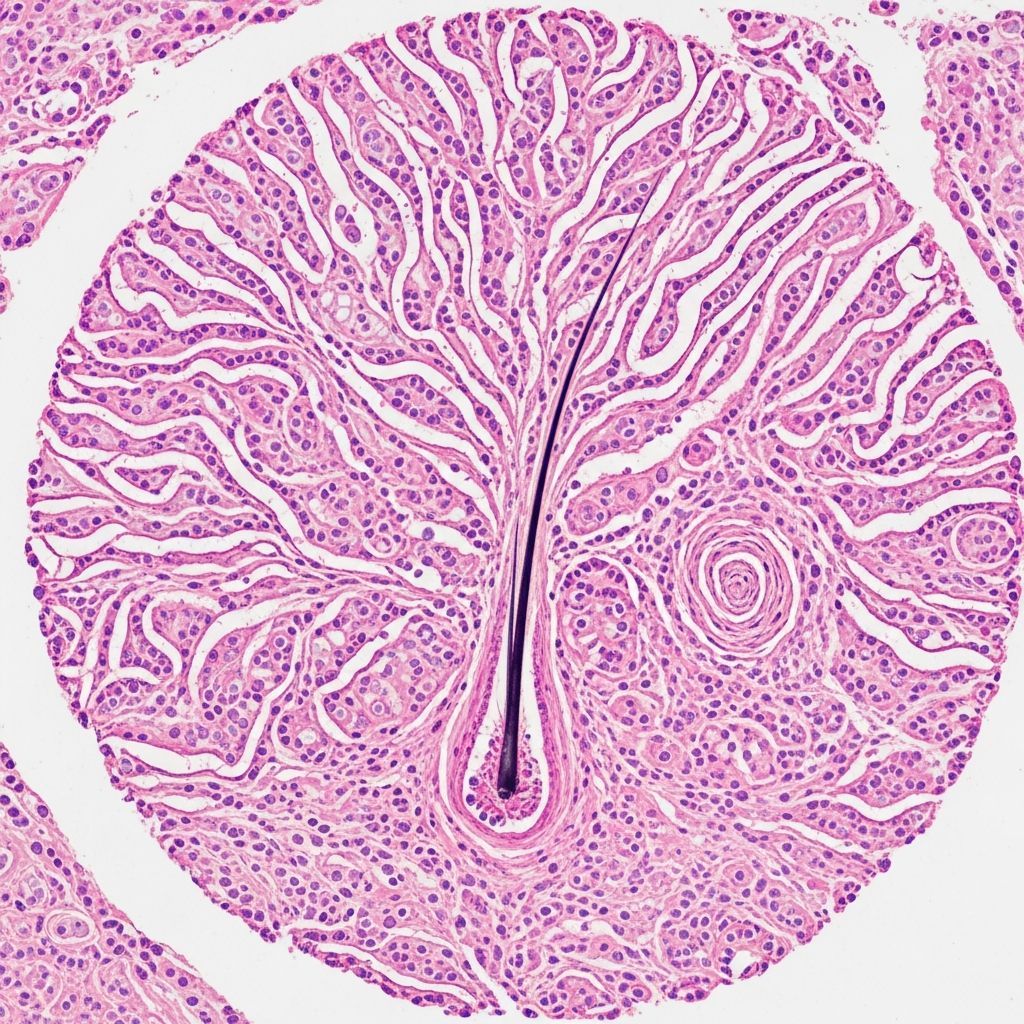
At scanning magnification, fibrofolliculoma presents as a well-circumscribed, nodular proliferation centred on a dilated infundibular follicle. Thin, anastomosing cords of basaloid epithelial cells—2-12 cells thick—radiate outward in a ‘sunburst’ or ‘mitt-like’ pattern from the central ostium. These strands exhibit peripheral palisading and maturation toward the centre, mimicking follicular mantle/isthmus.
The surrounding stroma is hallmark: densely collagenized, hypocellular, with plump fibroblastic cells recapitulating the perifollicular adventitia. Occasional mucin deposition or vascular dilation imparts a papillary architecture. Sebocytes may integrate into epithelial cords, blurring lines with folliculosebaceous hamartoma. Clefting between epithelium and stroma is common, aiding distinction from malignancy.
- Epithelial features: Thin cords, basaloid cells, no atypia/mitoses, central hair/follicle.
- Stromal features: Fibrotic sheath, loose/mucinous zones, CD34+ fibroblasts.
- Architectural clues: Symmetry, lack of infiltration, collarette epithelium.
Related Stories



Trichodiscoma
Trichodiscoma occupies the mesenchymal pole, featuring expansive papillary dermal fibrosis with delicate collagen bundles, increased vessels, and sparse ground substance (mucin/Alcian blue-positive). Epithelial components are vestigial: a peripheral collarette or attenuated mantle cells encircling the fibrovascular core. No central follicle is typically evident, distinguishing it from fibrofolliculoma.
Hypertrophied papillary dermis expands into reticular dermis, forming a dome-shaped nodule. Variants include:
- Myxoid/mucin-rich: Abundant Alcian blue+ stroma.
- Spindle cell: S100/CD34+ fascicles, hamartoma-like.
- Lipomatous: Adipocyte metaplasia.
- Sclerotic: Hyalinized collagen.
Spectrum and Variants
Lesions intermediate between fibrofolliculoma and trichodiscoma abound, supporting the unified ‘perifollicular sheath hamartoma’ concept. Hair bulge stem cells likely drive this diversity, yielding apocrine/eccrine differentiation, leiomyoma-like smooth muscle, or pseudocartilaginous nodules in rare cases. Folliculosebaceous cystic hamartoma may represent a cystic, sebaceous-enriched trichofolliculoma variant.
Histopathology Images
Low-power views reveal a central infundibulum with radiating epithelial strands enveloped by sclerotic stroma (akin to normal follicular sheath). Higher magnification shows bland basaloid cells without atypia, contrasting BCC’s retraction artifact. Trichodiscoma exhibits ‘onion-skin’ fibrosis with vascular papillae and minimal epithelium.
Differential Diagnosis
| Entity | Key Distinguishing Features |
|---|---|
| Basal Cell Carcinoma (BCC) | Retraction artifact, nuclear atypia, infiltrative growth, peripheral palisading without central follicle. |
| Neurofollicular Hamartoma | Spindle cells S100/CD34+, considered spindle-rich trichodiscoma variant. |
| Perifollicular Fibroma | Fibrosis around normal hair (not epithelial cords); possible fibrofolliculoma synonym. |
| Trichoepithelioma | Prominent germinative nodules, corneal lamellae, CK20+ Merkel cells; stromal adherence (no clefts). |
| Desmoplastic Trichoepithelioma | Thin cords in dense sclerosis, but ductular differentiation, no central follicle. |
| Fibroangioma/Angiofibroma | Vascular dilation, less organized fibrosis, no epithelial strands. |
Immunohistochemistry
Typically unnecessary, but supportive: Epithelial cords keratin+, CD34- (vs. stroma CD34+). Stromal fibroblasts nestin+, factor XIIIa+. S100 may highlight neural variants. Negative for BerEP4, PHH3 (vs. BCC). FLCN gene testing confirms BHD in multiples.
Birt-Hogg-Dubé Syndrome
BHD (MIM 135150) links multiple fibrofolliculomas/trichodiscomas to FLCN mutations, disrupting folliculin—a tumour suppressor involved in mTOR signalling, energy sensing, and ciliogenesis. Cutaneous signs precede systemic disease; screening includes renal MRI (every 36 months), PFTs, chest CT. Prognosis hinges on early renal detection (16-32% malignancy risk).
- Diagnostic criteria: ≥5 fibrofolliculomas/trichodiscomas or lung cysts + family history/pathogenic variant.
- Management: Dermatology surveillance, genetic counselling, oncologic follow-up.
Frequently Asked Questions (FAQs)
Q: Are fibrofolliculoma and trichodiscoma distinct entities?
A: No, they represent a morphological spectrum; fibrofolliculoma is epithelial-predominant, trichodiscoma mesenchymal.
Q: What syndrome is associated with multiple lesions?
A: Birt-Hogg-Dubé syndrome, mandating renal/pulmonary screening.
Q: How to differentiate from basal cell carcinoma?
A: Lack of atypia, central follicle, stromal clefting without retraction; BCC infiltrates.
Q: Is biopsy always required?
A: Not for classic solitary papules; essential for multiples or atypical sites to exclude BHD/syndromes.
Q: Treatment options?
A: Observation for asymptomatic; laser (CO2, Nd:YAG) or excision for cosmetics. Address systemic risks in BHD.
Q: Recent pathological variants?
A: Myxoid, spindle cell, lipomatous; stem cell origin hypothesized.
References
- Fibrofolliculoma / trichodiscoma pathology — DermNet NZ (Assoc Prof Patrick Emanuel). 2014 (updated). https://dermnetnz.org/topics/fibrofolliculoma-trichodiscoma-pathology
- Adnexal Neoplasms — Plastic Surgery Key. 2016. https://plasticsurgerykey.com/adnexal-neoplasms-2/
- Morphological diversity of trichodiscomas and fibrofolliculomas — PubMed (Journal of Cutaneous Pathology). 2014-06. https://pubmed.ncbi.nlm.nih.gov/24786577/
- Fibrofolliculoma/Trichodiscoma With Focal Follicular Germinative — Wiley Online Library (Journal of Cutaneous Pathology). 2024. https://onlinelibrary.wiley.com/doi/10.1111/cup.14819
Similar Articles








Read full bio of medha deb