Fibrous Papule Of The Nose: 5 Cosmetic Removal Options
Understanding the common, harmless skin lesion on the nose: causes, diagnosis, and cosmetic removal options.
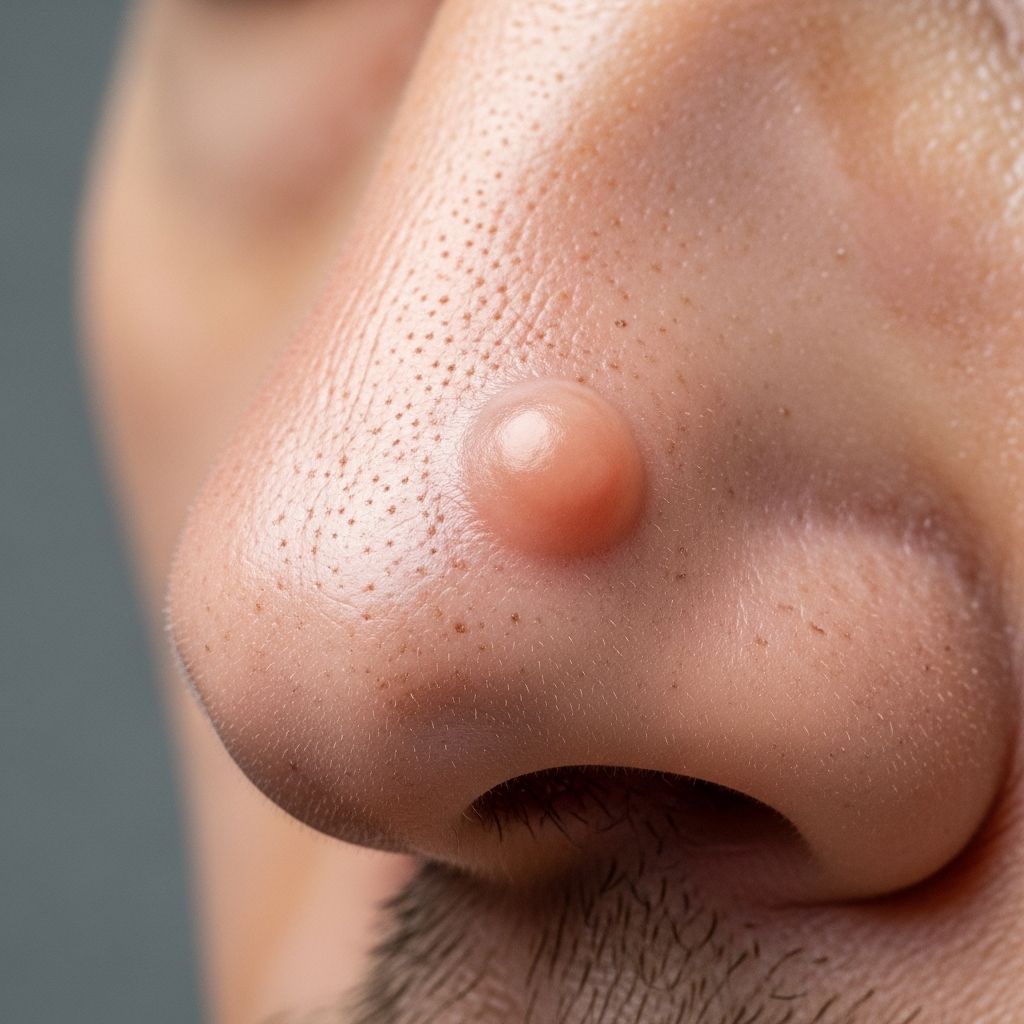
A fibrous papule of the nose is a common and harmless skin lesion. It is a firm solitary papule that occurs on or around the nose and has a characteristic appearance under the microscope.
Introduction
Fibrous papules, also referred to as fibrous papule of the face, solitary angiofibroma, or sporadic angiofibroma, represent a benign proliferation of connective tissue elements in the dermis. These lesions are typically discovered incidentally during self-examination or routine skin checks due to their prominent location on the nose. Despite their innocuous nature, they often prompt cosmetic consultation because of their visibility on the central face. Histologically, they feature increased collagen bundles, fibroblasts, and dilated vascular structures, distinguishing them from malignant counterparts.
Understanding fibrous papules is crucial for both patients and clinicians to alleviate unnecessary concerns and guide appropriate management. They do not evolve into cancerous growths and remain stable over time, but removal may be pursued for aesthetic reasons.
Demographics
Fibrous papules are prevalent across all age groups but predominantly manifest during late adolescence and early adulthood, often between the ages of 20 and 40 years. They affect individuals of all ethnic backgrounds without a strong gender predilection, though some studies note a slight female predominance in clinical presentations seeking removal.
These lesions are usually solitary, appearing as a single bump on the nose. However, multiple fibrous papules can occur without signifying an underlying systemic disorder. In rare instances, numerous and widespread papules beyond the nasal region may signal genetic syndromes such as tuberous sclerosis, Birt-Hogg-Dubé syndrome, or multiple endocrine neoplasia type 1 (MEN1). In these conditions, the papules are part of a broader spectrum of cutaneous manifestations and warrant genetic evaluation.
The anatomic predilection for the nose—particularly the tip, alar groove, and ala—makes them cosmetically conspicuous, leading many to seek dermatologic intervention purely for appearance.
Causes
The precise etiology of fibrous papules remains unknown, but several theories explain their pathogenesis. They arise from a localized overgrowth of collagen fibers, fibroblasts, and dilated blood vessels within the dermis, forming a structured lesion known histologically as an angiofibroma variant.
- Collagen and fibroblast hyperactivity: An focal increase in dermal fibroblasts and excessive collagen deposition creates the firm, dome-shaped architecture. These cells, including factor XIIIa-positive dermal dendrocytes, contribute to the fibrous matrix.
- Vascular components: Dilated capillaries and vascular proliferation impart the reddish or skin-toned hue observed clinically.
- Trauma and irritation: Chronic micro-trauma from friction, rubbing, or skin picking may induce low-grade inflammation, stimulating fibroblast activity and localized thickening.
- Skin aging: Age-related decline in collagen turnover and dermal remodeling might predispose certain areas, like the nose, to such growths.
Unlike inflammatory conditions, fibrous papules lack infectious or autoimmune triggers. They are not contagious and do not spread.
Clinical features
Fibrous papules present as asymptomatic, dome-shaped papules measuring 1–6 mm in diameter, most commonly 2–4 mm. They are firm to palpation, non-tender, and sessile, with a smooth surface. Colors vary from skin-toned and flesh-colored to pink, red, white, or pigmented, depending on vascularity and melanin content.
The classic location is the central nose, including the tip, bridge, or adjacent cheeks, though they can appear elsewhere on the face. They grow slowly and remain stable, persisting for months to years without spontaneous regression. Patients rarely report symptoms, but trauma may cause mild irritation, swelling, or bleeding.
Related Stories



- Size: 1–6 mm, rarely larger.
- Shape: Dome-shaped or sessile nodule.
- Surface: Smooth, occasionally with a central dell (small depression).
- Consistency: Firm, rubbery; does not blanch completely on pressure.
A variant, clear cell fibrous papule, features glycogen-rich clear cells on histology but shares identical clinical presentation.
Complications
Fibrous papules are biologically inert and do not lead to functional impairment, ulceration, or malignant transformation. Primary complications are psychological, stemming from self-consciousness over the visible lesion on the face. Occasional trauma from scratching or rubbing can provoke minor bleeding, crusting, or secondary infection, though these are uncommon.
In syndromic cases with multiple lesions, complications relate to the underlying disorder rather than the papules themselves, such as seizures in tuberous sclerosis.
Diagnosis
Diagnosis is primarily clinical, based on the characteristic appearance: a solitary, firm, dome-shaped papule on the nose in an adult. Dermoscopy may reveal dilated vessels, white collagen strands, and absence of pigment network, aiding differentiation. If uncertainty exists, a skin biopsy—either shave or punch—confirms the diagnosis, showing thick collagen bundles, stellate fibroblasts, and ectatic vessels in the dermis.
Histopathology is pathognomonic, ruling out mimics. No routine imaging or laboratory tests are required.
Differential diagnoses
Several lesions mimic fibrous papule clinically. Accurate differentiation prevents overtreatment:
| Condition | Key Distinguishing Features |
|---|---|
| Basal cell carcinoma | Pearly border, telangiectasia, ulceration, growth over time; symptomatic itch or bleed. |
| Intradermal nevus | Softer, more uniform pigmentation, lifetime presence; less vascular. |
| Sebaceous hyperplasia | Central umbilication, yellowish hue, multiple lesions; common in older adults. |
| Trichilemmoma | Warty surface; associated with Cowden syndrome if multiple. |
| Angiofibroma (tuberous sclerosis) | Multiple, perinasal; butterfly distribution. |
| Pyogenic granuloma | Pedunculated, friable, rapid growth, history of trauma. |
Biopsy resolves ambiguities, especially for atypical or changing lesions.
Treatment
Fibrous papules require no treatment as they are harmless and stable. Removal is elective for cosmetic improvement. Recurrence post-removal is rare. Options include:
- Shave biopsy: Superficial excision with scalpel; sends tissue for histology; minimal scarring.
- Excision: Full-thickness removal for larger lesions; suture closure; precise but leaves linear scar.
- Cryotherapy: Liquid nitrogen freezing; quick office procedure; post-treatment blistering, redness resolve in 1–2 weeks.
- Laser therapy: CO2 or vascular lasers ablate tissue precisely; excellent cosmesis, minimal downtime.
- Electrosurgery: Hyfrecation burns off lesion; controlled depth, good for small papules.
Pre-treatment assessment confirms diagnosis. Post-care involves wound protection, sunscreen, and moisturizers to optimize healing and minimize hypopigmentation or scarring. Consult a dermatologist for personalized approach.
Frequently asked questions
What is a fibrous papule of the nose?
A benign, firm dome-shaped bump on the nose caused by dermal collagen and vessel overgrowth; harmless and stable.
Is fibrous papule cancerous?
No, it is non-cancerous and does not become malignant.
Do fibrous papules go away on their own?
Rarely; they persist indefinitely without intervention.
How is it removed?
Via shave excision, laser, cryotherapy, or electrosurgery for cosmetic reasons.
Will it recur after removal?
Uncommon; low recurrence rate with complete removal.
Can it be treated at home?
No; professional evaluation prevents misdiagnosis and complications.
References
- Fibrous Papule of the Nose Removal Guide — Precision Hair Transplant & Aesthetics. 2023. https://precisionht.co.uk/blog/a-guide-to-fibrous-papule-of-the-nose-removal/
- Fibrous Papules: Causes & Treatments Explained — Monderma. 2025-01-19. https://www.monderma.co.uk/articles/fibrous-papules-causes-treatments-explained/
- Fibrous Papule of the Nose: Causes, Treatment & Removal — Cleveland Clinic. 2024. https://my.clevelandclinic.org/health/diseases/fibrous-papule-of-the-nose
- Fibrous papule of the nose — DermNet NZ. 2024. https://dermnetnz.org/topics/fibrous-papule-of-the-nose
- Cutaneous lesions of the nose — PubMed Central (PMC). 2010-06-30. https://pmc.ncbi.nlm.nih.gov/articles/PMC2903548/
Similar Articles








Read full bio of medha deb