Finasteride: Treatment for Male Pattern Hair Loss
Comprehensive guide to finasteride: mechanism, efficacy, and safety for androgenetic alopecia.
Finasteride for Male Pattern Hair Loss
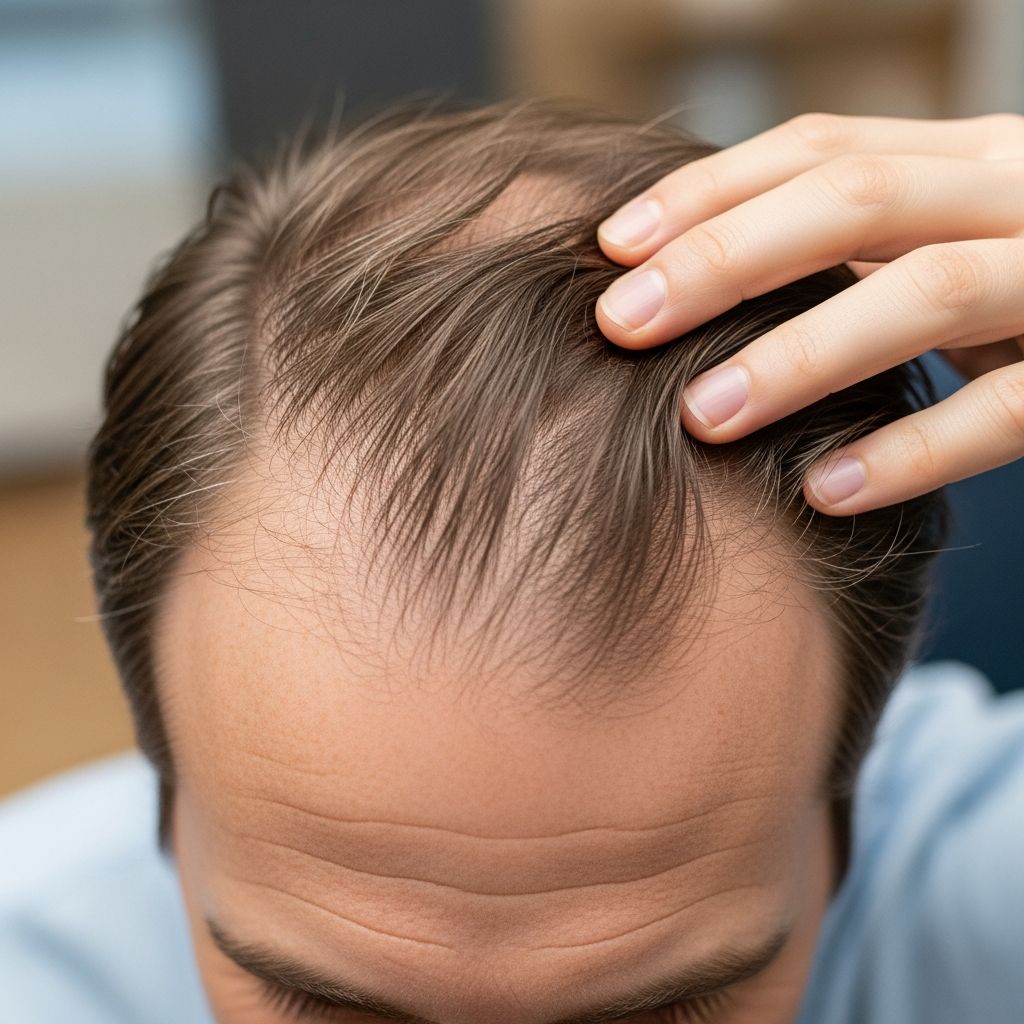
Finasteride is an FDA-approved medication indicated for the treatment of men with male pattern hair loss, clinically known as androgenetic alopecia (AGA). It is marketed under brand names including Propecia and is specifically designed to prevent further hair loss and promote hair regrowth in men experiencing pattern baldness. As one of only two FDA and European Medicines Agency-approved therapeutic options for androgenetic alopecia, finasteride represents a significant advancement in hair loss management.
How Finasteride Works
Finasteride functions as a specific type II 5-alpha reductase inhibitor. The medication works by inhibiting the enzyme responsible for converting testosterone to dihydrotestosterone (DHT), a hormone that plays a critical role in male pattern hair loss. DHT is the primary androgenic hormone that causes hair follicle miniaturization in genetically predisposed men, leading to progressive hair loss.
By reducing DHT levels in the scalp, finasteride decreases DHT’s harmful effects on hair follicles, effectively reversing the pathological process of androgenetic alopecia. The medication inhibits expression of the 5-alpha reductase enzyme found primarily in scalp hair follicles, which explains its targeted action on scalp hair while having minimal effects on hair in other body areas. Finasteride competitively inhibits 5-alpha reductase type 2, markedly suppressing serum DHT levels and creating a localized reduction of DHT in the scalp microenvironment.
Degree of DHT Suppression
Clinical research demonstrates that finasteride achieves substantial reductions in DHT concentrations:
- Serum DHT reduction: up to 70%
- Scalp DHT reduction: up to 60%
These significant reductions in DHT availability at the hair follicle level represent the mechanism by which finasteride halts hair loss progression and stimulates new hair growth in responsive patients.
Clinical Efficacy and Results
Finasteride has been extensively studied and demonstrates robust clinical efficacy. Multiple phase III clinical trials and high-quality studies have established its effectiveness as a treatment for male androgenetic alopecia. The medication was evaluated in 3,200 men during clinical trials and was found to be very well tolerated, with some patients receiving therapy for up to two years without significant safety concerns.
Clinical outcomes with finasteride include:
- Prevention of further hair loss in the majority of treated patients
- Increase in total and terminal hair counts
- Positive hair growth assessment in clinical evaluations
- Significant decrease in the rate of hair loss compared to placebo
Pharmacokinetics and Treatment Duration
Understanding the pharmacokinetics of finasteride is essential for patient management. The mean terminal half-life of finasteride is approximately five to six hours in men aged 18-60 years, and approximately eight hours in men older than 70 years. Despite its relatively short half-life, the medication produces sustained effects through continuous enzyme inhibition.
Following discontinuation of finasteride therapy, DHT levels return to normal within 14 days. However, the clinical manifestation of hair loss reversal occurs more gradually—if a patient stops taking finasteride, DHT levels will rise again in the scalp, and it is likely that hair loss will resume within approximately 12 months.
Related Stories



Safety Profile and Tolerability
Finasteride demonstrates an excellent safety profile based on extensive research spanning decades. Long-term suppression of DHT does not appear to be harmful, supported by research dating back to 1974 examining men born with a naturally occurring deficiency of 5-alpha reductase. This population has provided valuable long-term safety data demonstrating that sustained DHT suppression does not result in significant adverse health effects.
The medication is well-tolerated in the vast majority of patients, with most adverse events being mild and reversible upon discontinuation. Patients considering finasteride therapy should be educated regarding labeled warnings and potential side effects prior to initiating treatment.
Prostate-Specific Considerations
Finasteride produces a measurable effect on prostate health markers. The medication results in an average reduction of 50% for the prostate-specific antigen (PSA) score. This reduction is important for clinical interpretation—the PSA score should be doubled to accurately assess the risk of prostate cancer in men taking finasteride.
Prostate Cancer Risk Assessment
The relationship between finasteride use and prostate cancer risk has been very carefully reviewed and extensively studied. Current evidence is reassuring, indicating that finasteride does not appear to increase the overall risk of prostate cancer nor does it result in more serious disease compared to men who do not take the medication. The comprehensive safety data supports the use of finasteride as a well-tolerated treatment option for male pattern hair loss.
Other Considerations and Adverse Events
While finasteride is generally well-tolerated, certain considerations warrant attention:
- Finasteride is a specific inhibitor of type II 5-alpha reductase, which is found primarily in scalp hair follicles
- In clinical trials, there was no reported effect on hair in other parts of the body
- Although some cases of breast cancer have been reported in patients taking finasteride, there is no evidence that the drug was the cause
- Systemic use of finasteride is associated with side effects that may limit long-term utilization in some patients
Topical Finasteride: An Emerging Alternative
While oral finasteride is the established FDA-approved treatment, research into topical formulations of finasteride shows promising results. Topical finasteride may have therapeutic promise in managing androgenetic alopecia while limiting undesirable systemic side effects related to oral usage. Both scalp and plasma DHT significantly decreased with application of topical finasteride; importantly, no changes in serum testosterone were noted, suggesting greater selectivity for local scalp effects.
Topical finasteride significantly improves hair count compared to placebo and is well tolerated, with an effect similar to that of oral finasteride. Studies demonstrate that topical finasteride applied topically reduces systemic exposure to the medication while maintaining efficacy in suppressing scalp DHT levels. Combination approaches using topical finasteride with minoxidil and/or dutasteride have shown greater efficacy at hair regrowth than topical minoxidil alone.
Frequently Asked Questions
Q: How long does it take to see results with finasteride?
A: Significant hair regrowth effects typically become visible after several months of consistent use. Clinical studies show that results can vary among individuals, but treatment response is usually assessed over a 6-12 month period.
Q: What happens if I stop taking finasteride?
A: If you discontinue finasteride, DHT levels will rise again in the scalp within 14 days, and hair loss will likely resume within approximately 12 months. The hair gained from finasteride therapy may be lost gradually after stopping treatment.
Q: Does finasteride work on all areas of the scalp?
A: Finasteride is most effective for hair loss on the crown and mid-scalp regions. Its efficacy may be more limited for receding hairlines in some patients, though individual response varies.
Q: Does finasteride affect hair growth on other body areas?
A: No. Finasteride is a specific inhibitor of type II 5-alpha reductase found primarily in scalp hair follicles, so clinical trials reported no effect on hair in other parts of the body.
Q: Is finasteride safe for long-term use?
A: Yes. Long-term suppression of DHT does not appear to be harmful, based on extensive research dating back to 1974. Clinical trials demonstrated excellent tolerability in patients using finasteride for up to two years and beyond.
Q: Can women use finasteride for hair loss?
A: Finasteride is FDA-approved only for men with male pattern hair loss. For women with androgenetic alopecia, topical minoxidil is the primary FDA-approved option, though topical finasteride research is ongoing.
Q: Does finasteride increase prostate cancer risk?
A: No. Current evidence is reassuring and does not indicate that finasteride increases the risk of prostate cancer or results in more serious disease. Finasteride does reduce PSA scores by approximately 50%, so this should be factored into prostate cancer risk assessment.
Q: How should I interpret my PSA test results while on finasteride?
A: Since finasteride reduces PSA scores by approximately 50%, the actual PSA score should be doubled when assessing prostate cancer risk in men taking finasteride to account for this medication effect.
References
- Finasteride — DermNet. https://dermnetnz.org/topics/finasteride
- A Systematic Review of Topical Finasteride in the Treatment of Androgenetic Alopecia in Men and Women — Journal of Drugs in Dermatology. 2018. https://jddonline.com/articles/a-systematic-review-of-topical-finasteride-in-the-treatment-of-androgenetic-alopecia-in-men-and-wome-S1545961618P0457X
- Finasteride for Male Pattern Hair Loss Therapeutic Cheat Sheet — Next Steps in Dermatology. https://nextstepsinderm.com/derm-topics/therapeutic-cheat-sheet/finasteride-for-male-pattern-hair-loss-therapeutic-cheat-sheet/
- A Systematic Review of Topical Finasteride in the Treatment of Androgenetic Alopecia in Men and Women — UC Irvine Department of Dermatology. 2018. https://escholarship.org/content/qt9d78x4k3/qt9d78x4k3.pdf
- Efficacy and Safety of Topical Finasteride Spray Solution for Male Androgenetic Alopecia — National Institutes of Health. https://pmc.ncbi.nlm.nih.gov/articles/PMC9297965/
- Male Baldness — Royal Australian College of General Practitioners. April 2016. https://www.racgp.org.au/afp/2016/april/male-baldness
- Topical Finasteride: A Comprehensive Review of Androgenetic Alopecia Management for Men and Women — Cureus. https://www.cureus.com/articles/178511-topical-finasteride-a-comprehensive-review-of-androgenetic-alopecia-management-for-men-and-women
Similar Articles








Read full bio of medha deb