Flagellate Erythema: Causes, Diagnosis, Treatment Guide
Understanding flagellate erythema: causes, clinical features, diagnosis, and management of this distinctive linear dermatosis.
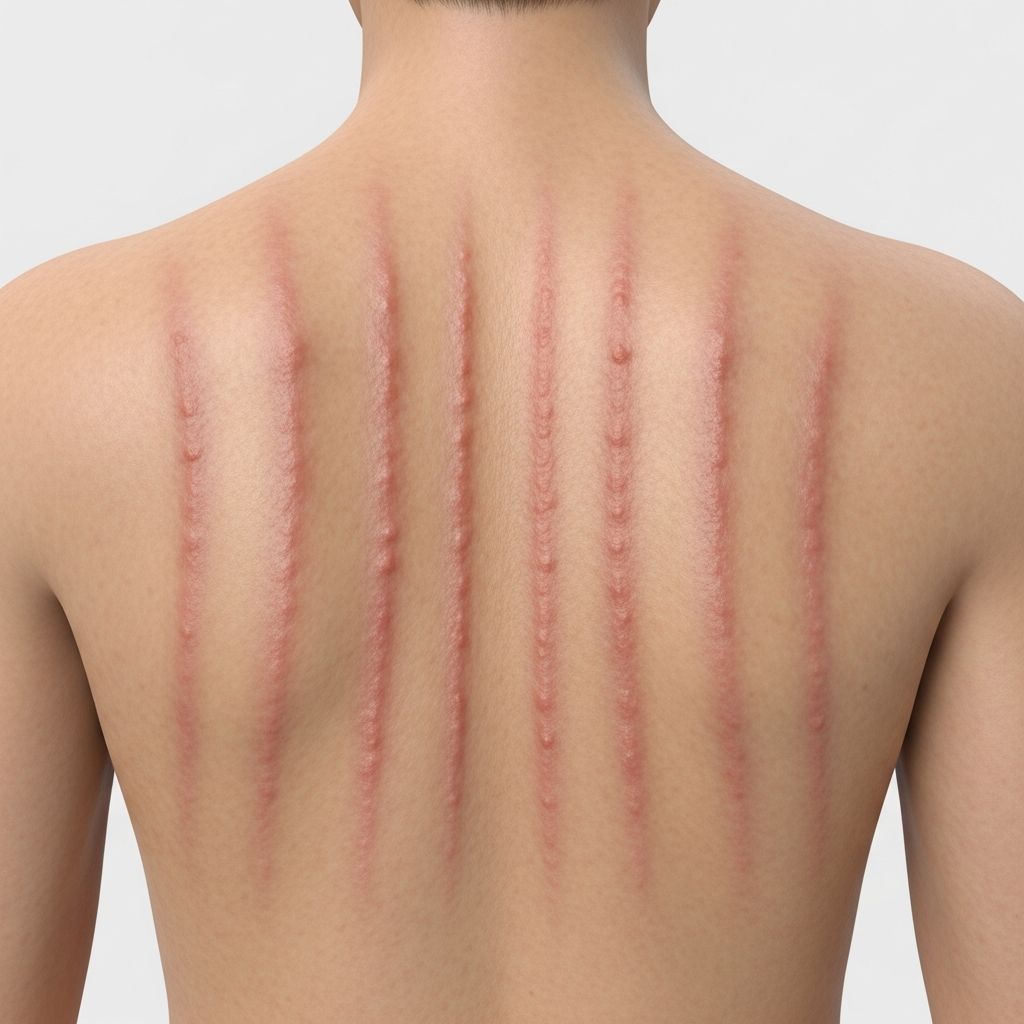
Flagellate erythema, also known as flagellate dermatitis or flagellate hyperpigmentation, is a distinctive dermatological condition characterized by linear, erythematous, or hyperpigmented streaks on the skin that resemble whip marks or flagellation injuries. These lesions arise spontaneously without external trauma and are associated with specific triggers such as chemotherapeutic agents, food intake, or underlying systemic diseases.
What is flagellate erythema?
Flagellate erythema refers to a rare pattern of cutaneous eruption featuring parallel or crisscrossing linear streaks of erythema, petechiae, or hyperpigmentation. The term “flagellate” derives from the appearance mimicking skin injured by whipping (flagellation). First described in 1970 in patients receiving bleomycin chemotherapy, it has since been linked to diverse etiologies including shiitake mushroom consumption, dermatomyositis, adult-onset Still’s disease, and certain drugs.
The lesions typically manifest as pruritic, erythematous lines, often 1-3 mm wide, distributed on the trunk, proximal extremities, shoulders, and upper back. They may evolve into hyperpigmented streaks persisting for months after resolution of acute inflammation. Histologically, early lesions show spongiosis, lymphocytic exocytosis, and dermal edema, while chronic phases reveal basal hyperpigmentation and melanophages.
Who gets flagellate erythema?
Flagellate erythema affects individuals exposed to its triggers:
- Bleomycin-induced: Cancer patients, particularly those with testicular cancer, lymphoma, or squamous cell carcinoma treated with bleomycin. Incidence up to 15-20% in some cohorts.
- Shiitake dermatitis: Consumers of raw or undercooked shiitake mushrooms (Lentinula edodes), often after Asian cuisine. More common in shiitake-producing regions like Japan and China.
- Dermatomyositis-associated: Patients with idiopathic or paraneoplastic dermatomyositis, occurring in approximately 5% of cases. Often signals active disease or malignancy.
- Other drug-induced: Rare reports with shiitake extracts, sulfur-containing foods, or medications like peplomycin.
- Systemic diseases: Adult-onset Still’s disease (rare chronic form), phytophotodermatitis.
No strong gender or age predilection, though bleomycin cases skew toward young adult males with germ cell tumors.
What causes flagellate erythema?
Multiple mechanisms underlie flagellate erythema:
Bleomycin toxicity
Bleomycin, a glycopeptide antibiotic used in chemotherapy, induces flagellate erythema in 8-22% of patients. The mechanism involves direct toxicity to keratinocytes and endothelial cells, possibly via free radical generation and impaired DNA repair. Lesions appear weeks to months after initiation, independent of dose or route (IV or IM). Risk factors include higher cumulative doses and renal impairment.
Shiitake flagellate dermatitis
Consumption of raw or inadequately cooked shiitake mushrooms triggers this via lentinan, a polyacetylene compound. It causes toxic dermatitis 1-5 days post-ingestion, with intense pruritus preceding linear eruptions. Cooking destroys lentinan, preventing occurrence. Systemic symptoms like fever or diarrhea are rare.
Dermatomyositis
In dermatomyositis, flagellate erythema correlates with disease activity and malignancy risk. Lesions are more inflammatory (violaceous, pruritic) than bleomycin-induced (brownish, less inflamed). Proximal muscle weakness, heliotrope rash, Gottron papules often coexist.
Other causes
- Drug eruptions: Peplomycin, shiitake extracts.
- Adult-onset Still’s disease: Persistent linear plaques in chronic phase.
- Phytophotodermatitis: Linear streaks from plant psoralens + UV.
What are the clinical features of flagellate erythema?
Key features include:
- Morphology: Linear, parallel erythematous streaks (1-5 cm long), urticarial, papulovesicular, or petechial. Evolve to hyperpigmented lines.
- Symptoms: Intense pruritus; pain in dermatomyositis cases.
- Distribution: Interscapular back, shoulders, chest, flanks, proximal limbs. Spares face/mucosa usually.
- Timeline: Bleomycin: 12h-6mo onset; shiitake: 24h-5d; self-limited 1-3 weeks acute phase.
Related Stories



| Type | Onset | Appearance | Location | Symptoms |
|---|---|---|---|---|
| Bleomycin | Weeks-months | Brownish streaks | Back, shoulders | Mild itch |
| Shiitake | 1-5 days | Erythematous, papular | Trunk, limbs | Severe pruritus |
| Dermatomyositis | With disease flare | Violaceous, linear | Trunk, proximal extremities | Painful itch |
Diagnosis
Primarily clinical, based on history and morphology. Key diagnostics:
- History: Drug exposure (bleomycin), mushroom intake, systemic symptoms.
- Examination: Characteristic linear streaks +/- muscle weakness (dermatomyositis).
- Biopsy: Nonspecific: spongiosis, perivascular lymphs, pigment incontinence. Rules out mimics.
- Labs: CK, ANA for dermatomyositis; malignancy screen.
Differential diagnosis
- Bleomycin vs. dermatomyositis: Brown vs. erythematous; no muscle involvement in bleomycin.
- Shiitake vs. contact dermatitis: Linear but dietary history key.
- Adult Still’s: Fever, arthralgias absent in others.
- Phytodermatitis: Photodistribution.
- Trauma/Koebner: History of scratching absent.
Investigations
- Skin biopsy if atypical.
- Muscle enzymes, EMG, MRI for suspected dermatomyositis.
- Cancer screening (CT, tumor markers) in adults.
- Patch testing rarely useful.
Management and treatment
Symptomatic and trigger-specific:
- Bleomycin: Discontinue if possible; rechallenge risky.
- Shiitake: Self-resolves; antihistamines, topical steroids.
- Dermatomyositis: Immunosuppressants (steroids, MTX, IVIG).
- Symptom relief: Emollients, potent topicals (clobetasol), oral antihistamines (loratadine 10mg BD), short prednisone taper. Avoid scratching.
Hyperpigmentation fades over months; cosmetics or hydroquinone if persistent.
Prevention
- Cook shiitake thoroughly.
- Monitor bleomycin patients; consider alternatives.
- Early dermatomyositis screening.
Flagellate erythema in skin of colour
In darker skin, acute erythema may appear violaceous/hyperpigmented early. Postinflammatory hyperpigmentation prominent and prolonged. Shiitake cases reported in African Americans. Biopsy helps confirm.
Related topics
- Shiitake flagellate dermatitis
- Bleomycin toxicity
- Dermatomyositis
- Drug eruptions
Frequently asked questions
Is flagellate erythema dangerous?
Usually benign and self-limited, but signals underlying disease (e.g., malignancy in dermatomyositis) requiring evaluation.
How long does it last?
Acute phase 1-3 weeks; pigmentation months.
Is it contagious?
No, not infectious.
Can it recur?
Yes, with re-exposure (bleomycin, shiitake).
What does it look like?
Whip-like red/brown linear streaks on back/trunk.
References
- Severe flagellate erythema in idiopathic dermatomyositis — PMC – NIH. 2020-02-01. https://pmc.ncbi.nlm.nih.gov/articles/PMC7001682/
- Flagellate Drug Eruption (Flagellate Erythema, Flagellate Hyperpigmentation, Bleomycin Drug Eruption) — Dermatology Advisor. 2023-01-15. https://www.dermatologyadvisor.com/home/decision-support-in-medicine/dermatology/flagellate-drug-eruption-flagellate-erythema-flagellate-hyperpigmentation-bleomycin-drug-eruption/
- Drug-induced flagellate pigmentation — VisualDx. 2024-06-01. https://www.visualdx.com/visualdx/diagnosis/drug-induced+flagellate+pigmentation?diagnosisId=53749&moduleId=101
- Recognizing Flagellate Erythema in Skin of Color: A Case of Shiitake Dermatitis — PMC – NIH. 2024-03-15. https://pmc.ncbi.nlm.nih.gov/articles/PMC10985566/
- Pruritic Flagellate Eruption — Consultant360. 2022-05-20. https://www.consultant360.com/articles/pruritic-flagellate-eruption
- Shiitake flagellate dermatitis — DermNet. 2023-11-10. https://dermnetnz.org/topics/shiitake-flagellate-dermatitis
Similar Articles








Read full bio of Sneha Tete